Nose-to-Brain Nanoparticle Platform Differentiation Across Reward Circuit and Dementia Indications
Nanoparticle design must match delivery to brain circuit, not just cross the barrier.

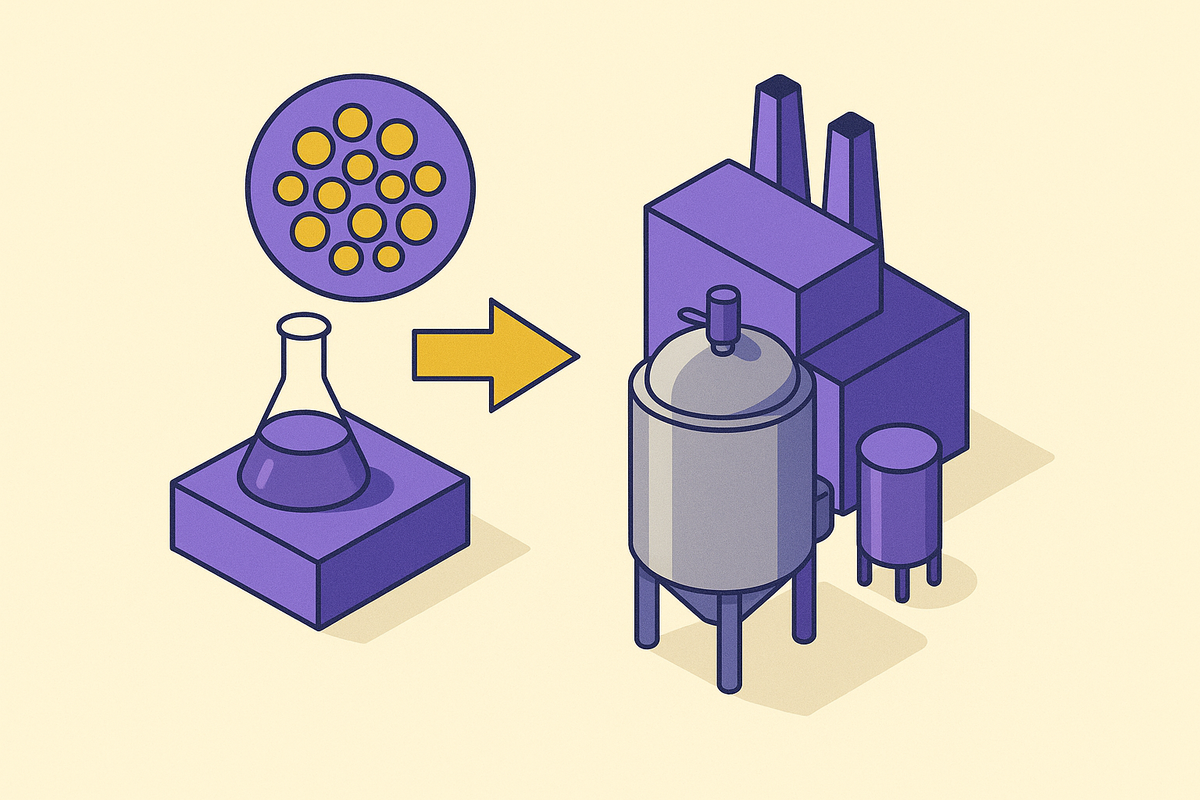
Nanoparticle nose-to-brain delivery for neurological indications uses nasal nerve pathways to bypass the blood–brain barrier, but a useful platform must do more than get a drug into the brain. Reward-circuit indications call for rapid subcortical delivery, while dementia indications call for sustained cortical and hippocampal exposure. A platform earns breadth by tuning particle type, surface chemistry, and release kinetics to those distinct demands.
Why injectable GLP-1 peptides cannot reach the brain circuits that drive their most promising new indications
The trial failure raises the question of whether a GLP-1 receptor agonist can achieve the exposure needed for a neurological indication through systemic administration. The result challenges the assumption that biological promise will translate without resolving CNS pharmacokinetics. The scientific lesson concerns route as well as molecule. A drug’s peripheral activity is not evidence that it reaches deep brain targets at useful concentrations.
Subcutaneous GLP-1 receptor agonists must enter systemic circulation before encountering the blood–brain barrier. That barrier is structurally hostile to high-molecular-weight, low-lipophilicity peptides with strong plasma protein binding, the profile of most GLP-1 analogues. Peripheral satiety signaling can occur while exposure at reward-circuit or neuroprotective targets deeper in the brain parenchyma remains insufficient.
Reward modulation makes this distinction especially important because the central amygdala and mesolimbic dopamine circuitry require exposure at structures that subcutaneous peptides reach only partially or inconsistently. Raising systemic exposure alone does not show that the drug reaches those sites. Separately, nausea and the burden of injections can undermine adherence, but that is distinct from insufficient drug exposure in the brain. How can a peptide reach the brain compartment it is meant for without having to cross the blood–brain barrier?
How does the nose-to-brain route physically reach neurological targets?
The olfactory and trigeminal nerve pathways provide anatomical continuity between the nasal cavity and brain parenchyma. Drugs delivered to the olfactory epithelium can exploit that continuity to largely bypass the blood–brain barrier. Drugs given systemically reach the brain from the blood, while nasal delivery can use nerve-associated routes. The trigeminal pathway may also involve partial systemic absorption, so intranasal administration should not be equated with exclusively direct transport.
The two pathways lead toward different brain regions. The olfactory epithelium enables direct intraneuronal transport primarily to the olfactory bulb and rostral brain regions, while trigeminal transport proceeds through intraneuronal and extracellular mechanisms primarily toward brainstem and cerebellar regions. These routes shape where a drug can go before a formulation is chosen. Reaching the brain through one pathway does not establish that a drug reaches every relevant structure within it.
Extracellular transport along olfactory nerves can reach the brain faster than intracellular axonal transport, making the route taken relevant to rapid exposure versus sustained parenchymal presence. Intranasal delivery can also lower systemic exposure compared with intravenous or subcutaneous administration, which gives a reason to expect fewer peripheral effects but does not prove they disappear. Yet anatomical access is only an opportunity. Enzymatic degradation, mucociliary clearance, and short mucosal residence time can remove or damage a peptide before it exploits that opportunity.
What nanocarrier engineering adds by overcoming nasal barriers and controlling arrival
Nanocarrier engineering addresses the gap between a privileged anatomical route and a usable peptide delivery system. Encapsulation can protect the payload from degradation, while surface chemistry can influence mucosal residence and interactions with cells. Release kinetics set when the protected drug becomes available. The proposed platform needs these functions to work as more than a nasal spray. A peptide that disappears from the nasal surface too quickly cannot benefit from the pathway beneath it.
Lipid-based, polymeric, protein-based, and inorganic nanoparticles are being investigated as carrier systems for intranasal brain delivery. These classes offer different materials to protect and transport a drug and control its release, but their names alone do not tell how well they work. How does a particular particle interact with the nasal surface, enter epithelial cells, and release its payload? Those questions connect formulation design to the destination and timing an indication requires.
Particle size illustrates how specific that connection can be. In vivo imaging found a non-monotonic relationship in which 240 nm solid lipid nanoparticles achieved peak brain accumulation through both olfactory and trigeminal pathways, while other sizes performed materially worse. In that study, the size class exploited clathrin, caveolae, and macropinocytosis endocytic pathways simultaneously. Preferential trafficking to the endoplasmic reticulum and Golgi apparatus facilitated transcellular transport.
That finding explains one way lipid nanoparticles can move from nasal tissue toward the brain, but it does not establish a universal optimal size. Size interacts with intracellular routing to influence penetration. Preclinical intranasal delivery of dulaglutide, a large fusion protein that cannot passively diffuse across the blood–brain barrier, has also reached multiple regions including the neocortex and hippocampus. The result supports the route’s potential for large peptides. It does not remove the need to establish the distribution and release profile of each engineered formulation.
What the reward circuit actually requires from a delivery platform
A June 2026 Nature paper, published online May 6, 2026, provides a concrete anchor for reward-circuit targeting. Using humanized GLP-1 receptor mouse models, the study showed that GLP-1 agonists recruit neurons expressing the GLP-1 receptor in the central amygdala, reducing dopamine release in the nucleus accumbens during hedonic feeding. The target is specific and subcortical. Investigators are examining this mechanism for effects on substance use disorder, but the feeding finding does not establish an addiction treatment effect.
The pharmacology also differs from broad dopamine blockade. GLP-1 receptor agonists modulate mesolimbic dopamine signaling in a context-dependent manner, dampening drug- or reward-driven hyperactivity while preserving baseline dopaminergic function. Preclinical studies involving exendin-4, liraglutide, and semaglutide have reported reductions in intake, preference, and relapse-related behaviors associated with alcohol, cocaine, nicotine, and highly palatable foods, providing promising signals that require clinical confirmation. Their mechanistic value lies in identifying circuits and responses that a delivery platform must engage.
For platform design, that specificity makes total brain penetration an incomplete endpoint. Reward-circuit indications call for rapid limbic access, with delivery speed and subcortical distribution constraining particle type and surface chemistry. Surface functionalization aimed at receptor-bearing cells or transport mechanisms in olfactory neurons becomes relevant because diffuse spread is not equivalent to directed accumulation at limbic nodes. Does the formulation deliver available drug to the central amygdala and related circuitry on the required timescale?
What dementia indications require from the same platform — and why the demands differ substantially
In primarily preclinical Alzheimer’s disease models, GLP-1 receptor agonists act on amyloid accumulation, neuroinflammation, and tau pathology. These processes extend across the neocortex and hippocampus rather than concentrating in the subcortical nodes emphasized for reward modulation. A drug that reaches a limbic target quickly still needs to stay across the regions involved in neuroprotection.
That distinction favors controlled-release kinetics and mucoadhesive systems that extend nasal residence time. Their purpose is to support slow, sustained cortical distribution. Can the formulation maintain the exposure needed in cortical and hippocampal tissue? A system judged only by its early brain accumulation could miss the very property on which the dementia application depends.
The Alzheimer’s Association’s July 2026 PROTECT-Cog announcement described large real-world datasets suggesting that GLP-1 receptor agonists may reduce dementia risk by 40 to 70 percent compared with other diabetes medications. That association gives reason to study the link further, but it does not prove causation or show that a brain-delivery strategy works. EVOKE keeps the alternative explanation visible. Its failure could reflect biology rather than delivery, and limited penetration cannot establish that a different route would succeed. Nevertheless, the genuine blood–brain barrier constraints on subcutaneous peptides make inadequate CNS exposure a mechanistically grounded explanation to investigate.
How the same platform accommodates both indications through tunable engineering rather than separate products
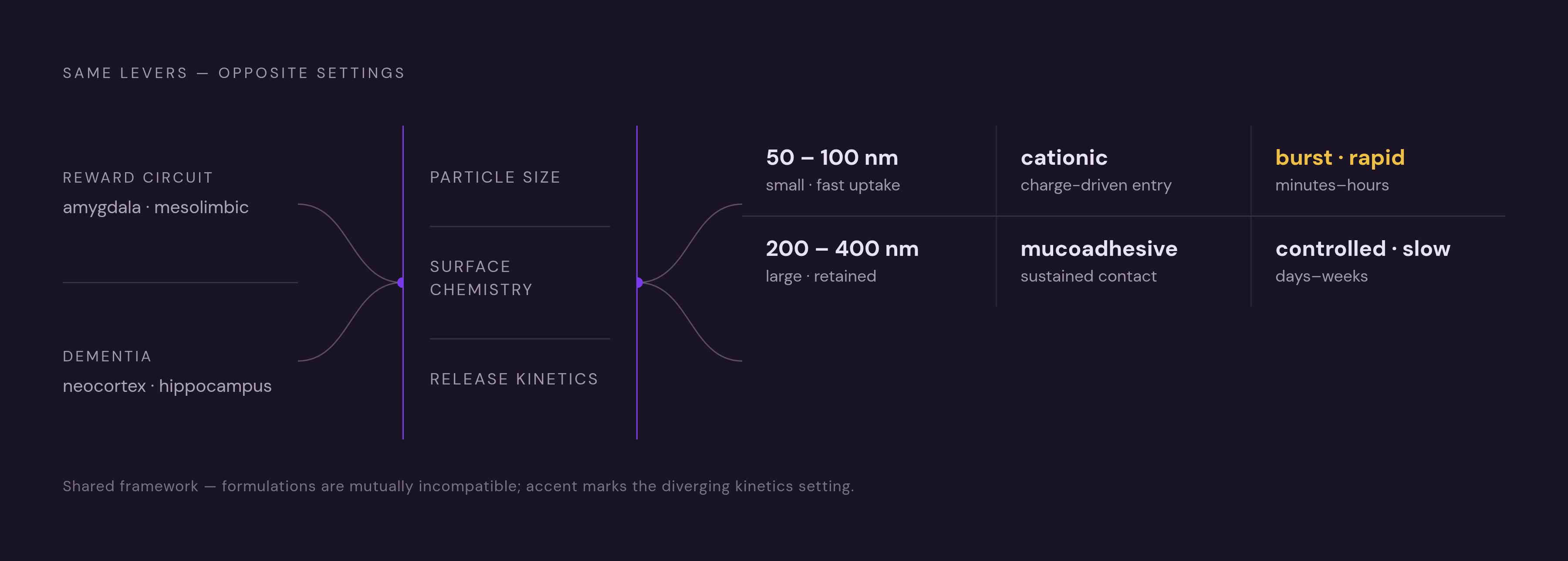
The reward-circuit and dementia specifications depend on the same engineering variables, though each needs different settings. Particle size influences endocytic pathways and transport behavior, surface chemistry governs mucoadhesion and cell interactions, and release kinetics govern payload availability over time.
For reward-circuit applications, the specification prioritizes speed and accumulation in subcortical targets. For dementia applications, it prioritizes sustained cortical and hippocampal exposure. The same engineering framework can address both without pretending that one fixed formulation is equally suited to each. Shared does not have to mean identical. The common asset is the ability to relate a design change to transport, distribution, and release, then evaluate whether it meets the indication’s requirements.
This distinction also sets a standard for platform claims. A formulation optimized for rapid limbic delivery cannot be assumed to support sustained cortical neuroprotection, and evidence of cortical exposure cannot establish timely engagement of reward circuitry. Deep, well-characterized nanoparticle intellectual property can provide an engineering framework for making and interpreting those adjustments rather than restarting formulation work for every target. The same logic may extend to other peptides and applications in gene editing or regenerative medicine, provided their own delivery requirements are defined.
What stands between current preclinical promise and clinical deployment across both indications
Translation requires performance in two environments, the nasal cavity and the brain. A nanosystem must survive and traverse the first while producing the intended distribution and release in the second. Success in one does not establish success in the other. Working in both environments calls for a deep knowledge of nanoparticles. Preclinical accumulation data are a starting point for that work.
The nasal constraints remain substantial, including a limited cavity volume of approximately 5–6 cm³, rapid mucociliary clearance, enzymatic degradation, and poor adherence to intranasal dosing regimens. Encapsulation alone cannot solve all of them. Mucoadhesive systems, permeation enhancers, and next-generation delivery devices therefore need to be developed with the formulation. How a dose is delivered must be considered together with how the carrier behaves after deposition.
The indications then impose different evidentiary demands. Reward-circuit development needs proof of limbic target engagement, which is hard to show with imaging and biomarkers in early clinical trials, while dementia development needs sustained cortical exposure and neuropathological endpoints that take years to measure. Foundational nanoparticle IP can support iteration within a well-characterized engineering framework across both programs. It cannot replace that evidence. Its value lies in providing mechanistic depth for adjusting parameters without inventing new delivery physics for each indication.
The Endocrine Society’s ENDO 2026 reporting found that 37 percent of patients who stopped GLP-1 therapy said nausea or other stomach-related side effects were the reason. Intranasal delivery does away with needles and offers a way to lower systemic exposure through its route, but whether it reduces nausea or improves adherence in humans still needs to be shown. A nasal regimen can also be difficult to sustain. The clinical mission is therefore not only to deliver a peptide to the right brain target, but to develop a treatment patients can keep taking.
Sources
- Full article: Can nanoparticle-based intranasal delivery systems revolutionize treatment of central nervous system diseases?
- Nanocarrier-based intranasal drug delivery for enhanced neurological disorders treatment
- Intranasal drug delivery: Unlocking the nose-to-brain route for central nervous system therapies - ScienceDirect
- Biopolymer Nanoparticles for Nose-to-Brain Drug Delivery: A New Promising Approach for the Treatment of Neurological Diseases
- Nose-to-Brain Delivery of Biomimetic Nanoparticles for Glioblastoma Targeted Therapy
- Navigating the Nose-to-Brain Route: A Systematic Review on Lipid-Based Nanocarriers for Central Nervous System Disorders
- Mechanisms of GLP-1 in Modulating Craving and Addiction: Neurobiological and Translational Insights