Intranasal Nanoparticle Platform Developers Advancing Peptide CNS Indications From Discovery to Clinic
Nanoparticles deliver peptides across the blood-brain barrier through the nose.
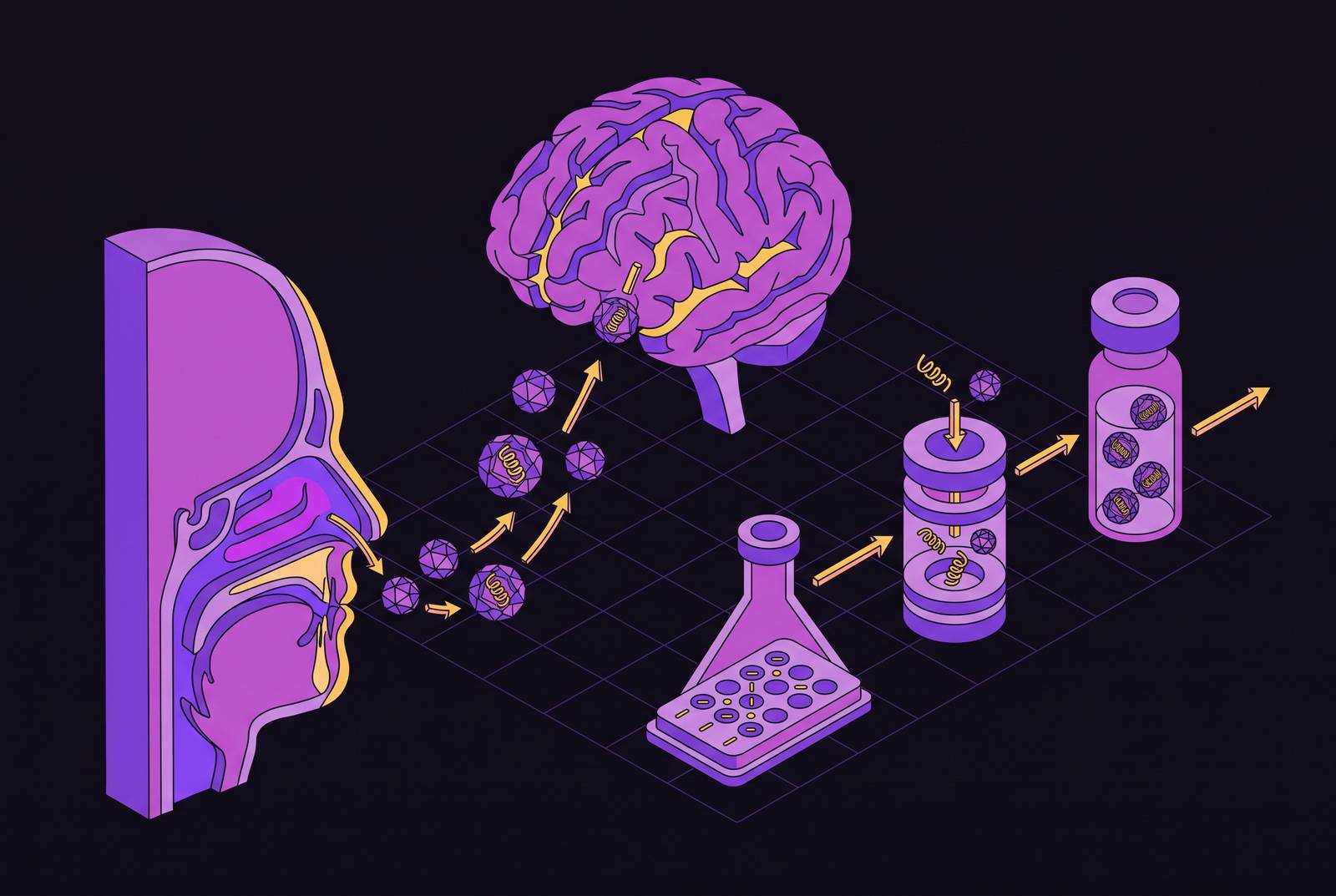
Intranasal nanoparticle platforms offer a credible path for peptide CNS indications by solving two sequential delivery problems. The olfactory and trigeminal pathways bypass the blood-brain barrier, while engineered carriers protect peptides and prolong their opportunity for uptake at the nasal mucosa. Preclinical results and announced development programs now support early clinical translation, although reliable brain exposure, chronic safety, and neurological benefit remain to be demonstrated in humans.
Why delivering peptides to the brain remains an unsolved problem despite decades of CNS drug development
The blood-brain barrier is a selective biological interface formed by endothelial cells, astrocytes, pericytes, and tight junctions. It lets essential nutrients through while keeping out many substances that arrive through the bloodstream. Protection is its function. For macromolecules such as peptides, however, that selectivity creates a near-total blockade, so systemic exposure does not reliably translate into therapeutically sufficient brain concentrations. A peptide can therefore be pharmacologically active yet fail as a CNS treatment because too little reaches its target.
Oral peptides face degradation in the gastrointestinal tract before meaningful systemic absorption, while intraparenchymal injection, intracerebroventricular injection, and intrathecal catheter infusion provide direct CNS access at the cost of invasiveness and local neurotoxic risk. These are substantial constraints for chronic treatment. A peptide’s influence on neurological biology therefore matters in practice only if a route can deliver enough peptide repeatedly without imposing the burden of direct CNS administration.
How the olfactory and trigeminal pathways create a structural bypass around the BBB
Intranasal delivery changes the anatomical starting point of that problem. Olfactory receptor neurons in the nasal epithelium project directly to the olfactory bulb, providing a pathway through which drugs can travel axonally into brain tissue without first entering systemic circulation. The trigeminal nerve supplies a second connection from the nasal mucosa to the brainstem and higher CNS structures. The distinction is between crossing and bypassing the barrier. Nose-to-brain delivery exploits connections that already exist rather than trying to make circulating macromolecules permeate the BBB.
These connections support a non-invasive route with the potential for rapid absorption and greater peptide stability than gastrointestinal delivery. More importantly for CNS indications, they create the possibility of brain exposure with low systemic exposure. That possibility is not a property of every nasal formulation. A nasal dose can also lead to systemic absorption, so absorption alone does not prove direct nose-to-brain transport. The route supplies the anatomical premise, but the formulation must preserve the drug long enough to exploit it.
Why bare drug molecules fail at the nasal mucosa, and what nanoparticle engineering does about it
The nasal surface is not a passive reservoir. Mucociliary clearance continuously moves deposited material toward the nasopharynx, shortening the time available for absorption. Nasal epithelial and mucosal enzymes also degrade peptides, while the epithelial layer remains a barrier to uptake even for molecules that survive. An unprotected peptide thus faces loss through both clearance and degradation. Bypassing the BBB solves only the first delivery problem.
Nanoparticle engineering addresses the second through control of particle size, surface charge, and surface functionalization. These properties can protect the payload from enzymes, extend mucosal residence, and promote uptake into olfactory neurons. Reported physicochemical characteristics include a particle size around 172 nm and a negative zeta potential of approximately −29.6 mV, which are linked to stability and help in avoiding rapid clearance. Those values come from the formulations studied and apply only within that context. Their usefulness depends on the payload and the rest of the delivery system.
The NanoInBrain platform makes the distinction between protection and residence especially tangible. Its 2026 study, published in Biomaterials, combined a polypeptide nanocarrier with Yalic®, a hyaluronic acid-poly-L-glutamate crosspolymer depot-forming hydrogel vehicle. The carrier and depot have complementary roles. Incorporating the hydrogel prolonged nasal residence to approximately 4 hours, while ex vivo Franz diffusion and nasal-mucosa-on-chip studies demonstrated robust permeation. In vivo imaging showed brain distribution and intracellular uptake in neurons and microglia, with the depot increasing total brain accumulation.
The platform landscape — how lipid, polymeric, and peptide-decorated nanocarriers each approach the same problem
Lipid-based carriers, including solid lipid nanoparticles and nanostructured lipid carriers, address payload stability and controlled release. Their drug-loading properties can improve solubility and bioavailability, while tailored lipid compositions shape release kinetics. When the drug is released matters especially for chronic brain diseases. Polymeric carriers offer another way to control it, with biodegradable PLGA allowing adjustment of degradation and payload-release timelines. Chitosan contributes a different property, namely mucoadhesion that extends nasal residence without necessarily requiring a separate depot vehicle.
Cell-penetrating peptide-decorated nanovectors focus more directly on cellular uptake. Surface functionalization with these peptides promotes entry. Dendrimers, liposomes, polymeric micelles, and extracellular vesicle-based systems extend the available toolkit, each with different stability and targeting profiles. Their coexistence gives developers several ways to address a payload’s limiting delivery step.
Which approach fits a given CNS peptide? The choice depends on peptide size, charge, and degradation rate, as well as which brain region is targeted and whether rapid onset or sustained exposure is needed. No single property settles the choice. Strong nasal residence is insufficient if brain distribution or intracellular release is poor, just as favorable uptake cannot rescue a peptide already degraded at the mucosa. The field’s engineering diversity is therefore an asset because performance must be optimized across two compartments with different demands.
Why GLP-1 peptides are the highest-value payload this delivery architecture could carry to the brain
GLP-1 receptor agonists give this delivery work a concrete therapeutic focus. GLP-1 receptors are expressed in brain regions that help control impulses, reward, and addiction, which gives researchers a biological reason to study effects beyond metabolic disease. Preclinical studies report reduced protein aggregation, enhanced autophagy, improved mitochondrial function, suppressed neuroinflammation, and preserved synaptic integrity. The neurological rationale spans several mechanisms. Epidemiological associations also extend across dementia, Parkinson’s disease, multiple sclerosis, seizures, and addiction to alcohol, cannabis, stimulants, and opioids.
A pooled analysis of three major cardiovascular outcome trials included 15,820 patients with type 2 diabetes treated with liraglutide or semaglutide. It reported a substantially lower hazard ratio for subsequent dementia diagnosis than placebo over a median follow-up of approximately 3.6 years. Established disease presents a less encouraging picture. A 2025 study found that GLP-1s did not slow progression in early-stage symptomatic Alzheimer’s disease, and a meta-analysis of several randomized controlled trials found that memory and cognition were no better than with placebo, though the evidence was low-certainty.
These null results call for more than an assumption that delivery failed. They leave open whether the protective signal seen at the population level comes from systemic metabolic benefits or from direct changes to neurological disease. Insufficient CNS concentration is another possible explanation that has yet to be proved. CNS-selective delivery could help tell these possibilities apart by testing GLP-1 biology when the brain is exposed more directly. That makes GLP-1 peptides a high-value payload for the architecture, but it does not make neurological efficacy a foregone conclusion.
The adherence crisis in injectable GLP-1 therapy and what it means for any brain-targeted indication
Even where metabolic benefit is established, injectable GLP-1 therapy faces substantial discontinuation. Patients without type 2 diabetes discontinue more often within the first year than those with diabetes, and only a small minority remain on injectable therapy after three years. A study of EHR claims data found that 58% of patients who stopped treatment regained some weight within a year. Dropout has consequences beyond an interrupted prescription. That finding documents a cost of stopping treatment.
Cost and insurance access account for the largest share, followed by side effects, predominantly nausea, and drug shortages. Gastrointestinal effects are the most commonly cited pharmacological reason for stopping. Nonadherence also rises sharply when monthly out-of-pocket costs are more than patients can afford, so staying on treatment becomes harder as months turn into years. A different delivery route cannot, by itself, resolve all these barriers.
For neurological indications, weighing the benefits against the burdens may be harder still. A patient who wants to slow dementia or lower addiction risk may accept weekly injections and nausea for a long-term benefit that is uncertain and hard to notice. Removing injections would change one part of that equation. Lower systemic exposure could also reduce the pharmacological burden associated with nausea, although improved tolerability and persistence require clinical demonstration.
What companies are developing these platforms, and where does the field stand in 2026?
A Switzerland-based company reported 2025 preclinical results in rats showing preferential CNS exposure for a metabolic peptide delivered through its nasal technology. Brain-to-plasma ratios were consistently above 1, brain exposure rose proportionally with dose, and systemic exposure remained low. Nevertheless, they address the central pharmacokinetic question of whether nasal delivery can favor the brain over the circulation. The company’s name is not established in the supplied source material.
Landmark Medicines Ltd., based in Loughborough, UK, announced in September 2026 that it planned to move its proprietary nasal drug-delivery platform toward a study in human volunteers. GLP-1 receptor agonists are the initial therapeutic application, with candidates including semaglutide under evaluation before final selection. The proposed study will test therapeutically relevant nasal exposure. The platform is the subject of multiple patent filings, and the program intends to investigate olfactory and trigeminal CNS delivery separately from systemic nasal absorption. That distinction is essential to interpreting what a successful exposure result would demonstrate.
Aptar Pharma, based in Crystal Lake, IL, announced publication of three international patent applications in May 2026 focused on inhaled and nasal delivery of biologic therapies. Its contribution concerns device and formulation infrastructure for biologics. This is a separate translational data point. Alongside the rat exposure results, Landmark’s planned human work, and NanoInBrain’s published carrier-plus-depot findings, it shows that work is under way on several parts of development. These programs signal movement beyond an anatomical hypothesis, but neither patent publication nor an announced study establishes clinical success.
What successful clinical translation requires beyond the nasal mucosa
Manufacturing is the first test of whether a promising formulation can become a dependable product. The formulation must work as well in GMP-grade production as it does in the laboratory, with particle size, surface charge, and drug loading kept consistent from batch to batch. These properties govern both efficacy and safety. Reproducing them at scale remains unresolved for many platforms, so a successful preclinical preparation is not yet a manufacturing process. The formulation’s defining features must remain controllable as production expands.
Repeated administration requires systematic evaluation of mucosal integrity, local tolerability, and long-term effects on the olfactory epithelium before human studies proceed. Regulatory planning adds another task because no established framework exists specifically for intranasal nanoparticle CNS delivery of peptides. Sponsors therefore need early FDA/EMA engagement to develop strategies that address both nasal drug product requirements and CNS biologic standards.
Regional brain distribution, cellular uptake, and release kinetics must fit the therapeutic purpose, while nasal residence and stability remain adequate. Better tools may shorten that development cycle. AI-driven formulation design offers a way to explore physicochemical design space without exhaustive empirical screening, while nasal-mucosa-on-chip models can add human-relevant evidence to animal studies. Neither substitutes for clinical exposure, safety, or efficacy data.
This is where foundational nanoparticle research gains practical value. Deep, patented nanoparticle IP built through years of academic and translational work can embody knowledge of how particle properties govern in vivo behavior. Patent depth provides knowledge that can help when problems with manufacturing, distribution, or tolerability arise. The strongest basis for progress is therefore not the broad promise of a nasal peptide platform, but accumulated scientific knowledge that can turn a preclinical result into a reproducible, testable clinical product.
Sources
- Nanocarrier-based intranasal drug delivery for enhanced neurological disorders treatment
- Can Blockbuster GLP-1 Weight-Loss Drugs Also Protect Brain Health?
- Glucagon-like peptide-1 receptor agonists for major neurocognitive disorders - PMC
- Cell-Penetrating Peptide-Decorated Nanovectors for Nose-to-Brain Delivery: A New Treatment Option for CNS Diseases
- Advanced intranasal peptide delivery systems for improved management of Alzheimer's disease - PubMed
- Intranasal Nano-Delivery Systems: Emerging Strategies for Central Nervous System Disease Therapeutics - PMC
- Intranasal Nanoemulsions for Direct Nose-to-Brain Delivery of Actives for CNS Disorders
- Pharmacokinetics and Pharmacodynamics of Intranasal Solid Lipid Nanoparticles and Nanostructured Lipid Carriers for Nose-to-Brain Delivery