Nanoparticle Scale-Up Challenges From Lab Bench to GMP Manufacturing
Particle properties shift unpredictably when equipment scales up.
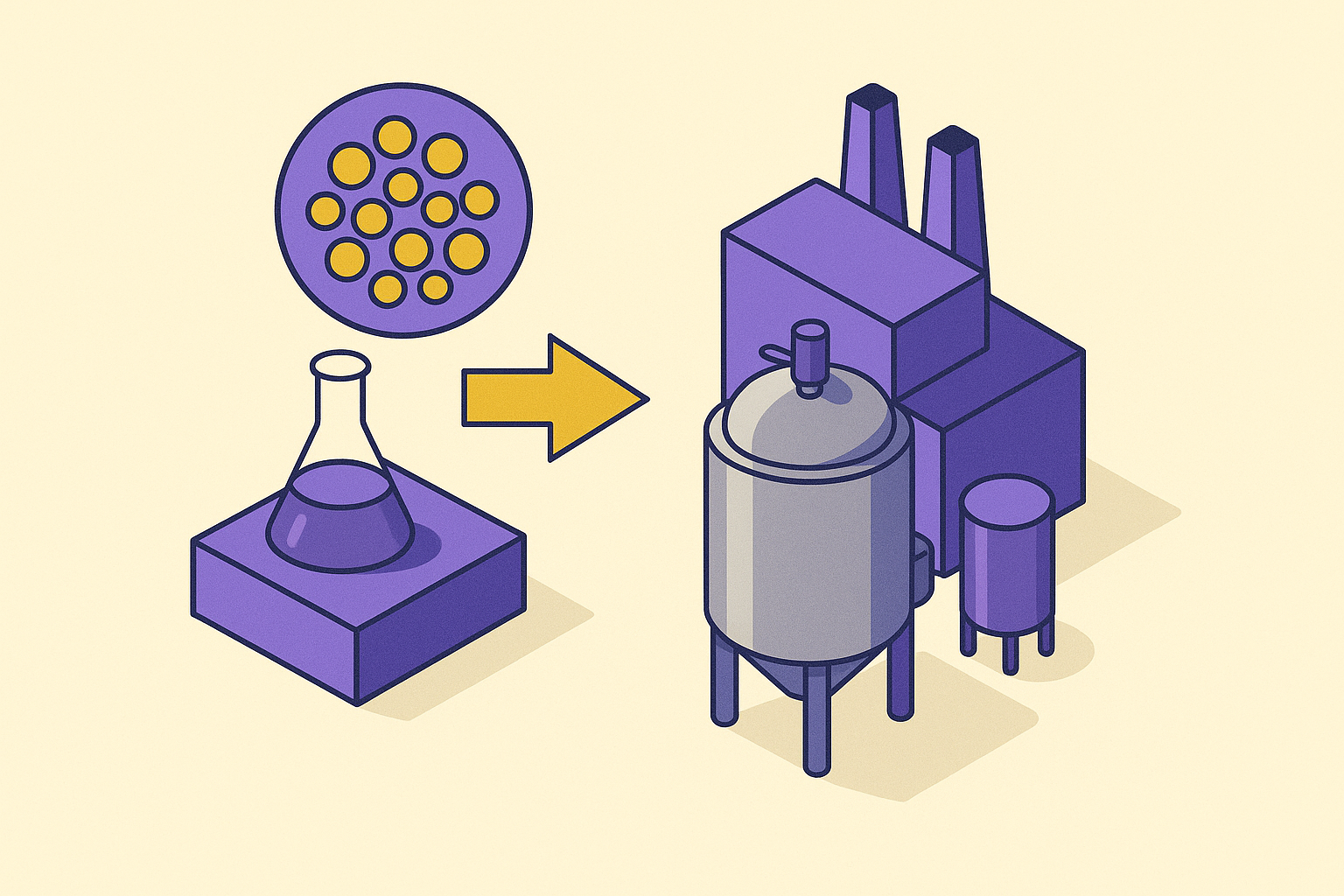
Nanoparticle manufacturing cannot simply scale up the way conventional pharmaceutical products do, because the particle itself is a direct product of the equipment that makes it. This piece examines why that is true at each stage of production, from the microfluidic chip to the filtration skid to the regulatory filing, and what a documented large-fold scale increase shows about what actually holds up under pressure.
Why nanoparticle manufacturing cannot inherit conventional pharma's scale-up playbook
A conventional tablet scales in a way that industry has understood for decades. Moving from a small lab-scale granulator to a much larger production-scale one changes batch size, mixing time, and product quality in ways that generations of process engineers have already mapped. The chemistry of the tablet does not change when the vessel gets bigger. The same cannot be said for a lipid nanoparticle.
Lipid nanoparticle formation happens within milliseconds, as lipids and payload collide and self-assemble under conditions governed by fluid dynamics, mass transfer, and colloidal chemistry. The particle is not synthesized step by step in a reaction vessel. It forms spontaneously, out of equilibrium, when two fluid streams meet under specific flow conditions. Change the channel the fluids meet in, and those conditions change too. The particle that forms can change along with them.
A published review of polymeric nanoparticle scale-up names reproducibility as the central unresolved problem facing the field: industrial production remains difficult because the optimization parameters involved are not defined precisely enough to guarantee the same nanoparticle comes out at every scale. That is a different kind of problem than the ones conventional pharma solved in the twentieth century. It is a matter of whether the physics that built the particle at bench scale still holds when the equipment changes shape and size.
The stakes of getting this wrong are specific and measurable. A scale transition that shifts the fluid dynamics even modestly can raise the polydispersity index, reduce how much drug payload the particle actually encapsulates, or trigger particle aggregation. None of those outcomes work for a drug product meant for human dosing, and you cannot see any of them until someone measures the batch.
Microfluidic mixing at lab scale creates a scale-up trap
Microfluidic mixing is the dominant method for producing lipid nanoparticles at lab scale, and it works precisely because the channels are small. An organic phase carrying the lipids and an aqueous phase carrying the nucleic acid or peptide payload meet inside a microchannel at controlled flow rates, and the particle size and distribution that come out depend closely on the mixing conditions inside that channel. That precision is also the trap: the geometry responsible for good particles at bench scale cannot simply be built larger without changing what it produces.
A published analysis of LNP scale-up lays out the variables involved and how each behaves differently as scale increases. Total flow rate is one of them. Raising it improves mixing efficiency, but it can also raise shear stress on the particles forming inside the channel, so the common strategy is to hold the flow rate ratio steady and scale the total flow rate up using parallel channels or larger devices.
Flow rate ratio itself is the primary determinant of initial particle size: a higher ratio of aqueous to organic phase produces smaller particles. That ratio has to stay fixed across every scale transition, and each time it moves to a new scale, the target particle size needs confirmation again.
Mixing geometry varies by chip design, so different microfluidic chips produce different mixing regimes even when the flow rates and ratios are identical. Switching chip types, which often happens somewhere between lab and clinical-scale production, means the new chip has to be qualified at the target scale rather than treated as a drop-in replacement for the old one.
Lipid concentration in the organic phase matters too. Push the concentration higher and particle size and polydispersity can both increase, so the concentration optimized during development has to be confirmed again at GMP scale before a batch is ever manufactured for a trial. The payload concentration in the aqueous phase carries its own requirement: the ratio of nitrogen to phosphate, the N:P ratio, has to stay constant across scales because it governs how much payload each particle actually encapsulates.
Taken together, these variables point to one conclusion: changing scale means changing equipment, changing equipment changes the fluid dynamics inside the channel, and changed fluid dynamics can change the particle that comes out the other end. Lab-scale parameters cannot be extrapolated directly to GMP scale and trusted to hold. Each one has to be re-verified at the new scale, variable by variable.
The tangential flow filtration step that most often breaks scale-up
Particle formation gets most of the attention in discussions of nanoparticle scale-up, but it is rarely where developers get surprised. That distinction more often belongs to tangential flow filtration, the standard method you use after formation to exchange the organic solvent-containing medium for final formulation buffer and to concentrate the product to its target dose strength. TFF has to be re-optimized and re-validated at every manufacturing scale, because its operating parameters interact with particle quality in ways that shift as the equipment gets bigger.
At development scale, TFF typically runs through small-volume hollow fibre cartridges. At GMP scale, those give way to larger cartridges, or to multiple units running in parallel to handle the batch volume. That transition can introduce changes in shear stress on the particles, along with changes in the effective membrane area available relative to the batch size, neither of which is obvious from the development-scale run.
Four parameters have to be re-optimized at each new scale: transmembrane pressure, cross-flow velocity, the number of diafiltration volumes used, and the membrane's molecular weight cut-off. Each one affects both how efficiently the process runs and the quality of the LNP product that stays behind on the retentate side of the membrane. Get the cross-flow velocity wrong at the new scale, for instance, and the particles can see mechanical stress they never experienced in the small cartridge, even though the chemistry on paper looks identical.
The filtration step is one illustration of a broader pattern. Concentration methods beyond TFF, including centrifugal ultrafiltration, evaporation, dialysis, and membrane ultrafiltration, each affect nanoparticle recovery, size distribution, morphology, and binding performance differently. None of them are interchangeable across manufacturing platforms, and a method validated for one process cannot be assumed to behave the same way in another. The lesson extends past TFF itself: every unit operation downstream of particle formation carries its own scale-dependent behavior, and none of them can be treated as a fixed, neutral step in the process.
Critical quality attributes preserved across every scale transition
The engineering problems described above, in mixing geometry and filtration cartridges, exist because of what they threaten: the critical quality attributes that define whether a scaled-up batch is still the same product that worked in earlier testing. Preserving CQAs across every increase in production scale is the organizing challenge of nanoparticle manufacturing, because each attribute can fail a different way depending on which scale transition is underway.
CQAs for a nanoparticle drug product include particle size and size distribution, surface charge, drug loading, encapsulation efficiency, sterility, and drug release behavior. None of these can be verified in isolation from the process that produced them. Bench-to-clinic translation works only if you control the entire chemistry, manufacturing, and controls workflow, not just the individual unit operations inside it. Raw material quality, excipient selection, how thoroughly solvent gets removed, impurity control, facility segregation, and downstream purification all interact to determine what the final CQAs look like, so a defect introduced at one stage can appear as a quality failure several steps later.
Biology adds a layer that chemistry alone does not capture. Once a nanoparticle enters a physiological system, it comes into contact with proteins, lipids, and carbohydrates that coat its surface, a phenomenon known as the biomolecule corona effect. That coating changes particle size, surface charge, and targeting behavior, and it can provoke immune responses that were never present in a test tube. Translational research on nanoparticle delivery systems points to the corona effect as one of the central biological obstacles standing between bench success and clinical performance.
Surface charge carries its own tension. Positively charged nanoparticles support gene transfection through the proton sponge effect, the mechanism by which the particle escapes the endosome once inside a cell. The same positive charge that makes that escape possible can also disrupt cell membranes and cause toxicity if it is not controlled tightly and consistently across every batch. A property that helps the drug work and a property that can harm the patient turn out to be the same property, calibrated differently.
Aggregation and contamination during scale-up matter for another reason beyond quality control: they affect whether the manufacturing process is economically viable at all, since batches that fail specification represent lost material, lost time, and lost manufacturing capacity.
The cGMP manufacturing study of saponin/MPLA nanoparticles, published in the Journal of Pharmaceutical Sciences in September 2025, shows what preserving CQAs actually requires in a documented production setting. The study used orthogonal analytical methods, meaning multiple independent techniques measuring different properties rather than one method standing in for all of them: CAD-HPLC for quantifying QS-21 and lipid content, dynamic light scattering for particle sizing, and transmission electron microscopy for confirming particle morphology. Stability studies conducted under ICH guidelines demonstrated the formulation's robustness under refrigerated storage, while also identifying the specific conditions, frozen and accelerated storage, under which degradation became a risk.
Process analytical technology for real-time quality control during scale-up
Holding a CQA steady across a scale transition requires knowing, while the process is running, whether it is actually holding steady. That is the function process analytical technology serves. PAT shifts quality assessment from a single test performed on the finished batch to continuous measurement taken throughout the process, which matters enormously for nanoparticles because an undetected shift in particle size distribution is both expensive to discover late and consequential for how the drug performs in patients.
The published LNP scale-up analysis identifies specific PAT tools suited to nanoparticle manufacturing. In-line or at-line dynamic light scattering can detect particle size drifting during the mixing step or during tangential flow filtration, catching the problem before it produces a batch that fails specification at release. In-line fluorescence monitoring, using dyes that intercalate with the nucleic acid payload, gives a real-time readout of encapsulation efficiency as the formulation process runs, rather than waiting for an end-of-batch assay to reveal a problem that already happened.
The FDA has encouraged this shift for two decades, through dedicated PAT guidance issued in 2004. For a product category where batch failure carries real financial cost and where size distribution changes translate directly into clinical performance changes, building PAT capability into a scale-up program is a justified investment.
The SMNP cGMP study offers a concrete picture of what this looks like in practice at full GMP scale: CAD-HPLC, dynamic light scattering, and transmission electron microscopy running alongside each other, each catching something the others would miss. PAT applies that same principle in real time. Problems caught during the process can be corrected before the batch is lost. Problems caught only at release testing mean the batch has already failed, and the time spent producing it is gone.
What a documented large-scale increase teaches
The clearest evidence that nanoparticle scale-up can succeed, and what it demands when it does, comes from the documented scale-up of saponin/MPLA nanoparticles (SMNP) to cGMP clinical trial material, published in the Journal of Pharmaceutical Sciences in September 2025. The program moved from research-scale production to clinical-grade manufacturing at a substantial increase in scale, and it did so while holding its critical quality attributes in place, which is the outcome every argument in this piece has been building toward.
The program achieved that scale increase using closed-system dilution and diafiltration, a choice that served two purposes at once: it protected sterility by limiting the product's exposure to the open environment, and it preserved process efficiency by avoiding the manual interventions that open systems often require at larger volumes. Analytical characterization after the scale-up confirmed that the SMNP produced under cGMP conditions matched the particle size, morphology, and polydispersity of the preclinical batches made at much smaller scale. The core CQAs carried through the transition intact.
Safety testing had to be repeated at the new scale. Hemolysis testing validated the product's biocompatibility by assessing QS-21-related activity at the new scale, confirming that a safety profile established in smaller batches still held once the manufacturing process changed shape. Stability studies conducted under ICH guidelines showed that the product maintained chemical and colloidal integrity through prolonged refrigerated storage, while also mapping where degradation risk appeared: under frozen conditions and under accelerated, elevated-temperature conditions. Those degradation pathways were specific to the production scale being tested, not inherited wholesale from earlier, smaller batches.
The paper distills its findings into three determinants of whether a nanoparticle product can reach early-phase clinical trials: managing raw material variability, ensuring reproducibility across batches, and building aseptic processes that scale. None of those three is a single fix applied once. Each is a discipline you maintain continuously, batch after batch, scale after scale. The program's success came from treating every scale transition, from research batch to clinical batch, as its own engineering problem to be solved on its own terms, rather than assuming that what worked at the previous scale would simply carry forward.
How the regulatory environment compounds the manufacturing challenge
Solving the manufacturing science does not close out the problem. A separate layer of cost and timeline risk sits on top of it, built from the fact that nanoparticle characterization and comparability standards are not harmonized across global regulatory agencies. If a developer validates GMP-scale manufacturing to satisfy one agency's requirements, they often have to repeat substantial portions of that work when a different agency reviews the same product for a different market.
The biomolecule corona effect illustrates the problem concretely. It is a recognized translational challenge, the point at which a particle's behavior in vivo diverges from what bench testing predicted, yet no agency has established harmonized standards for how to characterize it. A developer building a nanoparticle platform intended for multiple markets has to treat that absence of harmonization as a line item in the development budget and timeline, not as a peripheral regulatory detail to resolve later. It determines how many characterization studies get run and how many times they need repeating for different reviewers.
Combination products add a further complication specific to nanoparticle platforms. When a nanoparticle drug product pairs a drug substance with a delivery device or a biologic component, it triggers regulatory pathways that standard small-molecule CMC guidance was never built to address. Each of those pathways brings its own expectations for how you present and justify manufacturing data.
None of this is a separate conversation from the manufacturing challenges described earlier in this piece. Each additional regulatory requirement translates directly into additional scale-up validation runs, and each jurisdiction's particular expectations shape how the CMC package has to be built and organized for that market specifically. Regulatory divergence functions as a manufacturing cost, embedded directly into the timeline and the budget of getting a nanoparticle product from a small bench reactor to a clinical trial batch produced at a far larger scale.
Sources
- Scale-up polymeric-based nanoparticles drug delivery systems: Development and challenges - ScienceDirect
- Translational Challenges in Cancer Nanotherapy
- Scale-up and cGMP manufacturing of next-generation vaccine adjuvant saponin/MPLA nanoParticles (SMNP) - ScienceDirect
- Translating the Manufacture of Immunotherapeutic PLGA Nanoparticles from Lab to Industrial Scale: Process Transfer and In Vitro Testing
- Scale-up and cGMP Manufacturing of Next-Generation Vaccine Adjuvant Saponin/MPLA NanoParticles (SMNP)
- Using microfluidics for scalable manufacturing of nanomedicines from bench to GMP: A case study using protein-loaded liposomes - ScienceDirect
- Industrial Scale Manufacturing and Downstream Processing of PLGA-Based Nanomedicines Suitable for Fully Continuous Operation
- Scaling up nanoformulation manufacturing: A multi–case study linking target product profiles, critical quality attributes, and quality by design - ScienceDirect