Nanoparticle Platforms Engineering Peptide Blood-Brain Barrier Crossing
Nanoparticles hijack the brain barrier's own transport systems to deliver peptide drugs.

The blood-brain barrier does not simply cut down how much drug reaches the brain. Its architecture rules out peptide therapeutics almost by design. Pushing the dose higher does nothing to fix the underlying access problem. Tight junctions between brain capillary endothelial cells form a seal that only lets small, lipid-soluble molecules pass through by simple diffusion. GLP-1 analogs sit well above that threshold and lean hydrophilic overall, even though the lipidated side chains added to some of them give the molecule a partly amphipathic character. Size and water-solubility alone keep the vast majority of a dose outside the barrier no matter how much of it circulates in the blood.
The timing works against the peptide too. Even supposing a fraction of an injected dose reaches circulation in its active form, GLP-1 breaks down within under two minutes once it's in the bloodstream. That leaves almost no window for the molecule to encounter the barrier before it's degraded, and the clock runs out before the molecule gets a real chance to interact with the endothelium.
Scale matters here, because this isn't a barrier that filters out a troublesome minority of drug candidates. It excludes nearly the entire class of biologics, peptides included, as a matter of baseline physiology. That's why formulation tweaks to existing injectables, longer-acting analogs, altered injection schedules, modified excipients, can improve how a peptide behaves in the rest of the body without moving the needle on CNS access. Any strategy aimed at getting a peptide like a GLP-1 analog into the brain has to operate at the level of the barrier's own transport systems, not at the level of dose or formulation around the existing molecule. That reframing, from quantity to structure, sets up the engineering work the rest of this piece works through.
Three mechanistically distinct ways nanoparticles defeat the BBB's defenses
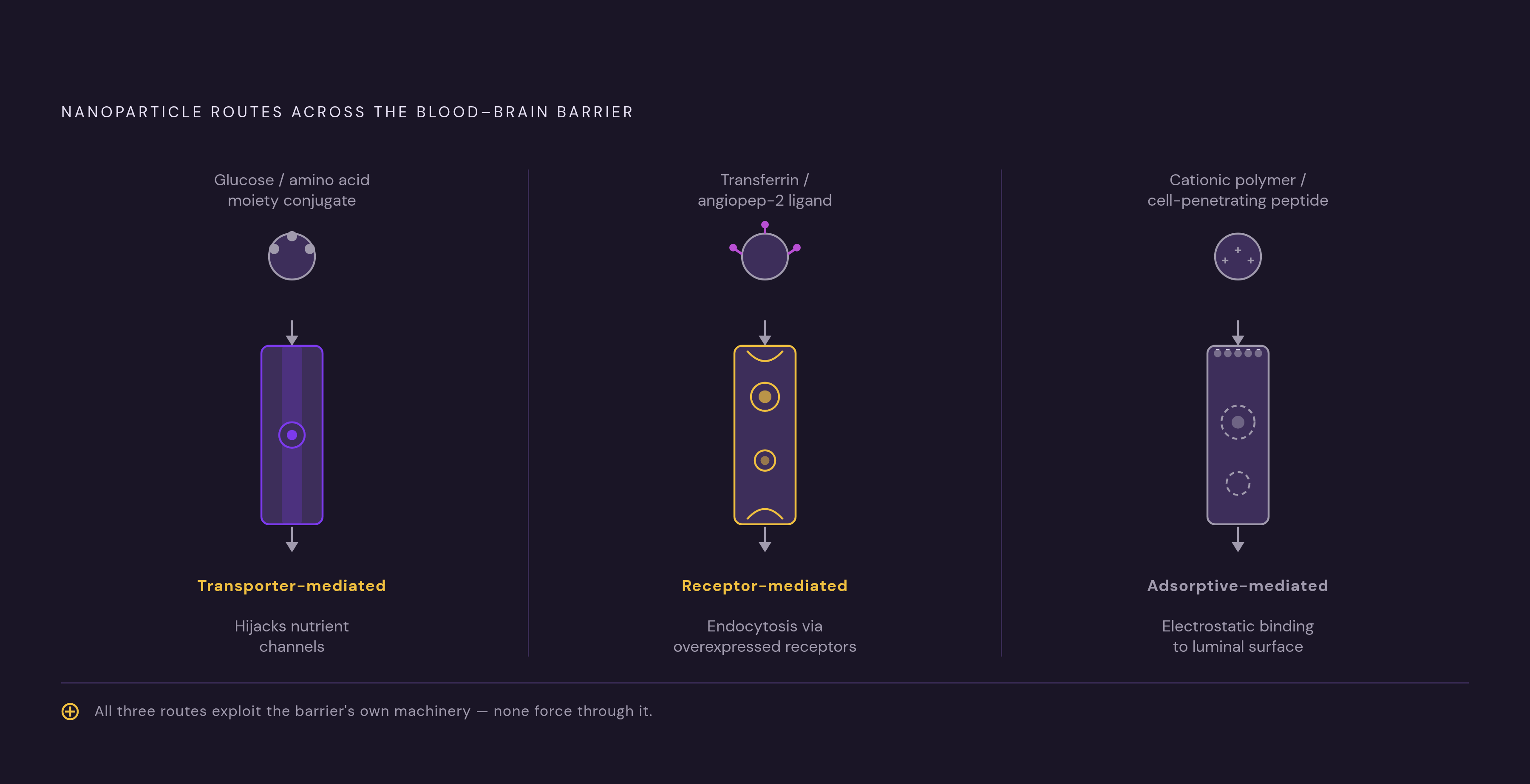
Nanoparticle platforms don't try to force their way past the blood-brain barrier. They get through by using the barrier's own transport machinery against it, and three mechanistically distinct routes have emerged for doing that.
Transporter-mediated transcytosis works by disguise. A nanoparticle conjugated to glucose or amino acid moieties looks, to the barrier, like a nutrient the brain needs to feed itself. The particle hitches a ride on the endogenous glucose and amino acid transporter systems that the BBB already runs constantly to keep brain tissue supplied, crossing without triggering the defenses built to keep foreign material out.
Receptor-mediated transcytosis is the most extensively studied of the three. Ligands such as transferrin or angiopep-2, displayed on the nanoparticle's surface, bind receptors that are overexpressed on brain capillary endothelial cells. That binding event triggers receptor-mediated endocytosis, pulling the nanoparticle into a vesicle that then traffics across the cell and releases its cargo into the brain parenchyma on the other side.
Adsorptive-mediated transcytosis skips the lock-and-key logic of a specific receptor and instead plays on basic electrostatics. The luminal surface of the BBB endothelium carries a negative charge, so coating a nanoparticle in a cationic polymer or attaching cell-penetrating peptides to its surface produces non-specific electrostatic adsorption to that surface, which is followed by endocytosis and transit across the cell.
These three routes aren't walled off from each other. A single platform can be engineered to engage more than one simultaneously, and which combination makes sense depends on the payload being carried, the brain region being targeted, and how much off-target uptake elsewhere in the body is acceptable for that application. Finding the ligands that make receptor-mediated transcytosis work used to take years of empirical screening. Phage display and, increasingly, generative deep-learning models now search for peptides with high affinity for specific BBB receptors directly, compressing that discovery timeline substantially and building up a menu of targeting peptides that platform designers can draw from rather than discover from scratch for every new application.
Nanoparticle material choice shapes what each platform can deliver
Picking a mechanism for crossing the barrier is only half the engineering decision. What the nanoparticle is made of determines how long the payload survives the trip, how long it keeps releasing once it arrives, and whether the whole platform can realistically be manufactured at the scale a drug program needs.
Polymeric nanoparticles built from PLGA protect encapsulated peptides from enzymatic breakdown both in the nasal cavity and along whatever transit route the particle takes. PLGA is biodegradable and its release kinetics can be tuned, which makes it a strong fit for long-acting peptide formulations specifically. PLGA-based GLP-1 formulations have already shown they can stretch release out to weeks from a single dose, a property with direct consequences for how often a patient needs to be dosed and how well they stick with treatment over time. Delivered intranasally, PLGA nanoparticles also travel to the brain directly along the olfactory and trigeminal neural pathways, pairing the material's protective shell with a route that skips systemic first-pass metabolism.
Lipid nanoparticles carry a different set of advantages and a different limitation. LNPs are a nonviral vector class already approved for mRNA delivery by a major regulatory authority, so there's established manufacturing and safety precedent behind the platform. Brain delivery by systemic administration is harder for LNPs specifically because they tend to accumulate in the liver before they ever reach the brain. Functionalizing the LNP surface with targeting peptides is the engineering response to that liver-tropism problem, and two recent studies show how far that response has come. A peptide-functionalized LNP platform published in Nano Letters in 2025 was built specifically for targeted systemic mRNA delivery to the brain, addressing the liver-accumulation issue through surface modification. A separate platform called OS4T LNP, described in Science Advances, took a different approach: it built SR-57227, a serotonin 5-HT3 receptor ligand, directly into the ionizable lipid architecture rather than attaching targeting molecules only to the surface, and then added cell-penetrating peptides on top of that. In an orthotopic glioblastoma mouse model, interleukin-12 mRNA carried by OS4T LNPs suppressed tumor growth and improved overall survival.
Inorganic nanoparticles, built from iron oxide, gold, or silica, occupy a narrower niche. Their optical, magnetic, or electronic properties can be read out from outside the body, which makes them well suited to theranostic applications where diagnosis and treatment happen through the same particle. An early iron oxide nanoparticle study showed delivery of neuropeptides to the brain and reversal of anxiety symptoms during drug withdrawal in animal models. Of the three material classes, inorganic platforms remain the most distant from clinical use, but the theranostic angle keeps them relevant to the broader platform landscape.
Intranasal delivery as a complement to nanoparticle engineering
Intranasal delivery and nanoparticle engineering for BBB crossing get discussed as if they're two competing answers to the same question. They're not. They work on entirely different anatomical logic, and pairing them does more than either can do alone.
The olfactory and trigeminal neural pathways run directly from the nasal epithelium into the brain parenchyma. A drug that travels this route doesn't cross the blood-brain barrier, it bypasses it entirely, while also avoiding gastrointestinal metabolism and hepatic first-pass, two things that chip away at a peptide's effective dose when it's swallowed or injected and left to circulate.
That anatomical shortcut only becomes useful for peptide drugs once nanoparticle encapsulation enters the picture. A bare peptide delivered intranasally still faces rapid enzymatic degradation in the nasal cavity itself, the same kind of enzymatic environment that breaks down unprotected peptides anywhere else in the body. A PLGA or LNP shell protects the cargo through that transit and controls where and how fast it releases once it reaches its target. A 2026 ACS Nano paper demonstrated exactly this with mRNA-loaded lipid nanoparticles delivered nose-to-brain, bypassing the BBB for effective brain disease therapy, and in doing so showed the route works for large macromolecular cargoes, not only small molecules.
The pharmacokinetic case for combining the two stacks up cleanly. Intranasal delivery reduces how much drug accumulates in organs it isn't meant to reach, cuts down on systemic side effects, and can raise brain bioavailability compared to an injection, all without asking the nanoparticle to actively cross the BBB endothelium the way a systemically administered RMT-targeted particle has to. Systemic RMT-targeted nanoparticles and intranasal nanoparticle platforms aren't rivals so much as tools suited to different patient scenarios and different payload types, and a platform built around nanoparticle delivery can in principle be optimized for either path depending on what the clinical situation calls for.
That combination, a protective nanoparticle shell paired with a route that skips the barrier anatomically, lines up especially well with a peptide payload like a GLP-1 analog: large, fragile, hydrophilic, and short-lived in circulation. That particular payload warrants this level of engineering attention for specific reasons.
GLP-1, the peptide payload that makes brain delivery most consequential right now
GLP-1 receptor agonists have built up enough preclinical mechanistic evidence and enough epidemiological signal that getting them into the brain isn't a speculative long shot anymore. It looks like the next necessary step for the entire drug class.
GLP-1 receptors sit in brain regions central to cognition, including the hippocampus and the cortex. Where GLP-1RAs reach those receptors, they push microglia toward an anti-inflammatory M2 state, suppress the release of proinflammatory cytokines, boost autophagy, improve mitochondrial function, and reduce the buildup of aggregated proteins. That's a mechanistic profile that maps directly onto the processes driving neurodegeneration, not a loosely adjacent one.
The epidemiology backs this up independently of the mechanism. A large-scale propensity-matched cohort study found that obese patients treated with GLP-1 receptor agonists had substantially lower risk of developing Alzheimer's disease, Lewy body dementia, and vascular dementia than matched patients who weren't on the drugs.
A separate line of evidence points toward addiction. Endogenous GLP-1 is produced in the nucleus tractus solitarius of the brainstem and acts as a neurotransmitter in brain regions tied to reward processing. That anatomy suggests GLP-1 can dampen neural activity in the mesolimbic reward system and other reward-related circuits, modulating addiction-related behavior in a way that a peripheral injection, degraded within minutes and largely excluded from the brain, has little chance of reliably reaching.
Lining up the dementia data, the neuroinflammation mechanism, and the addiction signal reveals a pattern. GLP-1 isn't shaping up as a therapy aimed at one neurological condition. It looks like a payload with relevance across several distinct categories of brain disease, which is what makes solving its delivery problem worth this much engineering effort rather than a narrower, single-indication fix.
Mixed clinical trial results in GLP-1 neurology as an argument for better delivery
None of that preclinical and epidemiological promise has translated cleanly into clinical trial results, and that gap deserves a direct look. A meta-analysis of randomized controlled trials found that GLP-1RAs did not improve memory or cognition in Alzheimer's disease compared to placebo. Dedicated trials in both Alzheimer's and Parkinson's disease have produced mixed or outright negative results, without establishing a disease-modifying effect that holds up across the drug class. Anyone arguing for continued investment in GLP-1 neurology has to sit with that record honestly.
One explanation fits the data without requiring the underlying biology to be wrong: current injectable GLP-1RAs were never built to cross the blood-brain barrier. The CNS concentrations that peripheral subcutaneous dosing achieves may fall far short of the threshold needed to trigger the neuroprotective mechanisms that preclinical models showed, models where the compound was often delivered directly into the brain rather than injected under the skin and left to find its own way there. That's a mechanistic inference built on a plausible gap between dose and CNS concentration, and it deserves the same scrutiny as any unproven claim.
What makes the inference worth taking seriously is that it's hard to reconcile the epidemiological cohort findings and the preclinical mechanistic data with a simple story of biological failure. Both point toward a real effect that current delivery methods aren't capturing, which is a different claim than saying the trials were flawed or the biology was wrong.
The nanomedicine side of the equation adds a complication of its own. Nanoparticle-based treatments for neurodegenerative disease haven't advanced to late-stage clinical trials yet. Most of the evidence is at the proof-of-concept stage, so the delivery hypothesis laid out above hasn't actually been tested in humans using a purpose-built CNS-penetrating formulation. There's also no standardized protocol yet for evaluating BBB penetration, nanoparticle biodistribution, pharmacokinetics, or long-term toxicity across studies. Without one, comparing results across labs and programs is difficult, and it's hard to know when a given platform has cleared a meaningful delivery benchmark versus simply shown activity in one specific model. One might argue that this absence of standardization is itself a bigger obstacle to progress than any single technical limitation in a particular nanoparticle design: it isn't that any one platform has failed, it's that the field lacks a shared yardstick for judging success.
What the nanoparticle platform landscape has demonstrated in vivo
The in vivo record for nanoparticle-mediated BBB crossing is strong enough to validate the engineering logic laid out across this piece. Almost all of it stops short of the threshold needed for clinical translation, and that distinction matters for anyone trying to gauge how close this technology actually is.
On the polymeric side, PLGA nanoparticles delivered intranasally have shown direct transport to the brain along the olfactory and trigeminal pathways in animal models, with the encapsulated payload protected from enzymatic breakdown and released on a controlled schedule. PLGA's biodegradability and its compatibility with existing manufacturing processes make it a cornerstone material for this category, one of the more scalable options among everything discussed here.
On the lipid side, the peptide-functionalized LNP platform published in Nano Letters in 2025 demonstrated targeted systemic mRNA delivery to the brain in animal models, directly addressing the liver-tropism problem that limits ordinary LNPs.
Both results are genuine evidence that the underlying engineering works, not just a plausible theory on paper. What neither result does is answer the harder question of whether these same mechanisms hold up in humans, at scale, across repeated dosing, and with long-term safety data behind them. That's the gap the field still has to close, and it's the same gap underlying the mixed clinical trial record for GLP-1 neurology discussed above: a biological hypothesis with real support, waiting on a delivery system built specifically to test it properly.
Sources
- Polymeric nanoparticles functionalized with peptides: Advanced strategies for crossing the blood-brain barrier - PubMed
- Peptide-functionalized nanoparticles for brain-targeted therapeutics - PubMed
- Nanoparticle-Based Drug Delivery Across the Blood–Brain Barrier: Current In Vivo Evidence, Translational Challenges, and Future Perspectives
- Functionalization of inorganic nanoparticles with peptides to cross the blood brain barrier: In vivo evaluation - PubMed
- Peptide-Functionalized Lipid Nanoparticles for Targeted Systemic mRNA Delivery to the Brain
- Lipid nanoparticles for mRNA delivery in brain via systemic administration
- Iron Oxide Nanoparticle Delivery of Peptides to the Brain: Reversal of Anxiety during Drug Withdrawal
- Crossing the blood-brain-barrier with nanoligand drug carriers self-assembled from a phage display peptide