Peptide Stability Challenges in GLP-1 Analog Formulation
Every stabilizing trick introduces new failure modes that complicate drug development elsewhere.
GLP-1 analogs work because their peptide backbone binds a receptor with real precision, and that same backbone is what falls apart the moment it enters a bloodstream full of enzymes built to chew up exactly this kind of molecule. Every fix drug designers have found for that instability, whether it's a fatty acid tail, a swapped amino acid, or a protective capsule coating, tends to solve one failure mode while quietly creating another. This piece walks through that chain: what breaks native GLP-1 down, what stabilizing it costs elsewhere in the body, why that cost shows up as harder toxicology work, how it turns into a factory problem, and what happens when someone tries to get the whole thing past stomach acid in pill form.
What DPP-4 cleavage and renal clearance do to an unmodified GLP-1 peptide
Native GLP-1 is a short peptide, and left alone in the body it lasts about two minutes before it's cleared. That's the molecule doing what evolution built it to do: fire a signal after a meal, then get out of the way so the system can reset for the next one. It's the molecule doing what evolution built it to do: fire a signal after a meal, then get out of the way so the system can reset for the next one. A hormone that lingers for hours would flood the receptor and blunt its own signal, so the short half-life is a feature of the biology, not a bug that formulation chemists are being asked to patch.
The enzyme doing most of the damage is dipeptidyl peptidase-4, DPP-4 for short, and it works with almost surgical precision. It cleaves the His-Ala dipeptide sitting at positions 1 and 2 on the N-terminus of the peptide, and one cut is enough. The truncated fragment can't hold onto the GLP-1 receptor the way the intact peptide does, so the signal dies right there, often before the hormone has had time to do much of anything downstream.
Renal clearance backs up that enzymatic attack. Peptides under a certain molecular weight pass straight through the glomerular filter in the kidney and leave the body in urine, no enzyme required. Worse, the two mechanisms feed each other: once DPP-4 has clipped the peptide down to a smaller fragment, that fragment filters through the kidney even more easily than the intact molecule did. Smaller pieces move faster. Degradation compounds elimination instead of running alongside it.
Chemical degradation routes layered on top of both of those don't need any enzyme. Asparagine and glutamine residues deamidate over time, which changes the peptide's charge and messes with how well it binds its receptor. Methionine oxidizes, especially if the formulation sees light or picks up trace peroxides from packaging or excipients. And the peptide backbone itself is vulnerable to hydrolysis at certain bonds, a process that speeds up or slows down depending on the pH of whatever buffer it's sitting in. None of this requires DPP-4 or the kidney. The peptide can degrade sitting in a vial.
How lipidation, backbone modification, and albumin binding extend half-life at a cost
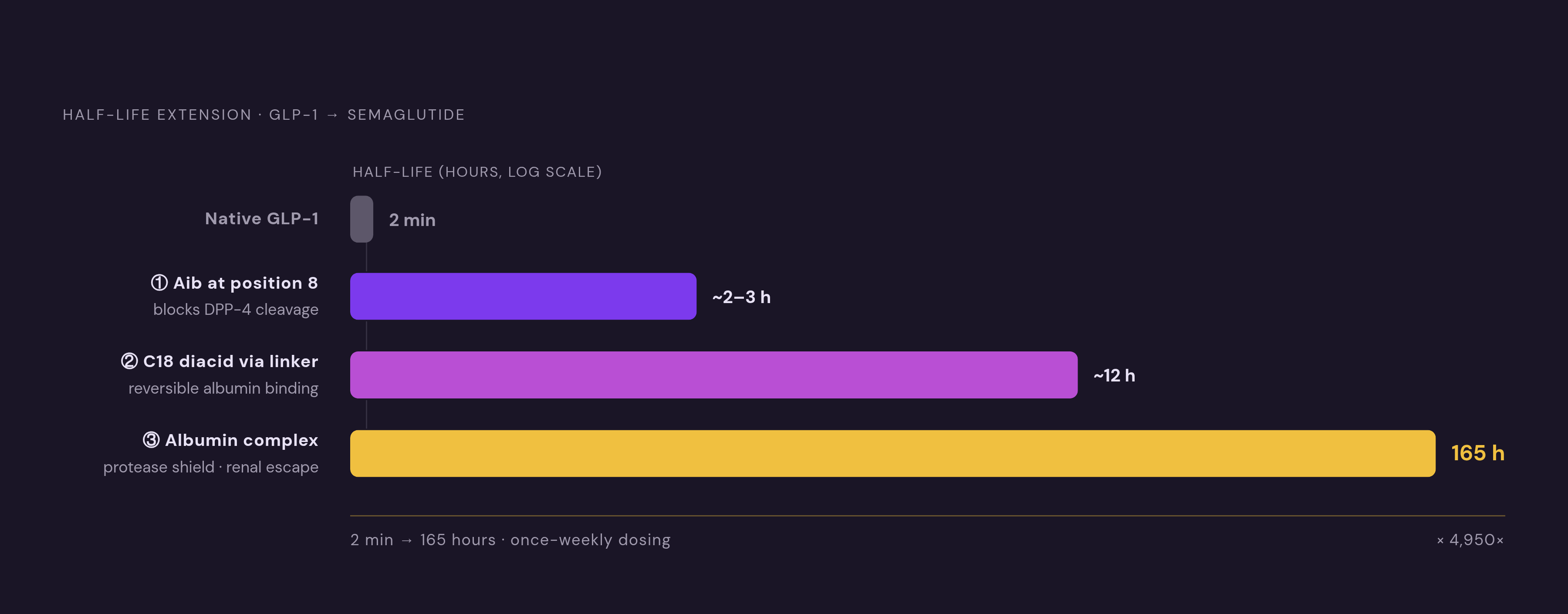
Semaglutide is the reference case for what happens when you deliberately fight all of that. Its half-life runs around 165 hours, close to seven days, which is what makes once-weekly dosing possible. Getting there took three separate structural changes stacked on top of each other, not one clever trick.
First, position 8 on the peptide backbone gets an unnatural amino acid swap: Aib in place of Ala. That single substitution blocks DPP-4 from making its usual cut, because the enzyme can no longer recognize the site it needs. Second, a C18 fatty diacid chain gets attached through a linker to a lysine residue on the peptide backbone. That fatty tail is what lets the peptide reversibly bind albumin, the most abundant protein floating around in blood plasma. Third, that albumin binding does two jobs at once: it shields the peptide from proteases while it's bound, and it makes the whole complex too large to pass efficiently through the kidney's filtration system. Slower renal loss, less enzymatic exposure, longer half-life.
None of that comes free. Lipidation doesn't just extend half-life, it moves the whole clearance process to a different part of the body. Instead of getting broken down mainly by plasma proteases, a lipidated peptide starts routing through tissue-specific metabolic pathways, and those pathways aren't nearly as well characterized as the ones a native peptide would use. The fatty acid chain itself can also introduce a cleavage site in the linker region that wouldn't exist in the unmodified molecule, so a modification meant to add stability accidentally opens up a brand-new place for the peptide to fall apart.
The unnatural amino acid carries its own tradeoffs. Blocking DPP-4 recognition can shift how tightly or how quickly the peptide engages its receptor, and it can generate metabolites that have no real precedent in human biology, since nothing in normal physiology produces them. And albumin binding, useful as it is for half-life, behaves differently across species. Rat albumin and human albumin don't grip a fatty acid tail identically, and that difference in plasma stability has real consequences for anyone trying to predict human pharmacokinetics from animal data. A modification can look stable in a rodent study and behave differently once it's in a person.
The degree of lipidation matters as much as its presence. Research from AstraZeneca compared four peptides side by side: J211, unlipidated but backbone-modified; J229, mono-lipidated and modified; MEDI7219, bis-lipidated and modified; and semaglutide, run as the mono-lipidated benchmark. In a head-to-head in vitro assay, semaglutide degraded completely within 10 minutes, while MEDI7219, carrying two fatty acid chains instead of one, held up considerably better against proteolysis. Lipidation isn't a switch you flip on or off, it's a dial, and where you set it changes the stability outcome by a wide margin.
Other approaches sidestep the underlying chemistry rather than solving it directly. Cyclic peptide structures lock the backbone into a fixed conformation, which makes it physically harder for a protease to get the access angle it needs to cut. Depot formulations take a different route, changing how the peptide gets absorbed after a subcutaneous injection rather than touching the molecule. Both strategies stretch out effective exposure time, but neither one is free of the same basic tension: change how the drug moves through the body, and something about its behavior downstream becomes harder to predict.
Why stabilizing modifications make ADME and toxicology programs harder, not easier
ADME research, the study of how a drug gets absorbed, distributed, metabolized, and excreted, grew up almost entirely around small molecules and the liver enzyme family responsible for metabolizing most of them. That toolkit doesn't map cleanly onto a long-acting peptide that spends part of its life reversibly bound to albumin and part of it releasing slowly from an injection depot. So what happens when the standard playbook doesn't fit the molecule? Several specific problems appear in ways that generic small-molecule ADME assays weren't built to catch.
Species-dependent plasma stability is the first one, and it's not a minor caveat. A modification that behaves stably in human plasma may behave completely differently in rat or monkey plasma, which undercuts the translational value of the in vitro assays that toxicology programs lean on before human trials even start. Linker regions and modified residues can also open up cleavage pathways that a native peptide would never generate, so the metabolite profile of a lipidated analog can include fragments nobody would predict from first principles. Prolonged systemic residence, meanwhile, changes the kinetics of renal elimination in ways that complicate dose-range-finding studies, since the assumptions built around a fast-clearing molecule stop applying. And reversible albumin binding can drive distribution patterns and tissue sequestration that plasma pharmacokinetics alone won't reveal, so a drug can be accumulating somewhere the standard blood-sample timeline never looks.
Those ADME complications don't stay contained to pharmacology, they bleed straight into toxicology. A depot-release peptide dosed weekly builds up exposure differently than a small molecule dosed twice a day, and that difference can show up as delayed-onset effects or a longer recovery window after dosing stops, which changes how a tox study needs to be designed and interpreted. Target-organ toxicity becomes genuinely harder to read when the metabolite profile isn't fully mapped, because a signal in an organ might trace back to the parent compound or to a fragment nobody characterized yet. Bioanalytical work has to separate the two, and for a heavily modified peptide, that's not a small technical hurdle. It's often the bottleneck.
The difficulty of measuring it compounds all of it. Peptide doses are small and molecular weights are high, so getting a clean signal usually requires radiolabeling the molecule at multiple positions, often inside the lipid moiety or the linker itself, just to track where it goes. Long systemic exposure means slow elimination. Standard study windows sometimes end before mass balance recovery is complete. And low circulating concentrations make it that much harder to pin down the structure of whatever metabolites do appear. None of this makes a stabilized peptide a worse drug. It makes it a drug that demands a different, more exacting kind of ADME and toxicology program than the field's existing small-molecule playbook was built for.
How aggregation and cold-chain dependency translate into manufacturing and supply constraints
Peptide instability isn't confined to a stability study on a shelf somewhere. It defines which manufacturing processes are possible at commercial scale, and that's a different order of problem.
Start with synthesis. Solid-phase peptide synthesis builds a chain one amino acid at a time, and each addition takes 30 to 40 or more coupling cycles to get right. For an analog running close to 40 residues, those small yield losses at each step compound across the whole synthesis, so a molecule that looks straightforward on paper can turn into a genuinely difficult manufacturing run once it's at scale. Formulation and fill are their own separate hurdle: peptides prone to aggregation need sterile fill-finish processes with tight control over temperature, agitation, and the exact materials the container and its seal are made from, because the wrong surface or the wrong amount of shear during filling can trigger aggregation right there in the vial.
And once the product exists, it still needs a cold chain that doesn't break, all the way from the manufacturing site to the point where a patient actually injects it. A temperature excursion anywhere in that chain risks both chemical degradation and physical aggregation, and unlike a small-molecule tablet, there's often no easy visual way to tell that it happened.
The shortage years made this concrete rather than theoretical. Demand for GLP-1 drugs ran well ahead of supply, and the binding constraint wasn't drug discovery, it was the capital-intensive, slow-to-build nature of peptide manufacturing capacity itself. Building a new peptide manufacturing line isn't like adding a shift to a tablet-pressing plant. It takes years and it takes serious capital. That reality is visible in the investment numbers: one major manufacturer has committed roughly $50 billion to new domestic manufacturing facilities, and another has put around $11 billion into acquiring and upgrading Catalent manufacturing sites. Numbers at that scale are a direct measure of how seriously the industry now treats cold-chain integrity and formulation-scale manufacturing as the actual bottleneck standing between a stable molecule and a patient who... They're a direct measure of how seriously the industry now treats cold-chain integrity and formulation-scale manufacturing as the actual bottleneck standing between a stable molecule and a patient who needs it.
The oral delivery attempt: what two-tier protection strategies reveal about the remaining gaps
Swallowing a GLP-1 analog means running it straight through every degradation mechanism described so far, all at once, inside a hostile environment built specifically to break peptides down. Stomach acid, pepsin, then trypsin, chymotrypsin, and elastase waiting in the small intestine, on top of a mucosal lining that large hydrophilic peptides can barely cross to begin with. Getting a peptide through all of that intact and still able to bind its receptor is a genuinely different engineering problem than protecting a peptide in an injectable vial.
One documented approach for exenatide, an earlier GLP-1 receptor agonist, tackled the gauntlet in layered steps rather than trying to solve it with a single trick. The first step is hydrophobic ion pairing, pairing exenatide with sodium docusate at a 1:4 molar ratio. That pairing shifts the peptide's log P from about 0.9 to about −2.9, a large jump in lipophilicity that lets the peptide actually dissolve into lipid-based excipients instead of sitting apart from them. The second step builds a lipid-based formulation around that paired complex: a mix of roughly 85% Labrafac MC60, 10% Kolliphor RH40, and 5% propylene glycol, formed into particles around 106 nanometers across, loaded with 6 mg of the exenatide-HIP complex per gram along with 20 mg of sodium caprate per gram to help the peptide cross the intestinal wall once it arrives there. The third step wraps the whole thing in a custom gelatin and HPMC-AS capsule engineered to survive stomach acid intact and only release its contents once it reaches the small intestine, so the lipid phase and the permeation enhancer meet together at the point where absorption is supposed to happen.
In vitro testing showed real protection against degradation by alpha-chymotrypsin, and the likely reason is straightforward mechanically: sequestering the peptide inside lipid droplets limits how much enzyme access it actually gets. That's a genuine result. Short-term stability testing found that the solubilized exenatide-HIP formulation picked up more impurities over time than a simple suspended exenatide acetate formulation, particularly at room temperature. Solving the enzymatic degradation problem with a lipid-based delivery system creates a chemical stability problem in its place, one that wasn't there before. That's the pattern running through this entire piece: every fix moves the failure point rather than erasing it.
The manufacturing math carries a hidden cost too. Oral peptides need substantially more active ingredient per dose than an injectable to reach the same systemic exposure, since so much of an oral dose never survives the GI tract to begin with. At commercial volume, that dose penalty becomes a real supply-chain pressure, not just a formulation footnote, because it multiplies straight through to how much active pharmaceutical ingredient has to get manufactured to meet demand.
Orforglipron takes a different route around the entire problem: it's a small-molecule oral GLP-1 receptor agonist, so none of the peptide stability issues covered in this piece, DPP-4 cleavage, aggregation, cold-chain dependency, GI enzymatic attack, apply to it. It isn't a peptide, so the gauntlet built to break peptides down simply doesn't touch it the same way. Reported weight loss efficacy at the top dose runs around 12%, and whatever the eventual approval and rollout path looks like, the mechanism itself is a genuine reminder that the peptide stability paradox this piece has been tracing is not an immovable law of GLP-1 pharmacology. It's a property of the peptide format specifically. Stepping outside that format opens up a different set of tradeoffs, which is also the logic behind intranasal delivery, Lionbio, a biotech reformulating GLP-1 peptides as a nanoparticle-based nasal spray designed to route the drug nose-to-brain and sidestep the nausea that drives roughly half of injectable patients to quit, is working from that same premise.