GLP-1 Receptor Agonists in Type 1 Diabetes and Non-Obesity Indications
Trial data shows GLP-1 drugs reduce heart risk in type 1 diabetes.

GLP-1 receptor agonists reached the market as diabetes drugs, but the biology behind them was never that narrow. Glucose-dependent insulin amplification, glucagon suppression, and receptor expression that stretches from the pancreas to the heart, kidney, and brain point toward a molecule built for more than one disease category. What follows is an account of how far that reach actually extends when tested against real trial data, not projection, revealing how far the therapeutic reach of the GLP-1 axis genuinely extends across non-obesity contexts.
GLP-1 biology beyond type 2 diabetes
Start with what GLP-1 does at the cellular level, because the mechanism explains everything that follows. As an incretin, GLP-1 amplifies insulin secretion from pancreatic β-cells, but only when glucose is elevated, and it suppresses glucagon release from α-cells, again only under hyperglycemic conditions. That glucose-dependence is the reason these drugs carry a low hypoglycemia risk relative to older insulin secretagogues, since the pancreas simply doesn't get the signal to overproduce insulin when blood sugar is already normal or low.
Compare that to GIP, the other major incretin. GIP acts in the opposite direction under low glucose, becoming glucagonotropic during hypoglycemia, while GLP-1 stays glucagonostatic during hyperglycemia. That divergence is why GLP-1, not GIP, became the pharmacological anchor for the entire drug class that followed.
But the pancreas is only one address on GLP-1's receptor map. GLP-1 receptors show up in the heart, the kidney, and the central nervous system, and that distribution is not an incidental finding buried in a supplementary table. It's a structural fact about the biology itself. More striking still: GLP-1 is synthesized in the brain, where it functions as a neurotransmitter. Give someone a GLP-1 receptor agonist and the drug is amplifying a signal the CNS already runs on its own.
That CNS involvement cuts both ways. The same central mechanisms that reduce energy intake, the therapeutic effect obesity medicine is built around, also drive the nausea and GI distress that patients report. Efficacy and side effect share an address. That overlap becomes central later in this piece, once the conversation turns to delivery route and why an injection built for the gut doesn't automatically serve the brain.
The unfinished problem in type 1 diabetes: what insulin alone cannot do
It's an autoimmune disease with its own pathophysiology, and it deserves its own accounting of what treatment has and hasn't fixed.
Despite decades of insulin refinement and a wave of technology, continuous glucose monitors, hybrid closed-loop pumps, only 20 to 30 percent of US patients with T1D hit recommended glycemic targets Nature Medicine. That means the majority of people managing this disease, even with modern tools, are not where their care teams want them to be.
The downstream cost is concrete. By middle age, 31 percent of T1D patients develop a major adverse cardiovascular event, and 7 percent progress to end-stage kidney disease Nature Medicine. Layer onto that a newer complication: obesity is becoming more common within the T1D population, and part of the cause is the treatment itself Nature Medicine. Intensive insulin therapy can produce iatrogenic hyperinsulinemia, which drives insulin resistance, which in turn demands more insulin. A self-perpetuating cycle, and not a rare one Nature Medicine.
There's a parallel loop happening at the islet level. Disrupted intra-islet regulation leads to hyperglucagonemia, further worsening glycemic control (a cycle that GLP-1's glucagon-suppression mechanism is directly positioned to interrupt). Insulin alone doesn't touch that glucagon problem, because insulin doesn't lower glucagon, it just tries to outrun it. GLP-1's glucagon-suppressing action sits directly in the path of that cycle. Add in the drug's effects on weight, insulin sensitivity, and possibly β-cell apoptosis, and the case for GLP-1 in T1D is that it does things insulin structurally cannot.
None of this is approved use, to be clear. GLP-1RAs remain off-label in T1D, and yet clinicians are prescribing them anyway, in growing numbers, ahead of the regulatory paperwork catching up. That gap between practice and label signals that clinical need is outpacing regulatory catch-up. T1D represents approximately 5–10% of all diabetes cases in the US, framed as a distinct, under-served population rather than a variant of the T2D story.
Clinical Evidence for GLP-1RAs Added to Insulin in T1D
So does the off-label enthusiasm hold up against trial data? Modest numbers, no single figure that reads as dramatic, but consistent across a fairly wide pool of studies, and that consistency affects how much confidence the enthusiasm deserves more than any single point estimate can.
A Danish nationwide cohort tracked 879 semaglutide users against 3,516 matched controls from 2018 through 2024 Nature Medicine iScience / PMC GLP-1 receptor agonists in type 1 diabetes: expanding the therapeutic landscape beyond insulin. HbA1c dropped 0.52 percentage points within the first six months, with only a small further decline by the two-year mark Nature Medicine iScience / PMC GLP-1 receptor agonists in type 1 diabetes: expanding the therapeutic landscape beyond insulin. Total insulin prescriptions fell 8.2 percent in the treated group while rising 4.2 percent among controls, an insulin-sparing effect that is visible not in a lab value but in what people actually needed to inject Nature Medicine iScience / PMC GLP-1 receptor agonists in type 1 diabetes: expanding the therapeutic landscape beyond insulin. Baseline HbA1c in that cohort sat at 7.9 percent and BMI at 31.9 kg/m² GLP-1 receptor agonists in type 1 diabetes: expanding the therapeutic landscape beyond insulin. The study's limits should be named honestly: 59 percent of participants had missing BMI follow-up data, which limits how confidently anyone can speak to weight outcomes GLP-1 receptor agonists in type 1 diabetes: expanding the therapeutic landscape beyond insulin.
A parallel-arm randomized trial (published in NEJM Evidence in 2025) tested semaglutide in obese adults with T1D and found both weight loss and glycemic improvement Nature Medicine.
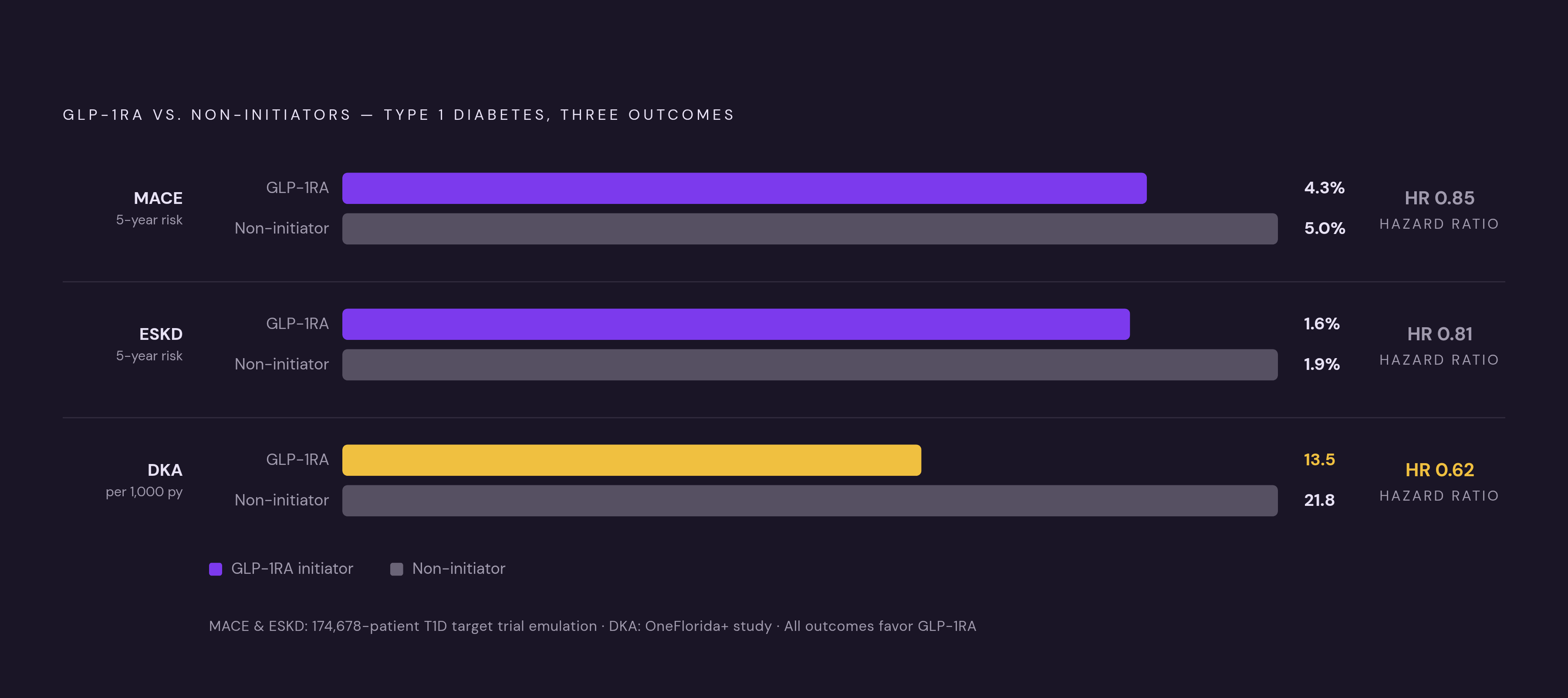
The most consequential data point, though, may be cardiorenal. A target trial emulation covering 174,678 patients with T1D, spanning January 2013 through March 2024, found GLP-1RA initiation associated with a 5-year MACE risk of 4.3 percent versus 5.0 percent among non-initiators, a hazard ratio of 0.85 Nature Medicine GLP-1 receptor agonists in type 1 diabetes: expanding the therapeutic landscape beyond insulin. ESKD risk came in at 1.6 percent versus 1.9 percent, hazard ratio 0.81 Nature Medicine GLP-1 receptor agonists in type 1 diabetes: expanding the therapeutic landscape beyond insulin. That repetition across disease types is the thread this piece keeps pulling on. Across 11 trials with roughly 2,856 participants, adjunctive GLP-1RA therapy in T1D reduced HbA1c by −0.21%, weight by roughly 4 kg, and systolic blood pressure, a modest but consistent signal drugdiscoverynews.com. Significant weight loss reductions were observed in T1D trials; for reference, semaglutide 2.4 mg weekly in T2D (STEP 2) produced a 9.5 kg weight reduction versus near-zero in the placebo group Nature Medicine.
The DKA question: where the safety concern stands after real-world data
Why has none of this translated into approval yet? Diabetic ketoacidosis is the reason, and it's not an irrational one. If a GLP-1RA lets someone reduce their insulin dose, and that reduction goes too far, ketosis can follow. That is a real mechanistic pathway, and it's the single biggest obstacle standing between current off-label practice and a formal indication.
What does the data actually say. A target trial emulation using the OneFlorida+ electronic health record network matched 651 GLP-1RA initiators against 651 non-initiators, all patients with T1D meeting anti-obesity treatment criteria Nature Medicine iScience / PMC. DKA incidence came in at 13.5 per 1,000 person-years among GLP-1RA users, versus 21.8 per 1,000 person-years in the comparison group, a hazard ratio of 0.62 iScience / PMC. The direction is favorable, and that direction is worth taking seriously even where the confidence interval leaves room for doubt.
What did reach clearer significance was health care utilization. GLP-1RA users had fewer hospitalizations, hazard ratio 0.74, and fewer ED visits, hazard ratio 0.73 iScience / PMC GLP-1 receptor agonists in type 1 diabetes: expanding the therapeutic landscape beyond insulin. That's arguably the cleanest signal in the entire dataset, because hospitalization counts don't depend on how a clinician coded a chart, they reflect whether someone ended up in a hospital bed or didn't.
The larger 174,678-patient emulation backs this up independently, finding no elevated risk of hospitalization for either DKA or severe hypoglycemia Nature Medicine. Two separate datasets, built on different patient populations and different time windows, landing on the same conclusion. That's a stronger form of evidence than either study alone.
A set of ongoing clinical trials, once complete, is positioned to actually settle this question with randomized rather than observational data. Where things stand now: the DKA fear is not supported by the observational record, but it isn't closed out either Nature Medicine. Call it a field moving from blanket caution toward something closer to case-by-case calibration. There was no significant association with severe hypoglycemia (HR 0.52; 95% CI: 0.17–1.55) iScience / PMC. Hypothyroidism was identified as a potential modifier of the GLP-1RA–DKA association, and clinicians should factor this into their assessment Nature Medicine.
Cardiovascular disease: from a benefit first seen in T2D to a mechanism that crosses disease categories
In T1D patients, the cardiorenal benefit signal now mirrors what was established first in T2D, suggesting the mechanism is population-agnostic.
Why would that be. Several mechanisms run in parallel rather than through one single pathway: direct anti-atherosclerotic action, weight-mediated reduction in cardiovascular risk, glycemic improvement, anti-inflammatory effects, vasodilation, and reduced oxidative stress. No single mechanism has to carry the whole effect, which may be exactly why the benefit appears across such different patient populations.
The frontier here is genuinely striking. A real-world propensity analysis published in Communications Medicine looked at GLP-1RAs and cancer therapy-related cardiac dysfunction, and found a cardioprotective signal extending into a context that has nothing to do with metabolic disease at all Nature Medicine. That's a population defined by chemotherapy exposure, not diabetes or obesity, and the drug class still appears to be doing protective work there.
The kidney tells a similar story: it means the kidney protection reflects the receptor acting locally.
Step back and the pattern across every one of these findings is the same. Benefit tracks where the receptor sits, not what disease label a patient carries. That's the conceptual hinge this whole piece turns on, and it's the reason the next section on neurological disease follows the same logic applied to a different organ. GLP-1RA cardiovascular protection in T2D is established, and the T1D cardiorenal data (HR 0.85 for MACE, HR 0.81 for ESKD) suggest the mechanism is not contingent on insulin resistance or T2D pathophysiology Nature Medicine. GLP-1 receptor expression in renal tissue and an ESKD HR of 0.81 in the T1D cohort, alongside a separate Nature review on GLP-1RAs and next-generation metabolic hormone therapies in chronic kidney disease (Nature Reviews Nephrology, April 2026, epub January 8, 2026), suggest the renal benefit may be partially weight-independent Nature Medicine.
Neurological indications: what the preclinical science shows
GLP-1 receptors sit in the CNS, and GLP-1 is made there too, acting as a neurotransmitter in its own right. A receptor agonist administered for diabetes or obesity is, whether or not the prescribing information mentions it, walking into wiring the brain already uses.
The neuroprotective hypothesis is not a recent addition to the literature. The ELAD trial tested liraglutide in 204 participants with mild to moderate Alzheimer's disease, reducing hippocampal atrophy and attenuating FDG-PET decline but not meeting its primary endpoint https://research.manchester.ac.uk/en/publications/liraglutide-in-mild-to-moderate-alzheimers-disease-a-phase-2b-cli/.
Preclinical models give the hypothesis real mechanistic backing. GLP-1 signaling appears to reduce amyloid-beta and tau pathology by enhancing clearance, dampens neuroinflammation through microglial modulation, and supports synaptic plasticity Nature Medicine. Broaden the lens further and GLP-1 signaling touches nearly every pathway implicated in neurodegeneration: metabolic dysfunction, chronic inflammation, oxidative stress, mitochondrial impairment, neurovascular injury Nature Medicine. On paper, that's about as strong a mechanistic case as exists for repurposing any metabolic drug into neurology.
Then the clinical trials happened. In the ELAD trial (liraglutide, phase 2b, NCT01843075), daily subcutaneous injection over 12 months in 204 participants with mild-to-moderate AD reduced hippocampal atrophy and attenuated FDG-PET decline, but did not meet its primary cerebral glucose metabolism endpoint.
Parkinson's disease sits further out on the frontier. The neuroprotective mechanisms overlap with PD pathology in ways researchers find worth pursuing, but the current literature treats this as a candidate area rather than anything close to an established clinical signal. Addiction is an even earlier-stage idea: GLP-1 circuitry plays a documented role in reward and motivation, a CNS function that a peripheral injection is poorly suited to reach with precision, but this remains an emerging research direction rather than a body of clinical evidence.
So what explains the gap between mechanism and outcome. This question is very much alive in the field, and GLP-1 receptor agonists, though built for type 2 diabetes, have biology (glucose-dependent insulin amplification, glucagon suppression, and broad receptor expression across the heart, kidney, and brain) that makes them compelling candidates across a widening set of indications, from type 1 diabetes to cardiovascular disease to neurological conditions. Neuroprotective potential was described in the literature as early as 2002, predating the first GLP-1 drug approval for T2D in 2005, meaning this is not a new hypothesis but a long-deferred clinical test Nature Medicine. Large randomized trials in symptomatic AD have yielded negative clinical outcomes and do not support therapeutic use, Cell Reports Medicine reported in August 2026, while a living systematic review at the AAN 2026 Annual Meeting confirmed biomarker and epidemiological signals but elusive primary endpoints Nature Medicine. A systematic review and meta-analysis of 15 RCTs with 1,341 participants in AD found a signal in biomarkers but not clinical endpoints, a pattern consistent with ELAD. The gap between preclinical promise and clinical endpoints in AD suggests either the wrong patient population, intervening too late in disease, the wrong delivery route, or a more limited translation than the mechanisms imply, and this is the open question the field is actively debating.
How the delivery route shapes what GLP-1 can reach
Every GLP-1RA approved for diabetes or obesity gets into the body the same way: subcutaneous injection. That route works fine for reaching the pancreas, and it works well enough to produce the cardiorenal and metabolic effects already described. But the brain is a different kind of target, because whatever crosses into the CNS has to first cross the blood-brain barrier, and a peripheral injection was never engineered with that barrier as its primary obstacle to solve.
Consider what's already been established about this drug class and the CNS. Nausea and vomiting, the most common reasons patients discontinue these drugs, are CNS-mediated. So is the appetite suppression that makes the drugs work for weight loss in the first place. The brain is clearly pharmacologically active territory here, both for the good and the bad. But no injection currently on the market was built to concentrate the good in the brain while sparing the periphery from the bad, and that mismatch recurs across the data reviewed above.
That mismatch may explain the Alzheimer's results directly Nature Medicine. Weekly subcutaneous dosing calibrated for metabolic targets may simply produce a CNS exposure pattern that isn't shaped right for neurological benefit, different timing, different concentration, different duration than what neurodegeneration might require. That's not a proven explanation, but it lines up with a broader pattern across the evidence reviewed here, as a peripheral insulin-sparing effect appears in the DKA data, a CNS biomarker signal without a clinical endpoint appears in ELAD, and nausea-driven dropout appears in the obesity adherence literature. Three separate datasets, same underlying story: delivery route shapes outcome as much as the molecule itself does. Nose-to-brain delivery, as an alternative route, bypasses the blood-brain barrier via the olfactory and trigeminal pathways, enabling direct CNS delivery of peptides, a pharmacological rationale rather than a product claim.
Intranasal delivery and the nose-to-brain route as a next-generation platform for GLP-1 and neurological indications
If the injection route is the bottleneck, what's the alternative. The olfactory epithelium and the trigeminal nerve both provide direct anatomical conduits from the nasal cavity into the CNS, a route that sidesteps hepatic first-pass metabolism and the blood-brain barrier at the same time. That's not a speculative claim; it's a mechanistic rationale with a solid footing in the delivery science literature, and it's the reason nose-to-brain delivery keeps coming up as the logical next step for peptide drugs that need CNS access without a systemic detour.
But knowing the route exists doesn't make it usable. GLP-1 peptides break down quickly once they hit nasal mucosa, and they don't cross the epithelial barrier on their own. That's an engineering problem, not a biological one, which is an important distinction. The mechanism for reaching the brain through the nose is sound. What's missing is a way to keep the peptide intact long enough to use it.
Nanoparticle encapsulation is the platform response to that exact gap. Wrapping the peptide in a nanoparticle carrier can protect it from enzymatic degradation in the nasal mucosa, help it move across the epithelial layer, and allow for a more controlled release once it reaches CNS tissue. None of that changes the underlying GLP-1 biology laid out at the start of this piece. What it changes is whether that biology actually reaches the tissue where its most theoretically promising, and so far clinically unproven, effects are supposed to happen.
Sources
- Glucagon-like peptide-1 receptor agonists for major cardiovascular and kidney outcomes in type 1 diabetes | Nature Medicine
- GLP-1 receptor agonists and acute diabetes complications in adults with type 1 diabetes
- GLP-1 receptor agonists in type 1 diabetes: expanding the therapeutic landscape beyond insulin
- Glucagon-like peptide-1 receptor agonists as add-on therapy to insulin for type 1 diabetes mellitus