Weight Loss Versus Metabolic Benefit in GLP-1 Therapy
The drugs' real power lies in tissue-specific effects that exist independent of weight loss.

GLP-1 drugs became famous for the number on the scale, but that number is turning out to be a poor proxy for what these molecules actually do inside the body. The deeper story, and the one that matters more for how these drugs get developed, prescribed, and delivered going forward, is that GLP-1 receptor agonists touch the heart, liver, joints, and brain through pathways that run parallel to, not through, weight loss itself.
Why GLP-1s became a weight-loss story first
The hormone at the center of this story was identified in the 1980s, and for roughly two decades afterward, it stayed a diabetes story, not a weight story. Exenatide, the first GLP-1 agonist to reach the market in 2005, needed twice-daily injections, and any weight loss patients experienced registered as a side note in the chart, not the reason the drug got prescribed. That changed once semaglutide trials came back showing an average weight loss around 15% of body weight, a figure that dwarfed anything an anti-obesity drug had produced before it. The American Physiological Society called this moment a turning point in its March 2026 issue of The Physiologist Magazine, and the phrase fits.
From there the story left the clinic fast. A November 2025 KFF Health Tracking Poll found roughly 1 in 8 U.S. adults now taking a GLP-1 drug for weight loss, diabetes, or another indication. Insurers, media outlets, and patients all landed on the same shorthand: these are weight-loss drugs. That's not wrong, exactly. A molecule that reaches receptors in the heart, the liver, the joints, and the brain will never have its full effect captured by a bathroom scale, and that incompleteness is the point. The rest of this piece is about what gets lost when weight becomes the only metric anyone tracks.
What GLP-1 receptors do across the body
GLP-1 itself is a hormone the gut releases after eating. Its job, in the body's native design, is to nudge insulin secretion up and glucagon down, which is why it lowers blood glucose in the first place. Pharmacologically, two effects get most of the attention: slower gastric emptying, which extends the feeling of fullness, and direct action on appetite centers in the brain. They don't explain everything else researchers are now finding.
GLP-1 receptors sit on cardiovascular tissue, on the liver and fat cells, on immune cells involved in inflammation, and, notably, in brain regions tied to impulse control, reward, and addiction.
Patients often describe something that sounds almost incidental at first: not just less hunger, but a quieting of the mental static around food, the constant low hum of thinking about the next meal. It's an informal but useful clue. It points toward motivational and reward circuitry, not just stomach and appetite mechanics. A drug engaging that many systems at once is not going to produce effects that trace back cleanly to a single number on a chart. Researchers don't yet have a full map of these mechanisms. That uncertainty isn't a gap to gloss over, it's the reason the weight-versus-metabolism question is a live scientific debate rather than a settled one.
The cardiovascular benefit that doesn't fully explain itself
In 2025, the FDA approved semaglutide to reduce the risk of worsening kidney disease, kidney failure, and cardiovascular death in adults who had both type 2 diabetes and chronic kidney disease, building on earlier trial data showing markedly lower rates of heart attack and stroke in diabetic patients with existing atherosclerosis. A 2026 prespecified analysis in Nature Medicine pushed the finding further: the cardiovascular benefit held up even in patients at higher risk of significant liver fibrosis, and semaglutide also improved fatty liver index scores and liver enzyme markers relative to placebo.
So how much of that benefit comes from weight loss itself, and how much is the drug acting directly on vascular tissue? Researchers working through the cardiovascular data haven't been able to pin all of it on weight reduction alone. A July 2025 narrative review in eClinicalMedicine, authored by Moiz and colleagues, points to anti-inflammatory action and direct receptor-mediated effects on cardiac tissue as plausible independent contributors. That's a meaningful claim: it suggests the drug is doing something to the heart and vasculature that isn't simply downstream of a smaller waistline.
The liver data adds weight to this. Improvements in liver enzymes and fatty liver markers exceeded what weight loss alone typically produces, which points toward a tissue-level effect that operates on its own track. None of this rises to proof of a fully separate mechanism. The consistency, across trials, across organ systems, across different drug formulations, is what makes the independent-effect hypothesis worth taking seriously rather than dismissing as statistical noise. SURPASS-CVOT, announced July 31, 2025, was a nearly five-year head-to-head randomized controlled cardiovascular outcome trial comparing tirzepatide to dulaglutide in 13,299 patients with type 2 diabetes and established atherosclerotic cardiovascular disease, offering additional data on how a dual agonist's cardiovascular profile compares GLP-1 Therapies in 2026: Beyond Blood Sugar and the Scale | AJMC.
Real-world response heterogeneity: when weight loss doesn't predict benefit
If weight loss were the whole mechanism, patient outcomes should track fairly tightly with pounds lost. Outcomes don't track that tightly with pounds lost. A study following more than 4,000 people with type 2 diabetes found that 43% of them showed neither meaningful weight loss nor meaningful glycemic improvement, with average weight loss in that group at just 1.4% of starting body weight and HbA1c dropping only 0.49% An Update on GLP‐1 Receptor Agonists. That's a large chunk of patients for whom the drug simply didn't do the thing it's famous for doing, on either axis.
The mismatch runs in both directions. Some patients lose relatively little weight and still see real metabolic improvement. Others lose a great deal of weight without a proportional glycemic payoff. Osteoarthritis data presented at the ADA's 2026 Scientific Sessions makes this concrete: semaglutide produced meaningful reductions in WOMAC pain scores, and tirzepatide, despite driving substantially more weight loss, produced a similar pain benefit. AJMC's coverage of that data put a number on it: roughly 23% weight loss with tirzepatide produced pain reductions comparable to semaglutide's 13%, which raises the possibility that past a threshold near 10% weight loss, additional pounds lost don't buy proportionally more joint relief GLP-1 Therapies in 2026: Beyond Blood Sugar and the Scale | AJMC Weight Reduction with GLP-1 Agonists and Paths for Discontinuation Wh…. That pattern only makes sense if something besides weight loss, likely an anti-inflammatory action working directly on joint tissue, is contributing independently.
MASH, or metabolic dysfunction-associated steatohepatitis, offers another data point from outside the core GLP-1 class. Survodutide, developed jointly by Boehringer Ingelheim and Zealand Pharma, works partly through glucagon agonism, which promotes fat burning and raises energy expenditure, and a large share of patients in trials showed liver improvement without worsening fibrosis. That's a tissue-level effect that goes beyond simply having less body fat to carry around. Add it up, and the scatter across these outcomes tells a fairly clear story: if weight loss were the entire mechanism, the variation in who benefits and by how much would be far more predictable than it is.
The muscle loss problem complicates simple weight-loss metrics
Weight loss numbers hide a composition problem, and it's a bigger one with GLP-1 therapy than with most other interventions. Across diet, drugs, and bariatric surgery generally, about a quarter of total weight lost tends to come from lean body mass rather than fat. Ian Neeland, of University Hospitals Harrington Heart & Vascular Institute, told the ADA's 2026 meeting that with the newer, higher-dose GLP-1 compounds, that fraction can climb to 40% or more.
That's not a cosmetic detail. Each kilogram of muscle lost costs the body roughly 13 kilocalories a day in resting energy expenditure, compared to just 4 kilocalories for a kilogram of fat lost GLP-1 Therapies in 2026: Beyond Blood Sugar and the Scale | AJMC. Lose muscle instead of fat, and the body's baseline metabolic engine slows down more than the scale would suggest, which works against exactly the kind of long-term weight maintenance these drugs are meant to support. Tirzepatide has shown dose-dependent reductions in muscle fat infiltration on MRI, even in patients whose total lean mass is declining. Quantity and quality of muscle are not the same thing, and a raw weight-loss figure captures neither with any precision.
The field is starting to respond. The phase 2 BELIEVE trial paired semaglutide with bimagrumab, a myostatin inhibitor, and cut the lean-mass share of total weight loss from around 28% with semaglutide alone down to about 7% in combination, while trimming absolute lean mass loss from 7.4% to 2.9%. CagriSema, which combines cagrilintide with semaglutide, has shown similar promise in preserving bone and lean mass during weight loss, Medscape reported in October 2025. Exercise adds another lever: the S-LITE trial found that pairing liraglutide with supervised aerobic training, mostly cycling and running, let patients actually gain lean mass, an outcome pharmacotherapy alone didn't produce. Neeland flagged a real gap here too: large trials tracking muscle function, not just muscle mass, are mostly missing from the literature, and clinicians don't yet have a settled answer for how to measure that in practice. What kind of weight comes off matters nearly as much as how much does.
GLP-1 effects on the brain: addiction, dementia, and the neurological frontier
GLP-1 receptors show up in brain regions tied to impulse control, reward, and addictive behavior, the same circuitry implicated in substance use disorders more broadly. The analysis found a decreased risk of neurocognitive disorders including Alzheimer's and dementia.
The dementia signal is also visible in other studies. A retrospective cohort study comparing GLP-1 receptor agonists against metformin, with 87,229 matched patients in each group, found GLP-1 users had a lower overall dementia risk, with an adjusted hazard ratio of 0.90. Why might that be? Kowalska and colleagues' review notes that Alzheimer's disease and type 2 diabetes share underlying biology: insulin resistance, chronic inflammation, oxidative stress, and mitochondrial dysfunction occur in both conditions.
The clinical trial record here is mixed, and it should be reported honestly rather than cherry-picked. The global EVOKE and EVOKE+ trials are testing semaglutide in Alzheimer's disease directly, with results still pending. The UK's ELAD trial, a phase IIb study of liraglutide in 204 patients with mild to moderate Alzheimer's over 12 months, missed its primary endpoint of cerebral glucose metabolism, though it did show a significant secondary benefit on an executive-function cognitive scale. Al-Aly's read is that these aren't secondhand effects of eating less. GLP-1 reduces neuroinflammation and acts directly on the brain's reward and impulse circuits, which is direct central nervous system pharmacology, not a downstream consequence of appetite suppression. Stroke, Parkinson's disease, substance use disorders, dementia: all of it is under active investigation now, and none of it has a plausible explanation rooted in weight loss alone. If the most striking effects of this drug class are happening in the brain, how the drug actually gets to brain tissue is the central engineering question, not a footnote. A large-scale real-world analysis from WashU/VA by Al-Aly et al. examined 215,970 patients with diabetes on GLP-1 therapy compared with more than 2 million patients not on GLP-1 therapy.
Why delivery route shapes which benefits patients receive
The blood-brain barrier blocks around 98% of small-molecule drugs and nearly all large biologic ones, which means injectable GLP-1 agonists reach the brain mostly through circumventricular organs, structures that sit outside the barrier's protection, and general systemic exposure, not through any direct route into the central nervous system. That's a real limitation if the brain effects turn out to be as important as the cardiovascular and dementia data suggest they might be.
Intranasal delivery offers a different path. Molecules delivered through the nose can travel along the olfactory and trigeminal nerves straight into the central nervous system, sidestepping both the blood-brain barrier and the liver's first-pass metabolism that breaks down a lot of what's swallowed. It also avoids the stomach's harsh chemical environment, which matters a great deal for a peptide as fragile as native GLP-1, which the enzyme DPP-4 degrades in around two minutes. The concentration a drug reaches in brain tissue, and how fast it gets there, differs meaningfully between an intranasal route and a systemic injection.
So, what if the neurological benefits, the addiction outcomes, the dementia risk reduction, the mood effects, depend specifically on how much drug reaches CNS receptors rather than how much circulates in the blood generally? If that's true, a delivery route built to concentrate the drug in brain tissue isn't a convenience feature. It's a more mechanistically appropriate way to reach the effect that matters. Nausea, the single biggest reason patients quit these drugs, is driven largely by peripheral gut receptor activation and by a brainstem structure called the area postrema. A delivery approach that lowers the overall systemic peptide load while keeping CNS exposure intact could, in principle, tackle both problems, GI discomfort and neurological under-delivery, at once. Nanoparticle-based platforms are the enabling technology behind intranasal peptide delivery generally: they shield a fragile peptide from being broken down by enzymes in the nasal lining, help it cross the mucosal barrier, and can be engineered to release the drug on a controlled schedule. None of that is incremental reformulation. It's a different hypothesis entirely about which receptors ought to be the primary target, and the neurological evidence increasingly supports testing that hypothesis seriously.
The adherence crisis that makes delivery innovation urgent
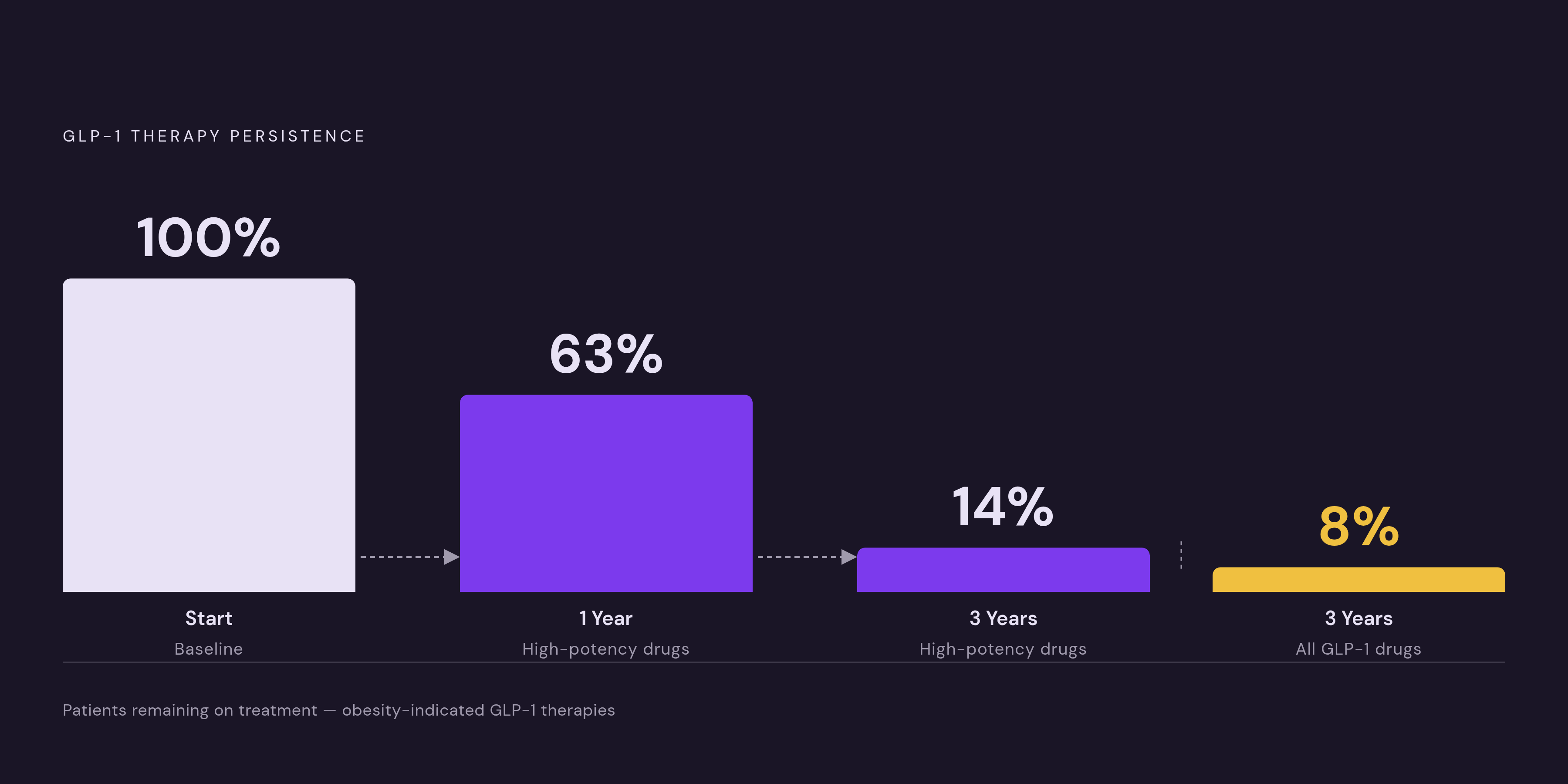
None of this matters if patients can't stay on the drug long enough to get the benefit, and right now, a lot of them don't. Gastrointestinal side effects are the leading reason people quit. RAND's survey found roughly half of users reporting nausea and about a third reporting diarrhea.
More recent data shows some improvement, but the longer-term picture is still stark. Real-world pharmacy claims among people who started GLP-1 therapy in 2024 show 63% still on treatment at the one-year mark, better than earlier cohorts, but persistence falls off sharply from there. Only 14% of people who started a high-potency, obesity-indicated GLP-1 drug were still taking it after three years, and across the entire GLP-1 category, that figure drops to just 8%. A Kaiser Permanente Colorado real-world analysis published in May 2026 broke down why people stop: 26.8% cited an adverse drug reaction, 14.4% cited cost concern, and the rest fell under non-adherence.
Put those numbers next to everything the earlier sections describe, the cardiovascular protection, the liver improvement, the joint pain relief, the dementia risk reduction, and the stakes of poor adherence come into sharper focus. Whatever solves the poor tolerability that drives patients to quit, whether that's a different delivery route, a different formulation, or something not yet on the market, isn't a side improvement to a working drug. It's the thing standing between the biology described here and the patients who could actually use it. A Danish study of over 40,000 first-time GLP-1 users with type 2 diabetes spanning 2007 to 2020 found that 14.1% discontinued treatment at 6 months and 21.2% discontinued at 12 months.
Sources
- GLP-1 Drugs and the Physiology of Metabolic Health | American Physiological Society
- GLP-1 Therapies in 2026: Beyond Blood Sugar and the Scale | AJMC
- Weight Reduction with GLP-1 Agonists and Paths for Discontinuation While Maintaining Weight Loss - PMC
- An Update on GLP‐1 Receptor Agonists
- Should We Be Concerned About Muscle Loss With GLP-1s?
- Study identifies benefits, risks linked to popular weight-loss drugs – WashU Medicine