GLP-1 Injectable Dropout Rates and the Compliance Crisis
Most patients quit GLP-1 injections within a year due to nausea during dose escalation.

GLP-1 receptor agonists post some of the most dramatic weight-loss numbers ever recorded in clinical trials, but real-world persistence data tells a colder story. A large share of patients who start these drugs stop within a year, often before they reach a dose that produces meaningful benefit, and the reason has less to do with the biology of the drug than with how it gets into the body.
Prescriptions have exploded. Gallup found that 11% of US adults reported taking a GLP-1 for weight loss in 2026, up from 3% in 2024, a nearly fourfold jump in two years. That growth reflects real enthusiasm among patients and prescribers for a drug class that has outperformed almost everything that came before it. But filling a prescription is the easy part. Staying on the drug, week after week, injection after injection, for months or years, is a different task entirely, and clinical trials, with their structured visits, financial support, and built-in accountability, were never built to replicate it.
A weekly subcutaneous injection, a mandatory dose-escalation schedule, and a treatment horizon with no defined end point impose a burden that trial protocols smooth over but real patients carry every single week. That burden is where this piece starts, and what follows is a compliance story that may be the central unsolved problem of the entire GLP-1 era.
How bad the dropout numbers are across major real-world studies
No major real-world study of GLP-1 use finds a comfortable majority of patients still on therapy after a year. The numbers shift depending on how strictly "discontinuation" gets defined, but they converge on the same uncomfortable conclusion: a lot of people quit, and they quit early.
A Danish registry study led by Aurélie Mailhac, published in JAMA Network Open, followed 157,822 first-time semaglutide users treated for obesity between 2022 and 2024. Median age was 49, and 69% were women. Using a 60-day gap to define discontinuation, roughly half of these patients had stopped therapy within 12 months. Tighten the definition to a 30-day gap, and the rate climbs to 58%. The definition moves the number. It does not move the conclusion underneath it.
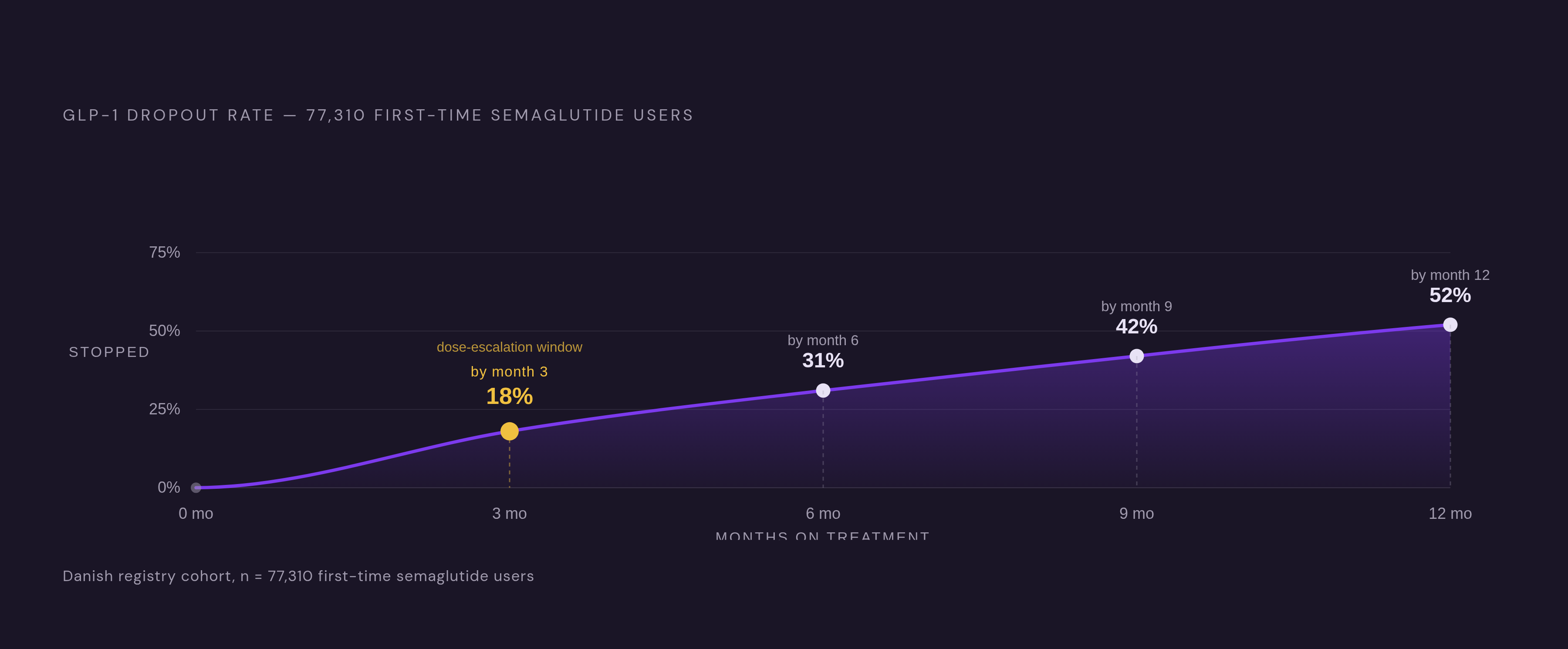
An earlier Danish population study, presented at the European Association for the Study of Diabetes meeting in Vienna, followed 77,310 first-time semaglutide users and found that 40,262 of them had stopped by the one-year mark. The pace matters more than the final tally. Eighteen percent of patients stopped within three months. Thirty-one percent were gone by six months. Forty-two percent had quit by nine months. Dropout is a steady bleed that starts almost immediately.
A US electronic health record cohort, drawn from Truveta data across 30 healthcare systems and covering 125,474 patients between 2018 and 2023, split results by diabetes status. Among patients without type 2 diabetes, 64.8% discontinued within a year. Among those with type 2 diabetes, the figure was 46.5%. The patients with the least medical urgency to stay on therapy, the ones using the drug purely for weight loss rather than glycemic control, quit at the highest rate in the data.
Mailhac summed up the pattern bluntly: "The discontinuation rate is considerable; we did not find any subgroup where discontinuation was low." No age bracket, no sex, no income tier came out clean. That rules out the comfortable idea that dropout is confined to some narrow, unlucky slice of patients. It is a structural feature of the treatment, built into the regimen itself, and treating it as anything else is the first mistake most coverage of this drug class makes.
Who quits earliest and why the dose-escalation period is the highest-risk window
Dropout starts as early as month three, and that timing points straight at dose escalation, the stretch when clinicians ramp patients from a starting dose up to a therapeutic one. That window is the single highest-risk stretch of the entire treatment course. Nausea and gastrointestinal side effects peak exactly there, and patients haven't yet banked enough visible progress to tolerate feeling sick.
Age cuts against intuition. In the Danish registry study, adults younger than 30 were 48% more likely to discontinue within the first year than those aged 45 to 59, despite having the longest runway to accrue metabolic benefit. Prior use of GI medications also predicted higher dropout, tied to a higher likelihood of discontinuation within the first year. Patients who already run sensitive stomachs are the ones most exposed to nausea-driven attrition, which suggests the escalation schedule itself, not patient resolve, is the variable doing the damage.
That schedule is the mechanical culprit. GLP-1 receptor agonists require gradual upward titration, and nausea and vomiting run worst during those escalation phases rather than at steady state. The regimen builds its own trap: low, tolerable doses produce modest weight loss, but the higher doses that deliver the results patients actually want carry a side-effect burden steep enough to drive people off the drug. Patients end up choosing between feeling well and losing more weight, and a meaningful share choose to stop.
Survey data backs this from both sides of the exam table. Physician surveys consistently identify nausea, vomiting, and other GI side effects among the top reasons cited for patient discontinuation. Among 194 patients surveyed directly, the two most common reasons were blunt: "made me feel sick" (64.4%) and "made me throw up" (45.4%). Patients quit because the drug makes them ill while it is actively working, which is a strange thing to ask anyone to sit through for months on end.
Layer the injection itself on top of the GI burden. Weekly subcutaneous self-administration is not a trivial ask for someone who has never given themselves a shot, and needle burden compounds over time. What feels manageable in week one starts to feel like a chore by month six and an open-ended obligation by year two. Individualized dose titration paired with counseling on meal size and timing can help patients manage GI symptoms, and that intervention works where it gets applied. But it needs clinical infrastructure, provider time, and follow-up visits that most practices don't have the staff or the hours to deliver at scale. So the fix exists, technically, and remains out of reach for most patients anyway.
The role of cost and coverage gaps in accelerating dropout
Side effects explain a lot of dropout, but not all of it. Cost operates as a separate driver, and it appears to hit a different population than the one dropping out from nausea. Younger patients and those in lower-income areas discontinued at higher rates, and researchers point to out-of-pocket cost, not tolerability, as the likelier explanation for that particular split.
The price tag is not small. The Danish study authors reported that the lowest dose of semaglutide ran around €2,000, roughly $2,350 to $2,360 annually. That is a significant recurring expense for anyone paying without insurance, and it forces hard household budgeting decisions long before a patient ever reaches a dose that produces meaningful results.
Coverage gaps make the arithmetic worse. Medicare and Medicaid do not currently cover GLP-1 receptor agonists prescribed specifically for weight loss. The Trump administration rejected a Biden administration proposal that would have extended Medicare Part D coverage to anti-obesity medications starting in 2026, leaving a large population of older and lower-income patients locked out of coverage for this indication.
That builds a compounding disadvantage. Low-income patients are less likely to afford the drug out of pocket, less likely to carry insurance that covers it, and, as a result, less likely to stay on it long enough to reap the benefit. Reimar W. Thomsen, senior author on the Danish study and based at Aarhus University Hospital, said higher-income patients are "probably better at being on the drug, not discontinuing, tolerating side effects, and continuously being able to pay for the drugs." Resource access shapes who stays on therapy as much as biology does, arguably more.
Supply shortages in prior years forced some patients off the drug involuntarily, well before cost or tolerability ever entered the picture. That disruption has eased, but dropout has never traced back to one cause. It has always run multi-causal. A single fix, cheaper drug alone or better coaching alone, was never going to close the gap. Solve the tolerability issue tomorrow and the coverage gap still sits there untouched. Cost and access are independent drivers, and pretending otherwise is how a lot of well-meaning compliance programs end up solving the coverage gap while leaving the tolerability issue untouched, or vice versa.
The biology of weight regain after patients stop
Quitting a GLP-1 is a clinical failure, full stop, not a mere inconvenience. It is a clinical failure, full stop, not a mere inconvenience. A systematic review and meta-analysis covering 37 studies estimated that patients return to their baseline weight within 1.7 years of stopping weight-management medication. Cardiometabolic markers follow close behind, with an estimated return to baseline within 1.4 years of stopping weight-management medication.
One cohort study found that 58% of patients regained weight within 12 months of stopping a GLP-1. The regain wasn't spread evenly, either. Patients who had lost 20% or more of their body weight regained an average of 17.2 pounds, compared to 11.0 pounds among those who had lost only 5% to 10%. The patients who benefited most from the drug lose the most ground the moment they stop taking it, which is close to the opposite of what anyone would want from a treatment this expensive and this hard to stay on.
Why does the reversal move so fast? GLP-1 receptor agonists suppress appetite through central pathways in the hypothalamus and mesolimbic reward circuits. Once the pharmacological signal ends, orexigenic hormone activity rebounds, and the appetite suppression the drug had been providing disappears abruptly. What's left exposed is the same biological drive toward weight regain that predated treatment, only now uncounteracted. Some drug effects, like delayed gastric emptying, reverse quickly. The hormonal shifts reverse more gradually, and patients often feel hunger return well before their metabolism has any chance to settle back down.
This is where the compliance trap closes. GLP-1s appear to require ongoing, indefinite use to sustain their benefits, yet the delivery method itself, weekly injections with escalating doses and mounting needle burden, makes indefinite use genuinely hard to sustain for a large share of patients. Dropout leads to regain, regain motivates patients to restart, and restarting means walking straight back into the same tolerability and cost barriers that drove them off. It runs as a loop.
Improving persistence and the structural ceiling on injectable adherence
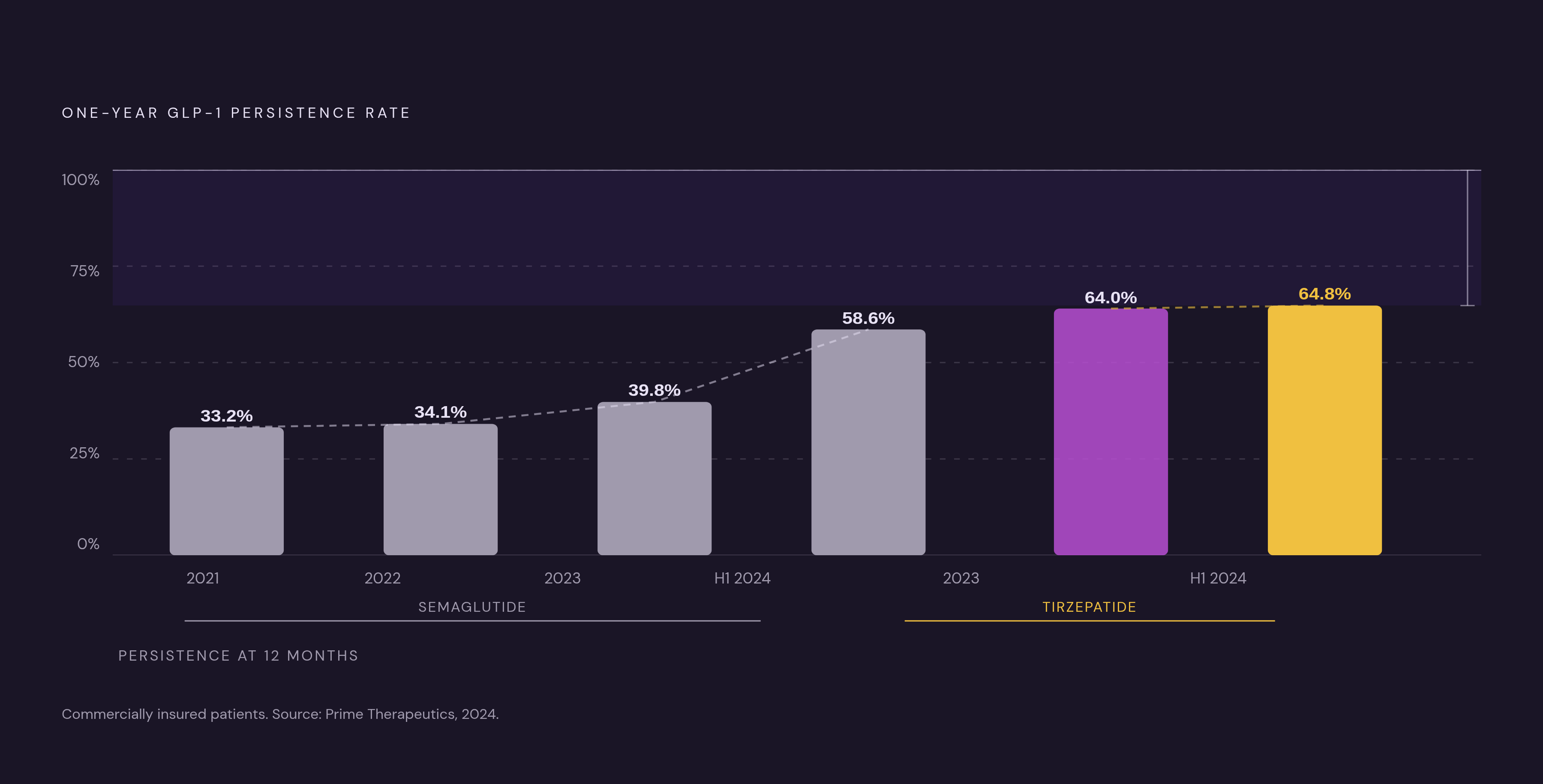
Credit where it's due before the caveat lands. The trend is moving in the right direction. A Prime Therapeutics cohort study, covering an average of 17.9 million commercially insured members per month, found that one-year persistence on GLP-1 therapy nearly doubled, from 33.2% in 2021 to 60.9% in the first half of 2024.
Broken down year by year for semaglutide specifically: 33.2% in 2021, 34.1% in 2022, 39.8% in 2023, and 58.6% in the first half of 2024. Tirzepatide, tracked separately, showed persistence of 64.0% in 2023 and 64.8% in the first half of 2024. Those gains likely trace to the resolution of earlier supply shortages, improved clinical protocols for managing dose escalation and side effects, and the rollout of lifestyle support programs that give patients more to lean on.
That 60.9% figure still deserves a harder look than it usually gets. It represents the best persistence rate on record, measured in a commercially insured population, about as advantaged a group as this kind of analysis will ever find. Even there, roughly 4 in 10 patients still quit within a year. Among Medicaid patients and the uninsured, persistence runs substantially lower, and that gap is the tell: the recent gains are riding on infrastructure, not on anything that changed about the drug or the regimen.
Persistence will probably keep climbing as clinical support matures. But every driver behind the recent improvement, better coaching, reduced shortage pressure, structured lifestyle programs, depends on healthcare infrastructure that isn't distributed evenly and isn't guaranteed to scale evenly either. The injection schedule and the escalation regimen haven't changed. They remain exactly as demanding as they were in 2021, no matter how much support gets wrapped around them.
The stakes of getting this right are large. Data from Amgen shows that patients who stayed on GLP-1 therapy for 12 months achieved a mean weight change of -10.9%, compared to just -2.2% among those who discontinued. That gap, nearly five times larger for persisters than for quitters, means every dropout represents a clinical outcome that simply never happened. Progress within the current injectable model deserves real credit. Whether that progress can fully dissolve a problem partly built into the delivery mechanism itself is a separate question, and the honest answer right now leans no.
The delivery route as the right target for solving compliance
Line up the causes of dropout laid out so far, nausea tied to dose escalation, needle burden, peripheral GI side effects, and a single pattern emerges: all three trace back to how the drug gets delivered, not to what the drug does once it arrives.
GLP-1's primary mechanism of action is central. It works through receptors in the hypothalamus and mesolimbic circuits in the brain. But subcutaneous injection forces the drug onto a long detour: from peripheral tissue, into the bloodstream, and eventually across the blood-brain barrier to reach those central targets. That detour produces the peripheral gastrointestinal effects patients report, because the drug acts on the gut and other peripheral tissue along the way, needed or not.
The blood-brain barrier is an extraordinarily selective filter that blocks most therapeutic compounds from reaching brain tissue. An injected GLP-1 has to reach high systemic concentrations just to push enough drug across that barrier to produce a central effect, and those high systemic concentrations are a large part of why peripheral side effects run as high as they do. The injection is doing what an injection does, flooding the whole body to get a fraction of the dose where it actually needs to go, and failing patients as a predictable result. It is doing what an injection does, flooding the whole body to get a fraction of the dose where it actually needs to go.
Nose-to-brain delivery, using the olfactory and trigeminal nerve pathways, sidesteps the blood-brain barrier instead of trying to force material across it. Peptides delivered this way have a more direct path to central targets, at least in principle, which raises the possibility of holding efficacy steady at meaningfully lower systemic exposure and cutting peripheral GI side effects along with it. No weekly needle, no injection-site reaction, no training a patient to self-administer a shot. Each of those is a named, documented contributor to real-world dropout, and each one disappears with intranasal delivery.
An engineering hurdle sits between this idea and practical use, though. Native GLP-1 peptides degrade quickly when exposed to enzymes, and the nasal cavity is full of them. Nanoparticle encapsulation is the technology most often cited as a way around that problem: a carrier that shields the peptide as it crosses the nasal epithelium and travels along nerve pathways, delivering an intact payload to the brain rather than a degraded one. This is an engineering and materials-science problem, not a failure of patient willpower or a shortfall in coaching, and treating it as anything else has kept the field focused on coaching programs instead of delivery science for this long.
The compliance crisis and GLP-1's broader neurological potential
GLP-1 receptors sit in the hypothalamus, where appetite gets regulated, but not only there. They're also expressed in mesolimbic reward circuits, the same neural architecture implicated in addiction and compulsive behavior. That overlap opens a research direction that runs well past obesity.
Preclinical work has shown that GLP-1 receptor agonists act on reward circuits in the brain, which suggests the drug class might have applications in substance use disorders and binge eating, conditions that share reward-circuit dysfunction with obesity even though they look nothing alike on the surface. Observational data adds another thread: some observational data has suggested potential neurological effects beyond appetite suppression. Whether that reflects a direct neuroprotective effect or simply the downstream benefit of better vascular and metabolic health remains under active investigation, and a 2025 randomized controlled trial did not find that the drug slowed the progression of Alzheimer's disease.
That gap between encouraging observational signals and a null result in a controlled trial deserves a second look, and the one possible explanation is that delivery limitations may be shaping what the drug can and cannot reach. If an injected drug has to clear the blood-brain barrier's 98% filtration rate just to reach the hypothalamus, how much of it actually reaches the specific circuits implicated in neurodegeneration remains an open question, and that uncertainty is itself telling. A nose-to-brain route, capable of delivering a more targeted dose directly to relevant brain regions without flooding the whole bloodstream first, could change the terms of that experiment.
Addiction, dementia, and other neurological indications are unlikely to be served well by a delivery method that depends on brute-forcing a drug across the blood-brain barrier at large systemic doses. Seen from that angle, the injectable compliance crisis stops looking like an obesity-specific problem. It starts looking like a bottleneck sitting in front of an entire class of neurological therapeutics that GLP-1 biology may eventually support.
The compliance problem is solvable, but only if delivery innovation is treated as primary
GLP-1 receptor agonists rank among the most effective metabolic drugs ever developed, yet a substantial share of patients quit before they've stayed on therapy long enough to realize the benefit. That is a failure of how the molecule gets into the body, not a failure of the molecule itself, and conflating the two is the mistake most conversations about GLP-1 compliance keep making.
The persistence data offers a genuinely hopeful signal, rising from 33.2% in 2021 to 60.9% in the first half of 2024 among commercially insured patients, and it proves that better clinical infrastructure and steadier drug supply move the needle substantially. But it also draws a ceiling. Even under close to ideal conditions, roughly 4 in 10 patients still walk away within a year, and that ceiling holds because the injection and escalation regimen has not changed even as clinical support has improved around it.
The weight-regain biology is what makes this more than an adherence statistic. Stopping isn't a benign pause. Patients drift back toward their starting weight within roughly 1.7 years, and the cardiometabolic gains they worked to achieve erode right alongside the weight loss. Every dropout, seen that way, is a reversal, not just a missed opportunity.
Solving this for good means treating drug delivery as a first-order scientific problem in its own right, not an afterthought patched over with better prescribing habits or more coaching calls. The pharmacology already works, and calling the remaining gap a willpower problem or a compliance-coaching shortfall misses where the actual failure sits: in a subcutaneous injection forcing a centrally-acting drug through a peripheral detour it was never suited for. What remains genuinely uncertain is whether patients can realistically stay on a given regimen for as long as the underlying biology demands. Nose-to-brain delivery, still a research pathway rather than a settled solution, is one of the more serious attempts on the table to close that gap.
Sources
- High Semaglutide Dropout Rates Signal Adherence Challenge
- GLP-1 RA Adherence Shows Drop-Off After 1 Year | AJMC
- The Gap Between GLP-1 Prescriptions and Persistence
- Trends in 1-year persistence and adherence among initiators of high-potency, weight loss–indicated glucagon-like peptide 1 receptor agonists