Lipid Nanoparticles vs Polymeric Nanoparticles for Delivering Peptides to the CNS
Lipid nanoparticles excel at endosomal escape; polymeric ones offer better cargo stability.
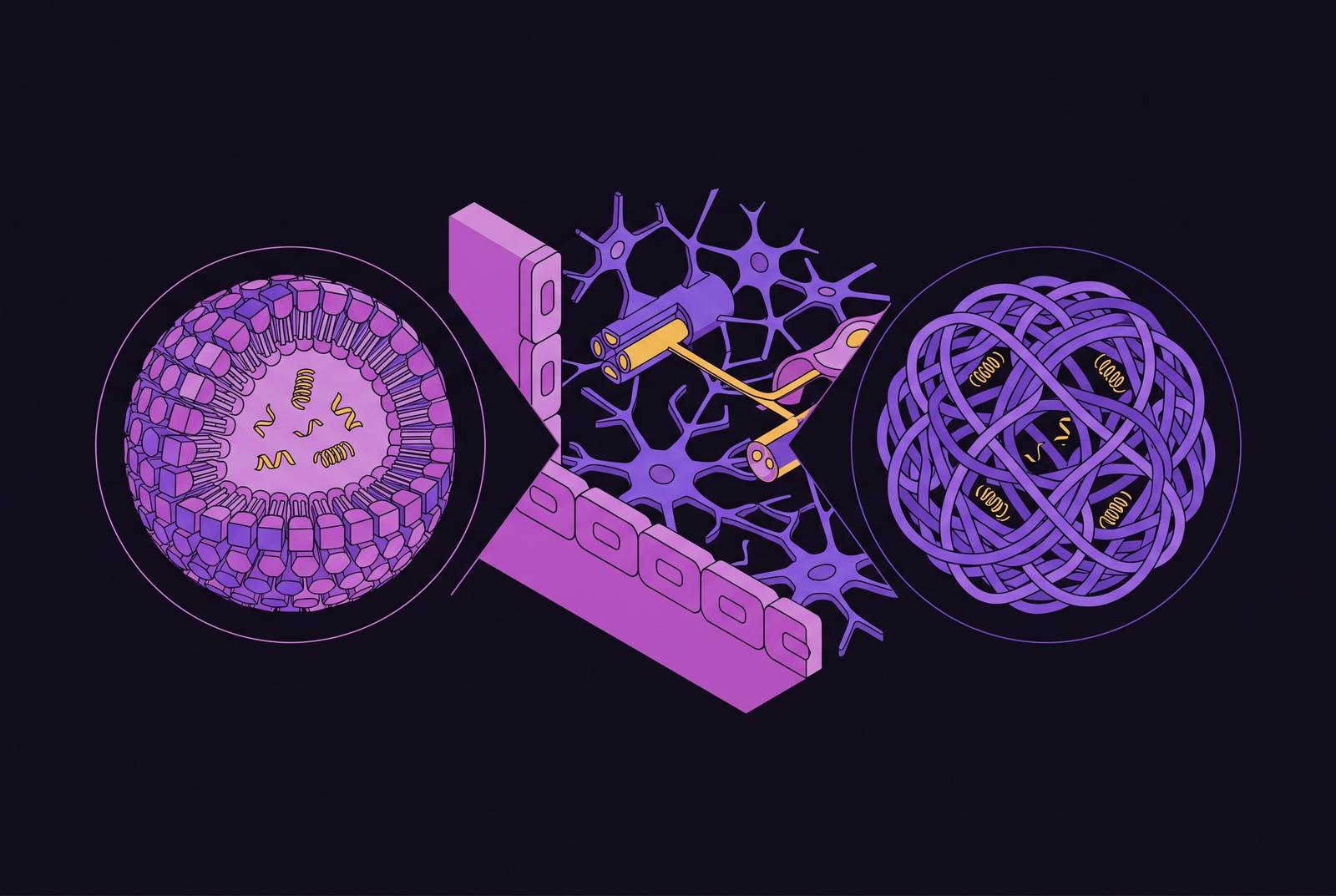
Getting a peptide across the blood-brain barrier is the central bottleneck in CNS drug development, and it explains why so much of the field's recent energy has shifted from molecule design to delivery vehicle design. This piece looks at two nanocarrier platforms built to solve that problem, lipid nanoparticles and polymeric nanoparticles, and asks what each one is actually good at when the cargo is a peptide instead of a small molecule or a strand of mRNA.
The blood-brain barrier is the foundational constraint that shapes nearly everything about how CNS drugs get designed, tested, and eventually abandoned. It's the foundational constraint that shapes nearly everything about how CNS drugs get designed, tested, and eventually abandoned. Nearly all large-molecule neurotherapeutics and the overwhelming majority of small-molecule drugs simply don't cross it at meaningful concentrations. Peptides sit at the harder end of that spectrum, and for reasons that compound rather than add: they get chewed up by enzymes in the bloodstream, cleared by the kidneys faster than most small molecules, and then, if any survive that gauntlet, actively pumped back out by efflux transporters sitting right at the barrier. CNS drug development carries notably high late-stage failure rates, and delivery failure alongside bad target biology are among the key drivers of that number. A drug can hit its receptor perfectly in a dish and still fail in a patient because it never reached the tissue where the receptor lives.
GLP-1 peptides make the point concrete. Preclinical work on modified GLP-1 peptides shows only very limited brain penetration following systemic administration, and the tension is structural: the same modifications that extend plasma half-life and clinical utility tend to increase molecular size and binding interactions in ways that limit CNS entry. So if systemic circulation can't be trusted to ferry a peptide into the CNS, the question stops being about the peptide. It becomes a question about the vehicle. The nanocarrier's architecture, quite literally, becomes the therapy.
What lipid nanoparticles do well with peptide cargo
Lipid nanoparticles are built from four components, an ionizable lipid, a phospholipid, cholesterol, and a PEG-lipid, and they self-assemble into a particle whose behavior is dictated almost entirely by that lipid mix. Get the ratios right and the particle does something genuinely elegant. Ionizable lipids stay neutral at physiological pH but become charged in the acidic environment of an endosome. That pH-dependent shift is thought to promote interaction with the endosomal membrane in ways that may allow the payload to escape into the cytoplasm before it gets degraded, though the precise mechanism is still an area of active study. This is endosomal escape, and it's a trick polymeric systems don't replicate on their own.
LNPs also pack in nucleic acid cargo with high efficiency, penetrate tissue better than free drug, and, in well-optimized formulations, show low toxicity and low immunogenicity. The COVID-19 mRNA programs proved out LNP performance at a scale nobody had attempted before, and that success pulled in a wave of downstream investment. According to Patsnap Eureka, more than 30 LNP-based products are now in clinical trials for applications beyond vaccines. That's a real number, and it reflects real regulatory familiarity: multiple approved LNP products have established a meaningful degree of regulatory familiarity for this class of carriers.
None of that translates cleanly to peptides, though. The chemistry that makes ionizable lipids so effective at binding nucleic acids doesn't bind peptides nearly as well, so encapsulation efficiency for macromolecular peptide and protein cargo tends to run low. Liposomes and lipid carriers built around a fluid bilayer are also prone to premature drug leakage, so the payload can slip out before it reaches its destination. Add in the fact that these formulations often struggle to hold up under storage and under the physiological stress of circulation, and a formulator ends up staring at a real tradeoff. What happens when the platform that's best at getting past one barrier (the endosome) is structurally weak at holding onto the cargo it's supposed to protect?
That question sets up the next platform.
What polymeric nanoparticles offer beyond lipid systems
Polymeric nanoparticles trade the fluid lipid shell for a solid matrix, usually built from PLGA, PLA, chitosan, or a PEG-block copolymer. That structural rigidity is the source of both their strength and their limits.
PLGA is the dominant clinical platform in this category, and for good reason. It's biodegradable, biocompatible, and already approved for parenteral and implantable use, which gives formulators a well-trodden regulatory path. What makes PLGA especially useful for peptide delivery is that its degradation rate can be tuned just by adjusting the ratio of lactic acid to glycolic acid, and by adjusting molecular weight. That ratio is a direct lever on how fast the drug gets released, which is a level of control a lipid bilayer simply doesn't offer. The peptide sits protected inside a matrix that erodes on a predictable timeline, rather than sitting inside a fluid compartment that's prone to leaking under the wrong conditions.
Polymeric micelles are a related but distinct design: amphiphilic block copolymers self-assemble into a structure with a hydrophobic core, good for solubilizing poorly water-soluble drugs, wrapped in a hydrophilic corona that gives the particle steric stability and extends how long it circulates. Dendrimers offer yet another architecture, built from branched polymers with a large, highly functional surface area that's well suited to displaying multiple targeting ligands at once.
But polymeric systems have their own gap, and it sits right where LNPs are strongest. Without the membrane-interaction properties of a lipid shell, polymeric nanoparticles typically show lower cellular uptake efficiency than lipid-based carriers. Some polymers also carry cytotoxicity concerns that demand careful material selection up front. The workaround is surface functionalization: conjugating peptide ligands onto the particle surface to increase interaction with lipid bilayers and improve penetration across the blood-brain barrier. That fix works, but it also means particle size, surface chemistry, and biodegradability all become variables that have to be tuned together, not separately. And the translational path isn't free of friction either. Synthesis variability, the enzymatic instability of surface-conjugated peptides, and inconsistent scale-up all remain real barriers for peptide-functionalized polymeric particles moving toward the clinic.
The intranasal route as a shared opportunity, and a shared obstacle course
Both platforms converge on the same delivery route for a reason that has nothing to do with lipids or polymers and everything to do with anatomy. The olfactory and trigeminal nerves connect the nasal cavity directly to brain tissue. A nanocarrier delivered intranasally can reach the CNS by bypassing the blood-brain barrier. It's a non-invasive route, and it does something systemic injection structurally cannot.
Three transport mechanisms compete for the payload once it's in the nasal cavity: direct transport along olfactory and trigeminal axons, systemic absorption followed by partial re-entry into the CNS, and lymphatic drainage. Which pathway dominates depends heavily on particle size, surface charge, and formulation, and that's part of why nanocarrier design matters so much here.
The nasal cavity, though, is not an easy place to deliver anything. Mucociliary clearance sweeps particles toward the nasopharynx before they get a chance to be absorbed. Enzymes in the nasal mucus degrade peptides fast, and peptides, again, are especially vulnerable to this kind of degradation. The olfactory epithelium offers only a short window for absorption before clearance mechanisms take over, and the mucus layer itself, along with tight junctions between epithelial cells, forms a physical barrier that a bare peptide has almost no way to get through.
This is why encapsulation isn't optional for peptide cargo delivered this way. A nanocarrier protects the peptide from enzymatic attack in the mucus, and surface engineering, mucoadhesive polymers or specific surface charges, extends how long the particle sits on the epithelium before it's cleared. Nanoscale size opens up mucosal penetration pathways that bulk particles simply can't access, and controlled release can stretch CNS exposure out past that narrow initial absorption window.
The data backs this up. Preclinical studies comparing nanocarrier-encapsulated peptides to free peptide delivered intranasally consistently show that the carrier formulation produces measurable brain concentrations while unencapsulated peptide often fails to reach the brain at detectable levels. That gap is the whole argument for nanocarrier-mediated intranasal delivery.
How each platform performs against the nasal-to-brain design requirements
Given those obstacles, mucoadhesion and residence time on the epithelium, protection from enzymatic degradation, efficient uptake across the epithelial layer, and controlled release, how do LNPs and polymeric nanoparticles actually stack up?
On mucoadhesion, polymeric systems have a structural edge. Chitosan-coated particles, for instance, carry a cationic surface charge that binds electrostatically to the negatively charged mucus layer, extending residence time as a built-in property of the material rather than an add-on. LNPs can be surface-modified to achieve something similar, but mucoadhesion isn't native to lipid chemistry the way it is to chitosan; it has to be engineered in as an extra layer.
On protecting the peptide from nasal enzymes, the polymeric matrix has a similar physical advantage. It sequesters the peptide, and release is governed by how the matrix erodes rather than by diffusion through a fluid bilayer that can leak prematurely under enzymatic or osmotic stress. LNPs rely on the lipid bilayer itself for protection, and that bilayer is more vulnerable to exactly the kind of stress the nasal mucosa puts it under.
On membrane fusion and getting across the epithelial surface, the advantage flips. LNPs' lipid shell allows them to interact with epithelial membranes through mechanisms that may reduce dependence on receptor-mediated endocytosis, which is a potential edge at this specific barrier. Polymeric particles need surface functionalization, receptor-targeting ligands or cell-penetrating peptides, to get anywhere close to that same uptake efficiency.
On controlled release for sustained CNS exposure, PLGA's degradation kinetics can be tuned to release peptide over hours or even days, which matters enormously for chronic CNS conditions where sustained receptor occupancy is the goal rather than a single spike. LNPs tend to release their payload relatively rapidly following endosomal escape, which makes them less inherently suited to sustained exposure unless the formulation gets reworked specifically for that purpose.
One preclinical result captures what happens when a formulation borrows from both sides of this ledger. Intranasal rotigotine delivered in a lecithin-chitosan hybrid nanoparticle improved brain availability 7.86-fold and peak brain concentration 3.84-fold compared to a nasal suspension, with 97.3% of the dose reaching the brain through direct nose-to-brain transport rather than systemic circulation. That hybrid lipid-polymer system achieved a result that the hybrid architecture was designed to capture advantages that neither a pure lipid nor a pure polymeric formulation offers simultaneously.
Charge matters across both platforms, too. Positively charged particles are drawn toward the negatively charged surface of nasal epithelial cells, which is part of why ionizable lipid pKa tuning on the LNP side, and chitosan surface charge on the polymeric side, both function as formulation levers pointed at the same underlying physics.
Lipid-polymer hybrid nanoparticles as a design response to the tradeoff
The rotigotine result comes from a lecithin-chitosan hybrid nanoparticle that combines lipid and polymeric components, pairing the two material classes so that each one's strength offsets the other's weak point. It's what happens when lipid and polymer components are combined on purpose, and the combination is designed to cancel out each platform's weak point using the other platform's strength.
The architecture is straightforward to describe: a polymer core gives the particle mechanical stability and lets formulators build in controlled release, while a lipid shell wrapped around that core restores biocompatibility, boosts cellular uptake, and brings back the fusogenic behavior that pure polymeric particles lack. The polymer core addresses a key peptide-delivery weakness of LNPs, premature leakage, by physically containing the cargo rather than trusting a fluid bilayer to hold it. The lipid shell, meanwhile, solves the uptake problem that plagues bare polymeric particles.
There's a third benefit that shows up specifically at the nasal epithelium: positively charged lipid-polymer hybrids have been speculated to transiently influence epithelial tight junctions, on top of their mucoadhesive properties, which together may boost uptake at exactly the barrier where a nanocarrier needs it most.
Research on this architecture (documented in PMC12197309) frames it as a smart drug delivery system built specifically for peptide and protein cargo, and that framing makes sense once you see why. Neither the lipid platform nor the polymeric platform fully solves the encapsulation-stability-uptake triad by itself. A hybrid at least has a shot at solving all three at once. Formulators can go a step further and add surface-conjugated targeting ligands on top of the hybrid structure, building a multi-layer particle: polymer core, lipid shell, and a targeting ligand on the outside.
None of this comes free. Two-material systems mean tighter process control during manufacturing, and batch-to-batch reproducibility remains an active challenge across the field. The regulatory pathway for hybrids is also less established than for either lipid or polymeric platforms on their own, simply because there's less precedent to point to. So while the rotigotine data shows what's achievable, getting there consistently at manufacturing scale is a separate, harder problem.
Where GLP-1 peptide delivery fits into this platform map
GLP-1 receptors show up throughout the CNS, on neurons, on glial cells, and on components of the neurovascular unit, which gives GLP-1 a biological rationale for CNS targeting that goes well beyond metabolic disease. But biological rationale and deliverability are two different things, and GLP-1 illustrates the gap about as clearly as any molecule in this space.
The peptides modified for metabolic use carry structural features, fatty acid chains and albumin-binding modifications, specifically engineered to extend how long the drug stays in plasma. Those same features make the molecule too large and too lipophilic to passively diffuse across the blood-brain barrier. The same tension flagged in the opening section appears again in a specific therapeutic context.
Intranasal nanocarrier delivery is mechanistically relevant here for a fairly direct reason: it avoids the albumin-binding trap by skipping systemic circulation. Direct transport along olfactory and trigeminal pathways can deliver peptide straight to GLP-1 receptor-expressing brain regions without requiring the peptide to cross the barrier.
Matched against the platform tradeoffs already laid out, GLP-1 peptides are in a spot that favors polymeric or hybrid systems more than pure LNPs. They're macromolecular cargo, which is precisely the category where LNP encapsulation efficiency runs weakest and polymeric matrix encapsulation runs strongest. Chronic CNS indications, neurodegeneration and addiction chief among them, call for controlled release over hours or days rather than a fast payload dump, which again favors polymeric or hybrid architectures over a standard LNP. The fusogenic uptake advantage LNPs bring at the nasal epithelium doesn't disappear from this picture, though. It just shifts role, becoming a component folded into a hybrid design rather than the entire solution on its own.
Researchers are actively looking at CNS GLP-1 delivery in Alzheimer's disease, Parkinson's disease, and addiction and substance use disorders, and all three involve brain regions that are, at least in principle, reachable through olfactory pathways. The clinical picture so far is mixed enough to be genuinely instructive. The ELAD trial, which tested liraglutide in 204 participants with mild-to-moderate Alzheimer's disease, found no significant difference on its primary outcome, but did detect a signal of reduced hippocampal atrophy, on the order of 0.25 standard deviations. What should a reader make of a null primary result sitting next to a modest structural signal? One reasonable reading is that the biology may be doing something real, just not enough of it is reaching the tissue that matters. That's a delivery problem sitting right alongside a biology problem, and better CNS exposure, achieved through nanocarrier-mediated intranasal delivery, might change that picture. That's a hypothesis to test against the data, not a solution anyone can claim outright yet.
The broader nanomedicine targeting problem and platform selection
Looking beyond CNS peptides specifically, the numbers across nanomedicine as a whole are humbling. A widely cited benchmark from cancer nanomedicine research put the average fraction of administered nanocarriers that actually reach their intended target site at just 0.7%. That's not a typo, and it's not specific to one bad formulation. Immune clearance picks off particles in circulation, nonspecific uptake by tissues other than the target absorbs another chunk, endosomal degradation destroys payload that does make it into cells, and cellular efflux pumps out whatever survives that far.
That 0.7% figure comes from cancer nanomedicine, not CNS peptide delivery specifically, so it shouldn't be read as a direct measurement of what LNPs or polymeric particles achieve via the intranasal route. But it's a useful reminder of just how much can go wrong between injection (or, in this case, intranasal administration) and the moment a peptide actually engages its receptor. Every design choice discussed in this piece, ionizable lipid chemistry, PLGA erosion rate, chitosan surface charge, hybrid shell composition, is an attempt to close some fraction of that gap. None of them close it fully. And given how differently LNPs and polymeric systems perform against the encapsulation, stability, uptake, and controlled-release requirements laid out here, no single platform looks likely to be the universal answer for peptide delivery to the CNS. Platform selection, at this point, looks less like picking a winner and more like matching a specific peptide's failure mode, leakage, poor uptake, short residence time, whatever it happens to be, to the platform architecture built to compensate for it.
Sources
- Comparison of Lipid Nanoparticles vs Polymer Carriers
- Lipid-Polymer Hybrid Nanoparticles as a Smart Drug Delivery System for Peptide/Protein Delivery
- Lipid-Polymer Hybrid Nanoparticles as a Smart Drug Delivery System for Peptide/Protein Delivery - PMC
- Intranasal Polymeric and Lipid-Based Nanocarriers for CNS Drug Delivery - PMC
- researchgate.net