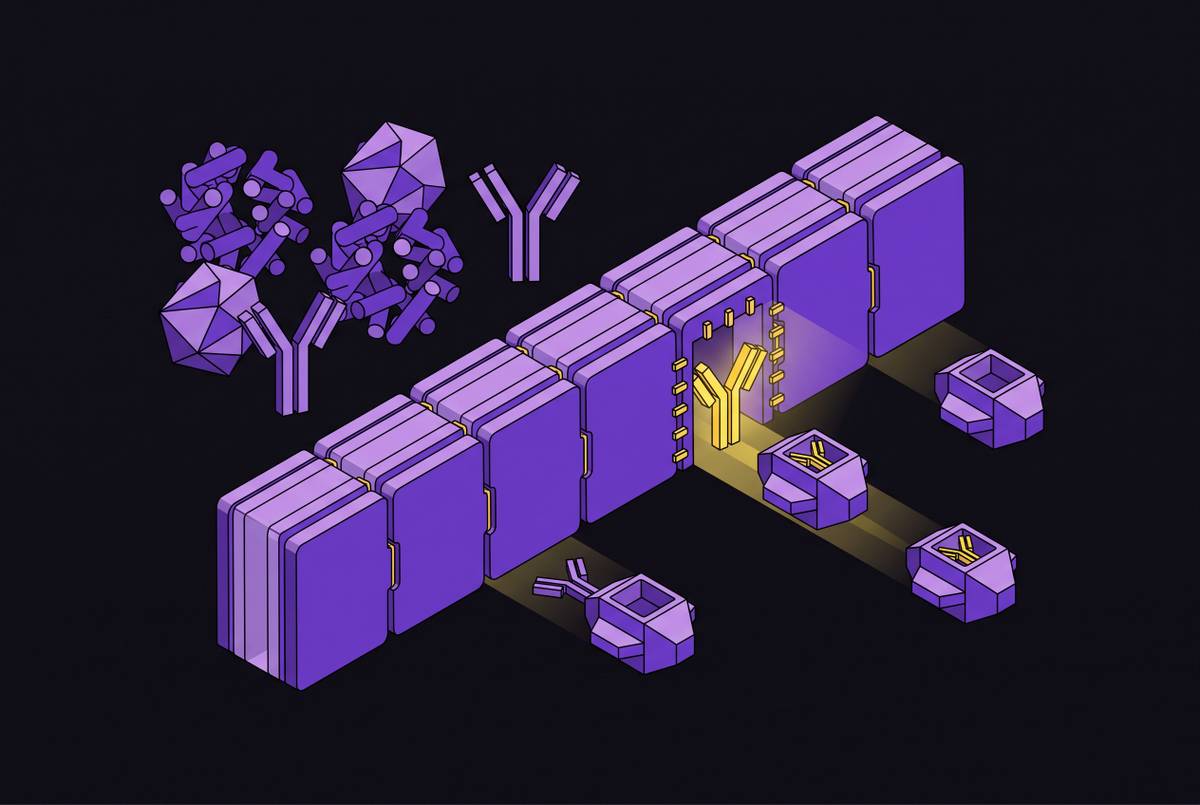
Oral GLP-1 Delivery Platforms and the Bioavailability Problem
Oral GLP-1s work around fundamental biology by accepting near-total losses at the gut barrier.
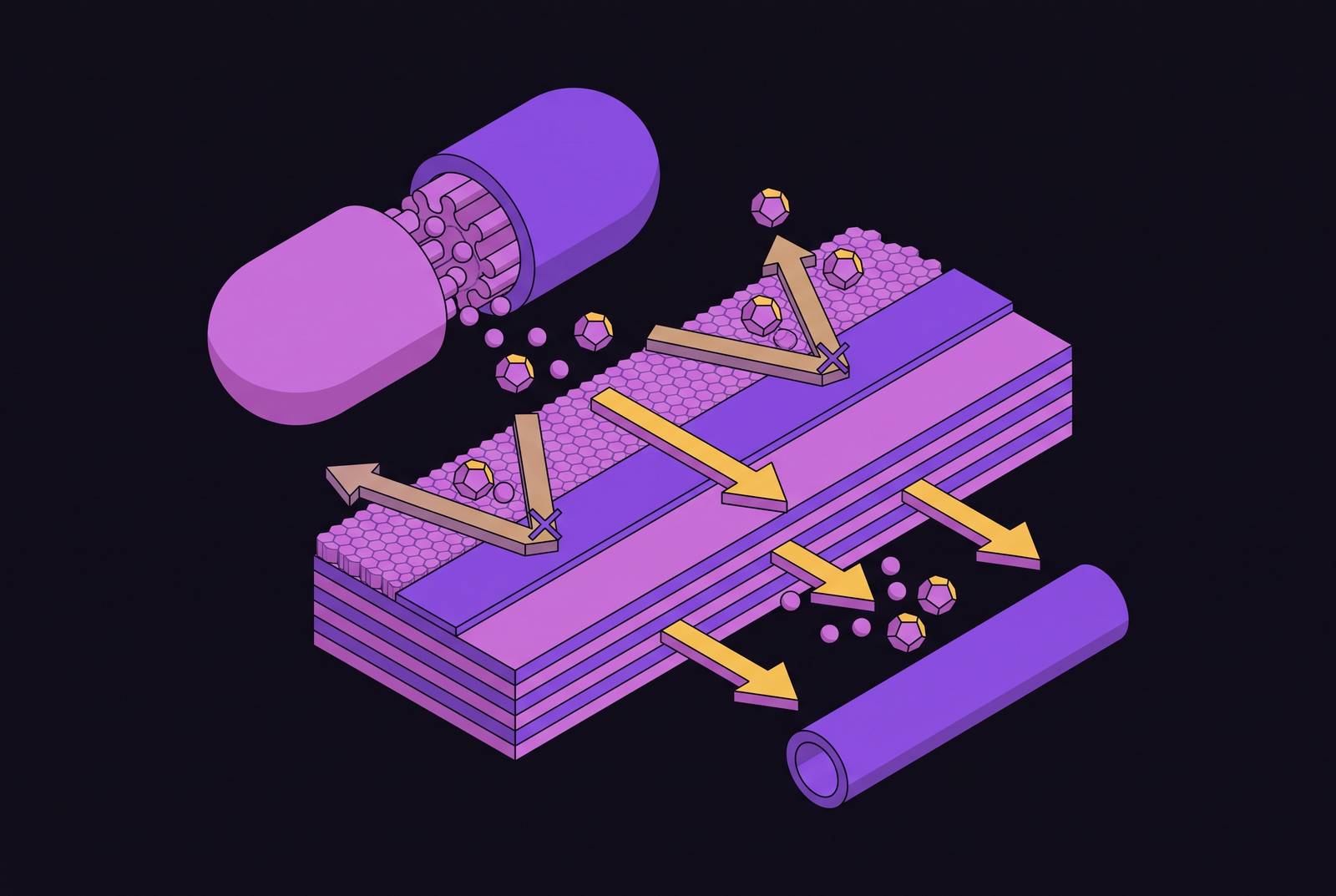
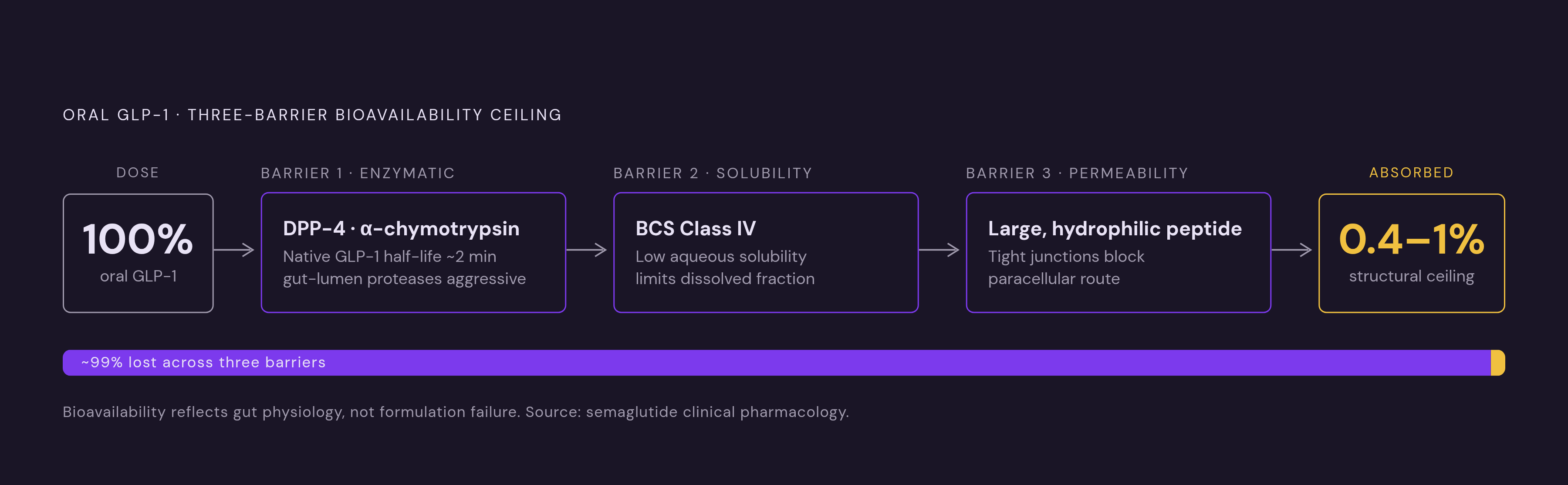
Oral GLP-1 delivery is possible now, but every version of it works around the same unforgiving biology, and understanding that biology is what separates a genuine engineering advance from a marketing claim. The starting fact is almost absurdly small: the body's own GLP-1 has a plasma half-life of roughly 2 minutes due to rapid degradation by DPP-4.
Getting a peptide from mouth to blood means clearing three separate barriers, and they don't yield to the same fix. There's enzymatic attack, first from DPP-4, then from gut-lumen proteases like α-chymotrypsin that are frankly more aggressive there than anywhere else in the body. There's permeability: GLP-1 peptides are large and hydrophilic, tight junctions block the paracellular route between cells, and the transcellular route through cells demands a lipophilicity these molecules simply don't have on their own.
Regulatory science has a shorthand for this kind of compound. Oral semaglutide behaves like a BCS Class IV molecule, saddled with low solubility and low permeability at the same time, not one problem to solve but two running in parallel. Add in the receptor's own reach, GLP-1R sits on pancreatic beta cells, hypothalamic neurons, gastric tissue, and peripheral organs, and shows up in brain regions including the hippocampus, frontal cortex, and substantia nigra, and you start to see why researchers treat this molecule with some caution rather than as a simple drug to reformulate. Given all that, oral semaglutide's absolute bioavailability of 0.4%–1% is not a failure of ambition, it is what the GI barrier actually allows a peptide even after aggressive formulation engineering Grand challenges in oral drug delivery. It's close to the ceiling the gut imposes on a peptide of this size and chemistry, even with aggressive formulation work behind it Grand challenges in oral drug delivery. Frontiers in Drug Delivery reports that the mucus layer adds a diffusion barrier before the epithelium is even reached, and that neutral or small particles (sub-100 nm) navigate it more effectively. Engineering responses to DPP-4 degradation in the injectable era included fatty acid acylation, D-amino acid substitution at position 2, and PEGylation, each extending half-life but not solving oral absorption.
What the first approved oral GLP-1s proved (and what they didn't)
The commercial results arrived fast. The oral tablet launched in early January 2026 and brought in roughly $355 million in its first quarter alone, on 1.3 million prescriptions meddeviceonline.com. By mid-2026 the combined oral obesity franchise had crossed 3 million prescriptions meddeviceonline.com. But the number that actually matters for understanding the market isn't revenue, it's composition: about 80% of oral semaglutide users were new to GLP-1 therapy altogether, not people switching off an injection pen meddeviceonline.com. That's a signal about the disease, not just the drug. Route of administration was gating who got treated in the first place, and fixing the needle barrier opened access rather than just shuffling existing patients between formats.
None of that happened by accident, and it didn't happen for free. SNAC, or sodium N-[8-(2-hydroxybenzoyl)amino]caprylate, is the absorption enhancer co-formulated with semaglutide, and it works by protecting the peptide from enzymatic breakdown in the stomach while nudging it across the stomach wall through the transcellular route. That ratio has a name in manufacturing: call it a tax. Every milligram that actually gets absorbed requires something like a hundred milligrams synthesized, purified, and formulated upstream. That math works for one blockbuster peptide with the commercial scale to absorb the cost. It is not a template anyone can casually extend across a pipeline.
What's striking is that this tiny bioavailability turned out to be plenty for outcomes that matter well beyond the scale. How little drug actually needs to cross the gut wall to do meaningful clinical work is apparently sufficient for a cardiovascular endpoint.
Still, plenty was left unresolved. The tablet has to be taken fasted, which limits convenience in exactly the way a pill is supposed to avoid. And there's a preclinical signal, still uncertain, that repeated high local concentrations of SNAC might cause reversible micro-injury to the epithelium over time, a question nobody has closed out yet. More consequential for the field: SNAC is a stomach-dependent mechanism, and it does not transfer to monoclonal antibodies, mRNA, siRNA, or most of the other biologics moving through development pipelines right now. Meanwhile the other approved oral route, the small-molecule agonist orforglipron, works by being orally bioavailable by design from the molecule up, a route structurally closed to any peptide of meaningful size. Two approvals, two completely different engineering solutions, and neither one generalizes to the next molecule in line. That's the real setup for everything that follows. Absolute bioavailability of 0.4%–1% reached clinical weight-loss endpoints (16.6% weight reduction among adherent patients in OASIS-4, per MedDevice Online) by delivering roughly 25–30× the injected dose (Grand challenges in oral drug delivery). Cardiac outcome evidence from the SOUL trial confirmed oral semaglutide reduced MACE with a hazard ratio of 0.86 (14% reduction) in high-risk adults with T2D (per Frontiers), establishing that bioavailability at 0.4%–1% is sufficient for cardiovascular endpoints (Grand challenges in oral drug delivery).
The adherence argument for oral delivery (and why it reframes the competitive stakes)
Multiple claims-based analyses find that close to half of patients on injectable GLP-1s discontinue within 12 months. Tolerability, cost, and the burden of self-administration all feed into that dropout rate, and nausea sits at the center of tolerability.
But the adherence story runs wider than needle aversion alone. Injectable therapy comes bundled with cold-chain storage requirements, dose-escalation schedules that keep pulling patients back into clinical contact, and a self-administration burden that compounds over years, sometimes decades, of ongoing therapy. Preference for oral routes isn't a soft, marginal thing patients might mention in a survey. It's structural: oral administration is more accessible and sidesteps the complications and costs tied to injectables, some of which need a healthcare professional just to administer.
That 80% new-patient figure from the tablet's launch takes on its full weight here meddeviceonline.com. Needle aversion wasn't just nudging existing patients toward dropout, it was suppressing the move from diagnosis to treatment in the first place, keeping people who needed therapy from ever starting it. Which raises the real question for anyone watching this space: where does value actually get captured in a chronic disease? Not at the moment of prescription. It's captured across the persistence curve, over months and years of a patient staying on therapy, and a delivery platform that trims dropout by even a modest margin compounds into outsized lifetime value across a population this large. Every tradeoff discussed in the sections that follow, SNAC's ceiling, the small molecule's constraints, the two-tier lipid systems, carries consequences that are commercial as much as they are pharmacological. Nausea and GI side effects are the dominant tolerability driver, with pooled safety data from semaglutide trials in adults ≥65 showing GI events in 44.6%–73.8% of patients and discontinuation rates of 9.3%–12.4% in older adults vs. 5.7%–8.7% in younger populations (per MDPI).
SNAC-assisted peptide tablets: where the absorption enhancer approach stalls
SNAC does its work in the stomach, not the intestine. It raises local pH, cuts down on peptide aggregation, and transiently opens a transcellular absorption pathway through stomach wall epithelium, and none of that overlaps with how intestinal permeation enhancers operate. That's precisely why the fasting requirement isn't negotiable: food dilutes SNAC and shifts the local conditions before the drug ever gets its narrow absorption window. Take away the empty stomach and the mechanism doesn't have anywhere to work.
Within that narrow scope, SNAC earns its keep. It cuts down enzymatic exposure to DPP-4 and pepsin in the stomach, and it opens a transient bump in permeability, just enough for a small fraction of the peptide to cross before the window closes. The dose amplification required to hit therapeutic levels anyway carries the manufacturing consequences already laid out, and epithelial integrity, high local concentrations of both drug and enhancer, a preclinical signal of reversible micro-injury, remains open enough that nobody can wave it off in a therapy meant to run for years.
There is also a molecule-specificity wall. Semaglutide's particular size, charge, and acylation pattern happen to line up well with how SNAC behaves, but that fit doesn't transfer automatically. Apply SNAC to a different peptide and the whole optimization has to start over, more or less from scratch. A PatSnap patent landscape observation notes that FDA approval of oral semaglutide for T2D is already cited as prior art in recent patent filings, showing the field has internalized SNAC as one solved case, not a solved category.
None of that diminishes what SNAC accomplished. It remains the most clinically validated oral peptide delivery approach that exists today, and its limits are well mapped rather than mysterious. Ironically, that clarity is exactly what pushed other engineering teams to stop trying to stretch SNAC further and start building something structurally different instead. What SNAC does not overcome is addressed next. The 0.4%–1% bioavailability ceiling is structural.
Small-molecule GLP-1R agonists: the route that bypasses peptide chemistry entirely
One way around the whole absorption-enhancer approach is to not need one. Small-molecule GLP-1R agonists are non-peptide compounds designed from the start to be orally bioavailable, with the chemistry built around that goal rather than bolted on afterward as a formulation fix. Patent filings covering phenyl and pyridinyl ring structures with halogen, cyano, and alkyl substituents mark out a distinct intellectual-property space here, and the pattern is telling: oral bioavailability is the design target from the first molecule sketched, not a workaround discovered after the fact Frontiers in Drug Delivery.
That approach buys real advantages. What it can't promise yet is pharmacological parity. The structural changes that make a molecule small enough and lipophilic enough to survive the gut also constrain how it behaves at the receptor, and these newer entrants working through trials have not yet shown they replicate the full signaling profile of peptide agonists across every clinical endpoint.
The pipeline behind the two approved molecules has gotten crowded fast, with oral semaglutide behaving like a compound with both low solubility and low permeability, not just one problem but two simultaneously. One manufacturer discontinued its earlier small-molecule candidate, danuglipron, over safety concerns in April 2025, then re-entered the space in November 2025 through a roughly $7 billion acquisition, with contingent milestones potentially pushing the total toward $10 billion Frontiers in Drug Delivery. AstraZeneca has AZD5004 moving through earlier development, alongside Regor Therapeutics' RGT-075 and other candidates further back in the pipeline. Viking Therapeutics is preparing to start Phase 3 trials of an oral tablet version of VK2735 in the fourth quarter of 2026, aiming to be first to bring a dual GLP-1/GIP agonist to market in oral form, while also continuing an injectable version of the same molecule in parallel. Roche has CT-996, an oral candidate that came out of its Carmot Therapeutics acquisition for $2.7 billion, now in Phase 2 with a potential market entry projected around 2029.
That breadth of activity points toward a genuinely open question. Can small-molecule chemistry replicate that same multi-receptor pharmacology while staying oral? Nobody has closed that question out yet, as these programs mature. What's already clear, though, is that this route stays closed to the wider biologic pipeline, antibodies, mRNA, siRNA, larger peptides, none of it fits inside a small molecule's chemistry, so success here doesn't remove the need for formulation platforms built for those other molecule classes. Pipeline breadth extends beyond the two approved molecules. The multi-receptor frontier of dual GLP-1/GIP agonists and triple GLP-1/GIP/glucagon agonists (e.g., retatrutide, which peptidejournal.org reports achieved up to 28.7% weight loss in Phase 3) raises the question of whether small-molecule design can capture the same multi-receptor pharmacology, still an open engineering and clinical question.
Lipid-based formulations and enteric capsule two-tier systems: a platform approach to the intestinal barrier
Step back and a pattern becomes obvious across everything discussed so far: the GI barrier isn't a single wall, it's several barriers stacked one after another, and a strategy built around just one mechanism, a permeation enhancer alone, an enteric coating alone, only ever solves one layer while leaving the rest of the sequence untouched. That's the insight behind a different kind of platform, one that treats the problem as a series rather than a single obstacle to clear.
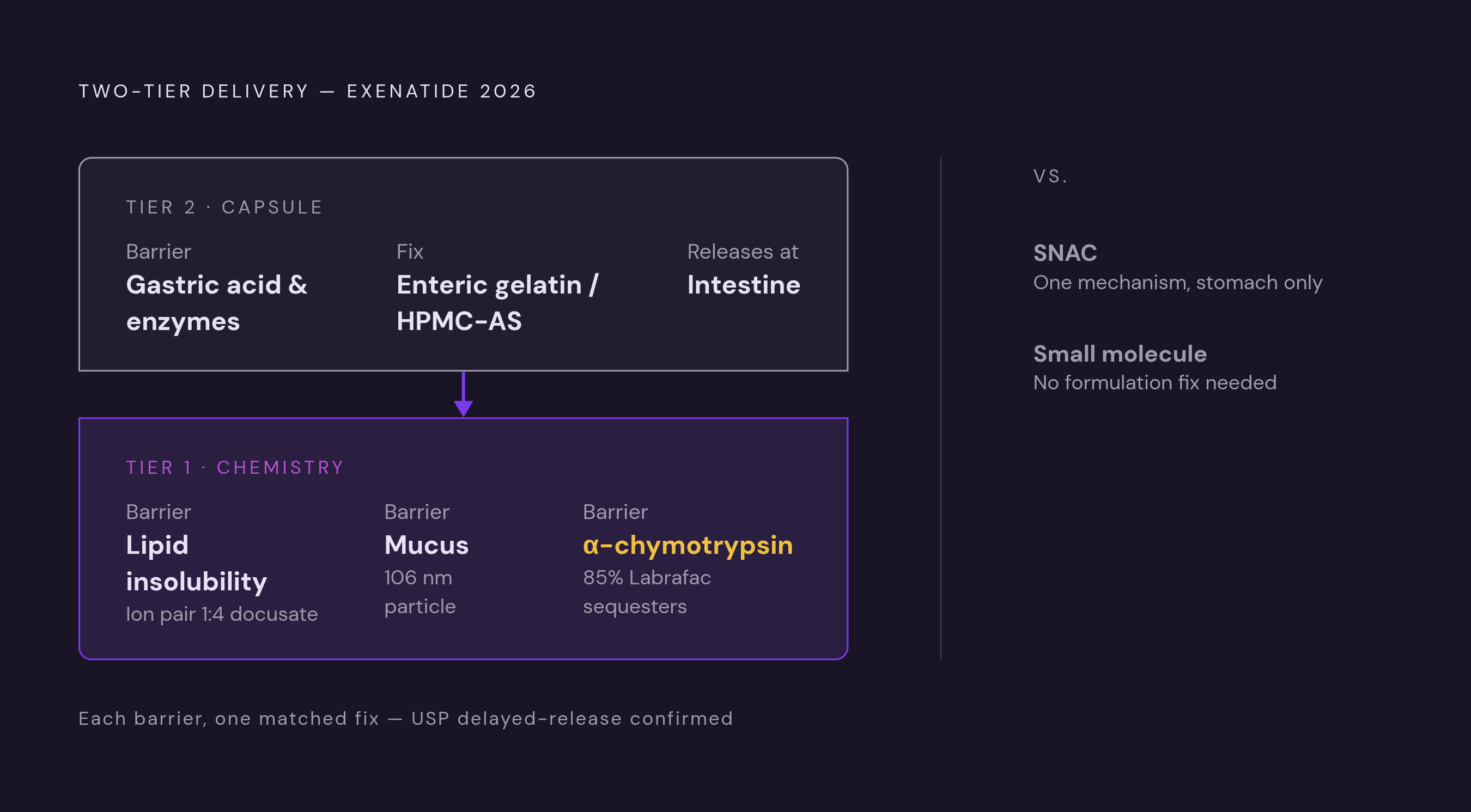
A 2026 proof-of-concept study built exactly that kind of layered system for exenatide, and the engineering detail shows how each barrier gets a distinct, matched response. The first tier uses hydrophobic ion pairing, pairing exenatide with sodium docusate at a 1:4 molar ratio to make the peptide lipophilic enough to dissolve into a lipid carrier, directly addressing the hydrophilicity that normally keeps peptides out of lipid-phase formulations entirely. Testing found meaningful protection against α-chymotrypsin degradation, consistent with the peptide staying sequestered inside lipid droplets where the enzyme simply can't reach it.
The second tier is an enteric capsule, built from gelatin and HPMC-AS, engineered to shield the lipid formulation from gastric enzymes and stop the gastric fluid from prematurely diluting it, a failure mode that would strip the peptide out of its protective lipid environment before it ever reached the intestine. The capsule releases its contents, both the ion-paired peptide and the permeation enhancers, right at the intestinal absorption site, and it met USP delayed-release requirements in testing. Line this up against the SNAC and small-molecule routes discussed earlier, and the design logic reads differently. Rather than picking one barrier and engineering hard against it, this platform assigns a distinct fix to each layer in sequence, chemistry for hydrophilicity, lipid carrier for enzymatic exposure, particle size for mucus penetration, capsule for gastric survival, which is arguably the more honest response to a barrier that was never really one problem to begin with. An optimized lipid-based formulation of 85% Labrafac™ MC60, 10% Kolliphor® RH40, and 5% propylene glycol, with a final particle size of 106 nm, was loaded with 6 mg/g solubilized EXE-HIP and 20 mg/g sodium caprate as a complementary permeation enhancer. Labrafac™ MC60 is a medium-chain fatty acid lipid excipient known to promote intestinal permeability, and a 106 nm particle size was selected to improve mucus penetration.
Sources
- A two-tier protection strategy for oral delivery of GLP-1 peptides: lipid-based formulation combined with enteric capsules - PMC
- Frontiers | A two-tier protection strategy for oral delivery of GLP-1 peptides: lipid-based formulation combined with enteric capsules
- Engineering Medical Devices To Improve Oral Delivery Of Biopharmaceuticals
- Grand challenges in oral drug delivery
- Oral GLP-1-Based Therapeutics in the Obesity–Metabolic Syndrome–Diabetes Continuum: Translational Advances, Clinical Barriers, and Emerging Strategies
- Oral vs. injectable GLP-1 therapies: patent landscape | PatSnap
- Oral GLP-1-Based Therapeutics in the Obesity–Metabolic Syndrome–Diabetes Continuum: Translational Advances, Clinical Barriers, and Emerging Strategies - PMC