Subcutaneous Auto-Injector Design and Its Adherence Ceiling
The handheld auto-injector hits its limits with larger, thicker drugs.

An auto-injector solves a specific, narrow problem well: it takes the skill and hesitation out of pushing a needle into your own skin. Mechanically, the device is a spring-loaded syringe housed in a casing that automates two motions a patient would otherwise have to perform by hand, needle insertion and plunger depression, triggered by a single activation step. That automation reduces operator-dependent variability in injection conditions, so the outcome of the injection depends less on who is performing it. Consistent penetration depth reduces operator-dependent variability in injection conditions, which means the drug lands in the same tissue layer every time, regardless of whether the person holding the device is confident, shaky, or injecting themselves for the first time. The dose is preloaded and fixed, so accuracy is not something the patient has to get right on their own, and across a wide range of disease areas, patients on chronic self-administered therapy have consistently preferred this format over drawing up a manual syringe.
None of that is a small thing. Removing the confidence barrier around self-injection is a genuine engineering win, one that has let care move out of clinics and into kitchens and bathrooms and bedrooms, on the patient's own schedule. But the same spring-loaded architecture that makes the device simple to use also defines what it can never do. An auto-injector delivers one preloaded dose in one rapid injection event. There is no titration, no adjustable rate, no way to slow the bolus down or split it into a variable infusion. The needle is not incidental to the mechanism, it is the mechanism: the device physically cannot activate without subcutaneous penetration, so needle exposure is not a design choice that could be engineered away in a future revision, it's structural to the category. And because the drug and the device are sold and used as a single unit, the formulation itself has to survive and perform inside that one specific container-closure system for the life of the product. A 2023 industry review in Drug Development & Delivery found that high-viscosity or large-volume biologics require devices configured for much higher delivery forces or considerably longer injection times: the standard handheld auto-injector was built around small-volume, fast-bolus delivery, and that constraint doesn't bend just because the drug pipeline behind it keeps getting more ambitious.
The formulation and volume wall that handheld auto-injectors run into
So what happens when a biologic needs more volume or more viscosity than that architecture allows? The industry's own answer reveals how hard the ceiling actually is. Handheld auto-injectors are limited to small-volume, rapid bolus injections, and delivering large volumes or high-viscosity biologics subcutaneously remains a genuinely hard problem for conventional device formats, not a solved one waiting for a minor tweak. As biologic doses climb, driven by more complex molecules and higher therapeutic thresholds, the handheld auto-injector doesn't scale gracefully. It hits a wall.
The industry's workaround is telling. Rather than push the handheld format further, manufacturers have moved toward on-body wearable injectors that can deliver volumes exceeding 5 to 20 mL directly from the patient's skin over an extended period. A wearable injector is not an improved auto-injector; it is a different device category entirely, with its own adhesive patch, its own extended wear time, and its own user experience. The existence of that separate category is itself an admission that the handheld format cannot be stretched to cover the growing end of the biologics pipeline.
Viscosity compounds the problem in a way that isn't just about engineering delivery force. Cecile Gross of Nemera, quoted in that same 2023 industry review, ties higher-viscosity formulations directly to worse pain perception at the injection site: the physical experience of the injection itself degrades as the drug gets thicker. Markus Hörburger of Vetter, in the same piece, points out that managing viscous or large-dose products demands extensive device customization along with additional development and quality assurance work, which adds real cost and real time to a program. That lag isn't cosmetic. Even once a company has an established auto-injector platform, molecule-specific technical development requirements often keep the device from being ready at the start of pivotal clinical trials, Bittner and colleagues found (BioDrugs, 2025). Patients in those pivotal trials frequently end up receiving manual injections while the auto-injector version trails behind in development, which then requires separate pharmacokinetic comparability studies before the more convenient device can be approved for use.
Bittner and colleagues have proposed something called the Molecule-Independent Device Bridging Approach, or MIDBA, as a way to streamline that regulatory sequence. MIDBA would be easy to mistake for a patient-experience fix, but it is not one. It isn't. MIDBA is a regulatory efficiency mechanism, aimed at letting a previously validated auto-injector platform carry forward for a new molecule without triggering a fresh round of dedicated pharmacokinetic studies each time. That's valuable for getting devices to market faster. It does nothing, however, to change what the device delivers once it's in the patient's hand, or to touch the volume and viscosity ceiling described above. The formulation wall stays exactly where it was.
The human factors engineering of injection devices and its lack of a stable usability standard
If the mechanical and formulation constraints are fixed, you'd hope the usability layer, the actual interface between patient and device, had at least converged on some kind of shared standard by now. It hasn't, and the reason is almost administrative rather than technical. The FDA requires a human factors assessment as part of the new drug application process for new products, and through the abbreviated new drug application pathway for generics, which covers auto-injectors as a device class. That sounds like it should have produced a common design language over time. Instead, a 2025 paper by Conrad and colleagues found that no comprehensive, standardized set of injection device definitions had ever been established across the field before their own effort compiled one.
Think about what that actually means in practice. Every feature a patient touches, the grip, the force needed to activate the device, whether the end of dose is confirmed by a click or a beep or nothing at all, the design of the needle shield, gets optimized inside a single product program rather than measured against any field-wide benchmark. One manufacturer's idea of an acceptable activation force may differ meaningfully from another's, and there has been no common yardstick forcing either of them to reconcile the difference. For generic auto-injectors, the ANDA pathway actually requires a usability comparison against the reference listed drug, but Conrad and colleagues point out that without standardized definitions to work from, that comparison lacks the rigor it's supposed to have. A regulatory requirement without a shared vocabulary tends to produce compliance on paper rather than consistency in practice, because reviewers and manufacturers apply the requirement using different, unstated definitions.
The practical consequence is that usability improvements do happen, but they accumulate inside device silos instead of raising the baseline for the whole category. One company's better needle shield doesn't migrate to another company's platform. One firm's clever grip redesign stays proprietary. So why hasn't this converged after decades of auto-injectors on the market? Partly because connectivity and sustainability pressures have piled new complexity on top of an already unsettled foundation rather than simplifying it. Smart or connected devices get marketed as adherence tools, but Gross at Nemera frames the real challenge bluntly: adding connectivity without adding complexity to the device is the hard part, and it hasn't been solved cleanly. Layering disease-tracking and treatment data onto a device already asking a patient to manage anxiety, technique, and a needle is not a neutral addition. At the same time, sustainability concerns around single-use plastic waste are pushing toward reusability and recyclability, yet Hörburger notes that the single-use, combination-product nature of these devices resists exactly that kind of redesign. The auto-injector, in other words, is being asked to solve problems its original architecture was never built to hold.
The gap between trial-reported adherence and real-world persistence with injectable GLP-1s
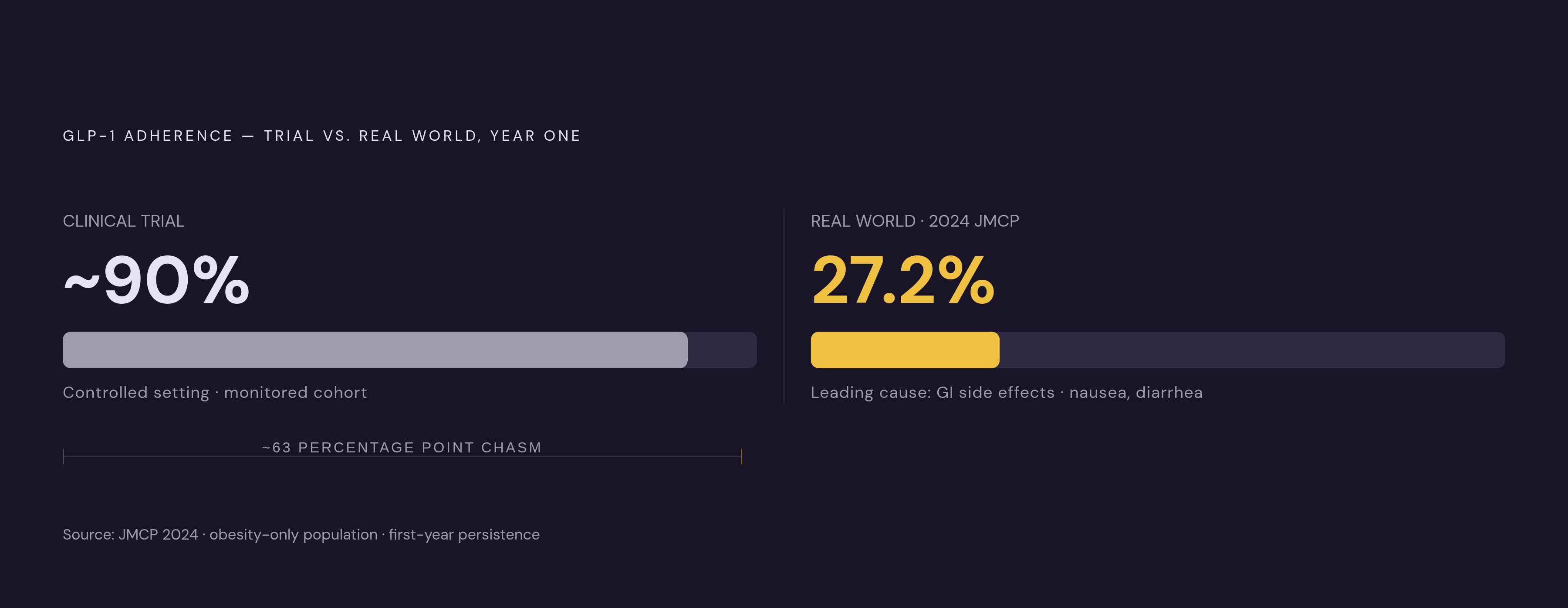
All of this, the volume ceiling, the siloed usability standards, raises a direct question: does any of it actually show up in how patients behave once they leave the clinic? It does, and the gap is large. Real-world adherence to injectable GLP-1 therapy falls well below what clinical trials report, and critically, the forces driving that gap are not things a better device could fix.
That's not a rounding error. And the data on why is fairly consistent: that same Truveta research found side effects to be the single leading documented reason for discontinuation among GLP-1 patients who recorded a reason for stopping. Cost matters too, as a secondary but real barrier, but side effects lead. Gastrointestinal discomfort, nausea and diarrhea specifically, is the most commonly reported adverse effect, and its severity tracks with dose. Side-effect vulnerability, in other words, isn't randomly distributed across the patient population. It clusters in identifiable, clinically relevant subgroups, which should matter enormously for how the industry thinks about who is likely to drop off and when.
None of this is a device problem, and it connects directly back to everything covered in the sections above. Nausea and gastrointestinal side effects trace back to the systemic pharmacokinetics of subcutaneous bolus delivery, specifically the spike in circulating GLP-1 agonist that follows injection, not to needle anxiety or difficulty operating the auto-injector itself. A more ergonomic grip or a softer needle shield does nothing to flatten that absorption spike. The device can make the moment of injection easier without changing anything about what the drug does once it's in the bloodstream. And the injection-site burden that builds up over months and years of rotating sites and managing tissue reactions is a consequence of the subcutaneous route itself, not a flaw specific to any one manufacturer's hardware. GLP-1 obesity clinical trials report high medication adherence, yet a 2024 JMCP analysis found real-world adherence among GLP-1 patients in their first year of therapy to be far lower. A 2025 population-based Danish study of semaglutide users, presented at AJMC/EASD 2025, found that patients with prior gastrointestinal medication use, psychiatric medication history, or cardiovascular disease were each meaningfully more likely to discontinue within the first year, showing that side-effect vulnerability is not random but clusters in clinically important subpopulations.
A market built on chronic therapy cannot sustain injection-driven dropout at this scale
A drug category whose value proposition depends on lifetime therapy cannot absorb real-world discontinuation rates near two-thirds without a delivery reckoning. GLP-1 treatment for obesity and metabolic disease only works as a chronic intervention. Stop taking it, and the benefit reverses. That's the therapeutic model, and it's also the commercial model: the GLP-1 market expanded enormously between 2018 and 2022, with some projections putting the market's value in the hundreds of billions of dollars by 2030. A market of that size is underwritten by an assumption of recurring prescriptions from patients who keep refilling.
That assumption is under real strain. A 2024 JMCP analysis put first-year real-world adherence at roughly 27.2 percent, and combined with majority dropout before year's end in the obesity-only population, the math doesn't square with what the market's growth projections seem to assume. As such, the injection format isn't just a clinical friction point, it's a commercial one too, and it compounds rather than offsets the cost of the therapy. The injection format amplifies expense and inconvenience at the same time, since it's both costly to sustain long-term and burdensome to keep doing week after week. A 2024 KFF survey found that a majority of U.S. adults who had taken a GLP-1 agonist reported difficulty affording it, and there's no obvious way to bring costs down that doesn't also mean renegotiating the device and the supply chain behind it.
The clearest signal that the industry itself sees this as a structural problem, not a rounding error, came on December 22, 2025, when the FDA approved the first oral GLP-1 receptor agonist for chronic weight management in the United States, an oral semaglutide formulation co-formulated with an absorption enhancer called SNAC. That approval shouldn't be read as a single product launch. It's a category-level admission that injection-based delivery has an adherence ceiling real enough that the field is now actively building around it. Oral delivery is one route around that wall. It is not the only one, and it raises its own question: if the goal is reaching tissues that injection struggles to reach efficiently, which tissue matters most?
The brain as both the frontier and the test case for whether injection can be the long-term delivery paradigm
That question turns out to have a very specific answer, and it reframes everything discussed so far. A growing body of evidence suggests GLP-1 receptor agonists do something in the brain, which shifts the delivery-route conversation from a matter of convenience to a matter of pharmacology. GLP-1 receptor agonists show therapeutic potential in neurodegenerative disease, including Parkinson's and Alzheimer's, and in reducing substance use among people with alcohol, tobacco, cannabis, and cocaine use disorders. Mechanistically, the proposed pathways are specific rather than vague: reduced α-synuclein aggregation through enhanced chaperone-mediated autophagy, attenuated neuroinflammation via microglial modulation, and improved dopaminergic neuron survival through anti-apoptotic signaling and mitochondrial protection. The randomized, double-blind, placebo-controlled ELAD trial, enrolling patients with mild to moderate Alzheimer's disease, found that liraglutide produced nearly 50 percent less brain volume loss across frontal, temporal, parietal, and total gray matter regions compared to placebo.
That's a striking signal. But it isn't the whole story, and the piece has to be honest about where the evidence actually stands rather than where it would be convenient for it to stand. A separate 2025 study found that GLP-1s did not slow disease progression in Alzheimer's patients, a finding that sits in direct tension with ELAD's result. One leading interpretation of that contradiction holds that GLP-1s may lower Alzheimer's risk indirectly, through improvements in vascular and metabolic health, rather than through any direct action on amyloid or tau pathology. If that interpretation holds, the neurological benefit is systemic rather than CNS-specific and wouldn't require the drug to reach the brain in any meaningful concentration at all.
The EVOKE and EVOKE+ trials were built to help settle exactly this question. The EVOKE and EVOKE+ trials (the first large-scale phase 3 studies evaluating a GLP-1 receptor agonist (oral semaglutide) in people aged 55–85 with mild cognitive impairment or mild dementia due to Alzheimer's disease) concluded with results published in 2026 showing that oral semaglutide did not slow clinical progression in early Alzheimer's disease, results that will help resolve whether the route and dose of CNS exposure matters.
That question reframes the entire adherence conversation this piece has been building. If GLP-1 neurological effects turn out to be partly or largely direct, requiring the drug to reach brain tissue itself rather than working through peripheral, systemic pathways, then a delivery route capable of maximizing brain concentration while minimizing systemic exposure stops being a matter of patient convenience. It becomes a pharmacologically distinct approach in its own right. And subcutaneous injection, whatever its usability advances, has to get past the blood-brain barrier to accomplish that, a barrier that excludes nearly all large biopharmaceuticals from entering the brain efficiently, regardless of how well-engineered the device pushing the drug into the bloodstream happens to be. The auto-injector solved the problem of getting a drug under the skin. Whether that was ever the right problem to solve, for every therapeutic target GLP-1s are now being asked to hit, is the question the entire field is quietly starting to confront.
Sources
- SPECIAL FEATURE - Injection Devices: Designing in Sustainability, Usability & Digitization for Patient Compliance
- Clinical Qualification of Subcutaneous Injection Devices for Monoclonal Antibodies | BioDrugs | Springer Nature Link
- Full article: Autoinjectors for large-volume subcutaneous drug delivery: a review of current research and future directions
- Seeking a common human factors language for the development and testing of injection devices - PMC
- Wearable Devices for Subcutaneous Delivery of Large-Volume Biologics: Design, Use, and Regulatory Perspective | Biomedical Materials & Devices | Springer Nature Link
- Real-world persistence and adherence to glucagon-like peptide-1 receptor agonists among obese commercially insured adults without diabetes | Journal of Managed Care & Specialty Pharmacy
- Real-world persistence and adherence to glucagon-like peptide-1 receptor agonists among obese commercially insured adults without diabetes - PMC