Transdermal Peptide Delivery Technologies and Their GLP-1 Applicability
Skin's lipid barrier makes GLP-1 patches fundamentally harder than injection, and the data prove it.

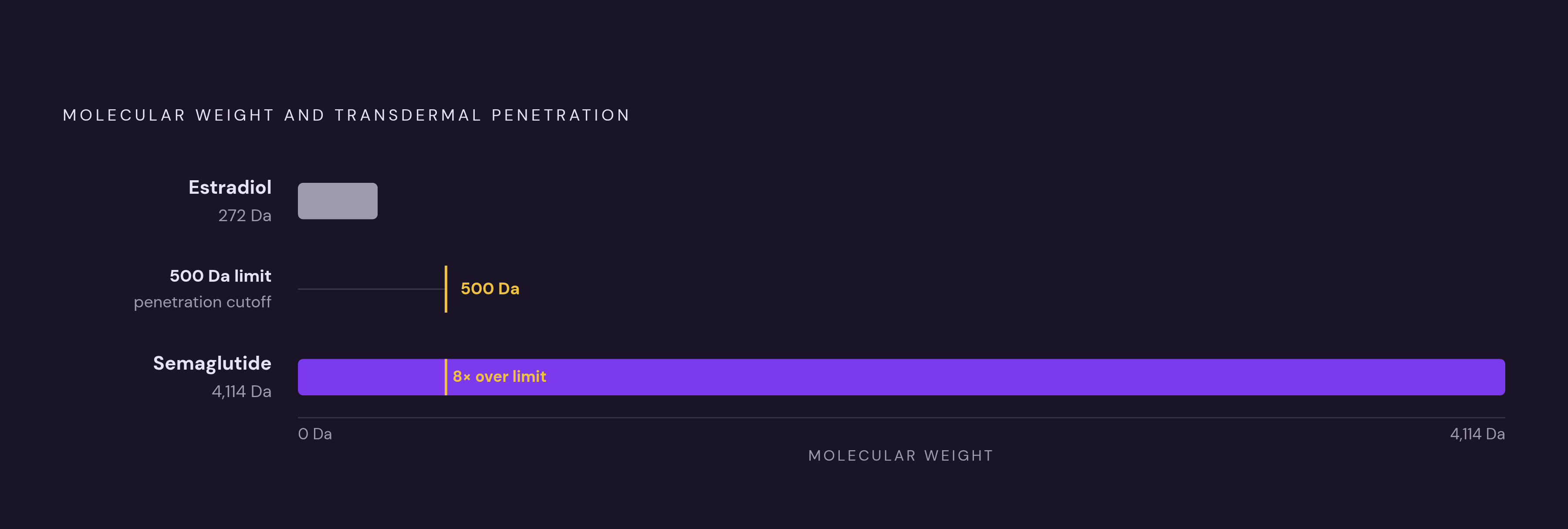
The stratum corneum exists to keep water-soluble substances out of the body. It is a thin layer of dead keratinocytes embedded in lipid lamellae, evolved over millions of years as a barrier against exactly the kind of large, hydrophilic molecules that define the GLP-1 receptor agonist class. For small, lipophilic drugs this barrier is an inconvenience that formulation science long ago learned to manage. For peptides like semaglutide, a 31-amino-acid molecule with a molecular weight of roughly 4,114 Da, the stratum corneum functions less as a barrier to be crossed and more as a wall that passive diffusion cannot breach at therapeutic doses.
The pharmaceutical sciences have codified this limitation in the "500 Dalton rule." Molecules above roughly 500 Da rarely penetrate intact skin in therapeutically meaningful amounts. Semaglutide sits at more than eight times that threshold. Exenatide, a 39-amino-acid peptide, is larger still. None of these molecules has any realistic prospect of crossing the lipid-rich stratum corneum through passive diffusion alone.
The contrast with approved transdermal patches makes the point precisely. Estradiol at 272 Da. The GLP-1 peptides reverse these properties: they are large, hydrophilic, and actively repelled by the lipid environment they would need to traverse. The stratum corneum presents a doubly hostile environment, rich in lipids that exclude water-soluble molecules and structured in a way that physically resists the passage of anything beyond a modest molecular weight.
This is not a problem that incremental formulation tweaks can solve. To understand why the transdermal GLP-1 field has struggled, one must first accept that the skin was never designed to admit these molecules, and that every engineering approach currently in development is an attempt to work around that biological fact rather than through it. The lipid-rich barrier that makes peptides so difficult to push through skin is precisely why alternative delivery platforms have emerged: a nasal nanoparticle approach, for instance, uses the nasal epithelium's natural permeability to achieve systemic peptide exposure without confronting the stratum corneum barrier at all.
What published bioavailability data actually show about GLP-1 patch performance today
The bioavailability gap between experimental transdermal patches and subcutaneous injection is the defining metric of the field, and it is not close. That ratio is not a rounding error. It is the difference between a drug and a different drug. A patch delivering a fraction of the active ingredient is not a dose-equivalent alternative to injection, and no amount of formulation enthusiasm changes the pharmacokinetic arithmetic.
Zealand Pharma's dapiglutide patch, the furthest-along clinical candidate in the transdermal GLP-1 space, illustrates the gap concretely. The molecule was re-engineered to be smaller and more lipophilic for patch delivery, a concession to the stratum corneum's requirements that acknowledges the scale of the problem. Yet even with that re-engineering, the clinical results have been underwhelming: dapiglutide showed only modest weight loss at 26 weeks, while injectable comparators in trials produced substantially greater weight loss over similar periods. The patch program remained in early Phase 1 trials as of mid-2025, with Phase 2 initiation then expected in the second half of 2025. As of April 2026, there is no Phase 3 start date and no prospect of one announced.
The dapiglutide case matters less as a company decision than as a data point. It demonstrates that even the most advanced patch program, built on years of formulation work and a re-engineered molecule, has not cleared the bioavailability threshold that would make it a credible substitute for injection. That threshold is not arbitrary. GLP-1 medications produce average weight loss of 15 to 22 percent of body weight in clinical trials. A patch delivering a fraction of the active ingredient will, by definition, produce proportionally less receptor engagement, and the clinical consequences follow directly.
The practical conclusion is that current patch formulations cannot be considered therapeutically equivalent alternatives to injection. They are better understood as experimental systems working toward an established target. Every technology entering development must solve this gap to matter clinically, and the route matters as much as the formulation: the bioavailability shortfall facing transdermal candidates underscores a broader principle in peptide delivery, one that approaches working with rather than against the body's absorption landscape, such as nose-to-brain nanoparticle delivery, address by sidestepping the dose-reduction problem entirely.
The three engineering approaches trying to close the bioavailability gap
Every credible transdermal GLP-1 program is built on one of three strategies for bypassing or disrupting the stratum corneum, each with a distinct set of tradeoffs that determine how far it can realistically go. The three approaches do not compete so much as they represent different philosophical answers to the same biological question: whether to breach the barrier mechanically, soften it chemically, or carry the peptide across it biologically. Microneedle arrays receive the most research attention of the three approaches and are the subject of multiple preclinical programs and early clinical trials. The drug releases directly into dermal tissue where capillaries can absorb it, bypassing the lipid barrier rather than crossing it. While microneedles avoid the fundamental barrier problem, they introduce a different set of engineering demands around reproducibility and scale.
Chemical penetration enhancers take the opposite approach. Small molecules such as fatty acids, alcohols, and surfactants temporarily disrupt the lipid structure of the stratum corneum, creating transient permeation windows through which drug can pass. The approach also requires repeated application and raises questions about cumulative skin irritation over long-term use, a material concern for a therapy meant to be taken indefinitely.
Cell-penetrating peptides represent the third strategy. Neuland Laboratories and LIR Life Sciences announced a development partnership in May 2026: Neuland will develop, test, and manufacture CPPs to support pharmacokinetic and pharmacodynamic studies and Phase I formulations for LIR Life's transdermal GLP-1/GIP program, a patch-based system targeting obesity. LIR Life Sciences Corp, a development partner in the patch program, is developing the patch platform, while Neuland Laboratories of Hyderabad brings CDMO peptide synthesis and manufacturing capability, including a new process development laboratory and a multi-phase commercial peptide manufacturing facility at its Bonthapally campus. The key open question is whether CPP-mediated delivery can achieve therapeutic systemic exposure for peptides as large as GLP-1 agonists. Preclinical PK/PD data will be the first real test.
Each approach is genuine engineering innovation. Yet they all share a common limitation: they are working to solve a biological constraint that exists only because of the route chosen. And as of 2026, no GLP-1 transdermal candidate in any of these three categories has reached Phase 3 trials.
Why the regulatory and development timeline matters more than the science headlines
The gap between a promising preclinical result and a pharmacy-available product is measured in years, not months. Even accelerated regulatory pathways cannot compress this substantially for a novel delivery modality, where the device and the molecule must each prove themselves and then prove themselves together. The current pipeline makes earliest realistic market entry for a transdermal GLP-1 patch 2028 to 2030 at the optimistic end.
That estimate is not speculative. It follows from where the field currently stands. Zealand Pharma's dapiglutide, the furthest-along candidate, has no publicly announced Phase 3 start date as of April 2026. The announcements that generate headlines, a development partnership here, a preclinical data readout there, are years removed from anything a patient could actually use.
The regulatory pathway adds another layer beyond standard drug approval. For a transdermal peptide delivery system, the delivery device itself must be validated alongside the molecule. A patch is a combination product in regulatory terms, and the FDA applies combination-product scrutiny to the device, its manufacturing, its dose reproducibility, and its interaction with the drug. What to watch for as signals that a patch program is advancing seriously: Phase 2 bioavailability data that approaches injection-equivalent levels, followed by a Phase 3 announcement. Neither has happened for any transdermal GLP-1 candidate as of this writing.
Why the adherence crisis in current GLP-1 therapy makes delivery innovation commercially urgent, not just scientifically interesting
To understand why the transdermal and intranasal efforts matter despite their timelines, one must look at what happens to patients on current GLP-1 therapy. In published real-world data, more than half of first-time GLP-1 users stopped taking the drug after one year, with meaningful proportions stopping within 3, 6, and 9 months. These are not marginal discontinuations at the edges of the data. They represent the majority experience.
The pattern sharpens when examined by indication. Discontinuation rates are substantially higher among patients without type 2 diabetes than among those with it. The population most likely to be using GLP-1s for weight management is also the least likely to stay on therapy. Each of these has a different solution, but they converge on a single conclusion: the current delivery model is losing patients in large numbers.
Obesity and metabolic disease are chronic conditions. A patch that works, or a nasal spray that works, would not be a convenience product. It would address the single largest point of failure in the current standard of care.
What the transdermal approach cannot reach that the nose-to-brain route addresses directly
Even a well-performing transdermal patch delivers GLP-1 to the bloodstream. This is the structural ceiling of the transdermal approach, and it is not a failure of engineering but a property of the route. A patch cannot preferentially deliver drug to the brain. It can only deliver drug to the blood and hope enough crosses over.
The intranasal route operates on a different principle. Subcutaneous injection, the current standard, faces a related limitation for CNS indications: the drug must cross the restrictive blood-brain barrier to reach brain targets, limiting both efficacy and the safety profile for cognitive and behavioral applications. The nose-to-brain route avoids the skin barrier problem altogether and simultaneously opens access to the CNS, the site increasingly understood to be central to GLP-1's therapeutic mechanism, which no transdermal approach is designed to target.
The neurological case for GLP-1 is building rapidly, and it reframes what delivery should aim to achieve. If the primary mechanism of benefit in addiction and dementia is brain-mediated, then a route that preferentially delivers drug to the brain is not merely more convenient. It may be more efficacious and produce fewer peripheral side effects than systemic injection.
This is the pivot that makes intranasal delivery more than a fallback for the transdermal field's difficulties. For the needle-averse patient seeking weight loss, the question is which non-injectable route most credibly matches injection efficacy. For the field, the question is larger: whether the next generation of GLP-1 therapy should be defined by how it gets into the body or by where it goes once it is there.
How nanoparticle engineering enables intranasal peptide delivery that passive diffusion and patches cannot achieve
Bypassing the stratum corneum solves one problem and creates another. Passive semaglutide permeability translates to less than 0.5 percent bioavailability across a full day, a figure that makes clear why simply putting a peptide in a nasal spray does not work. Formulation science is the rate-limiting factor, and nanoparticle encapsulation is the critical enabling layer.
Nanoparticles protect the peptide from enzymatic degradation in the nasal passage, control release, and can be engineered to direct uptake through specific CNS pathways. For brain-targeted delivery, particles in the 10 to 100 nm range are most effective for CNS uptake, though optimal size depends on biomaterial type. Functionalization with CPP sequences such as TAT and penetratin, and with transferrin-receptor-targeting ligands, has been shown to increase CNS drug delivery efficiency substantially.
The preclinical record is a useful corrective to any narrative of easy progress. These are the honest data points of a field still learning which formulations and which measurements matter. The science has not yet settled the question of how much drug reaches the brain through this route, only that the route is real and the engineering variables are tractable.
What has changed is the maturity of the enabling science. Lionbio's nanoparticle delivery platform, built on more than 30 years of biomedical innovation from Columbia University, addresses the formulation challenges that have limited the field: enabling intranasal delivery of GLP-1 peptides directly to the brain with the goal of matching injectable efficacy while reducing the peripheral side effects and adherence failures the field has documented. These are serious platforms operating in a space that has moved from hypothesis to active development.
The enabling science is now mature enough that the question is no longer whether non-injectable GLP-1 delivery is possible. It is which route and which platform will prove it first in humans. But the scientific center of gravity has shifted, and the next chapter in non-injectable GLP-1 delivery will be written not on the skin but through the nose.