Pulmonary Inhalation as a Peptide Delivery Route for Systemic Indications
Inhaled peptides face barriers that make systemic delivery harder than lung anatomy suggests.
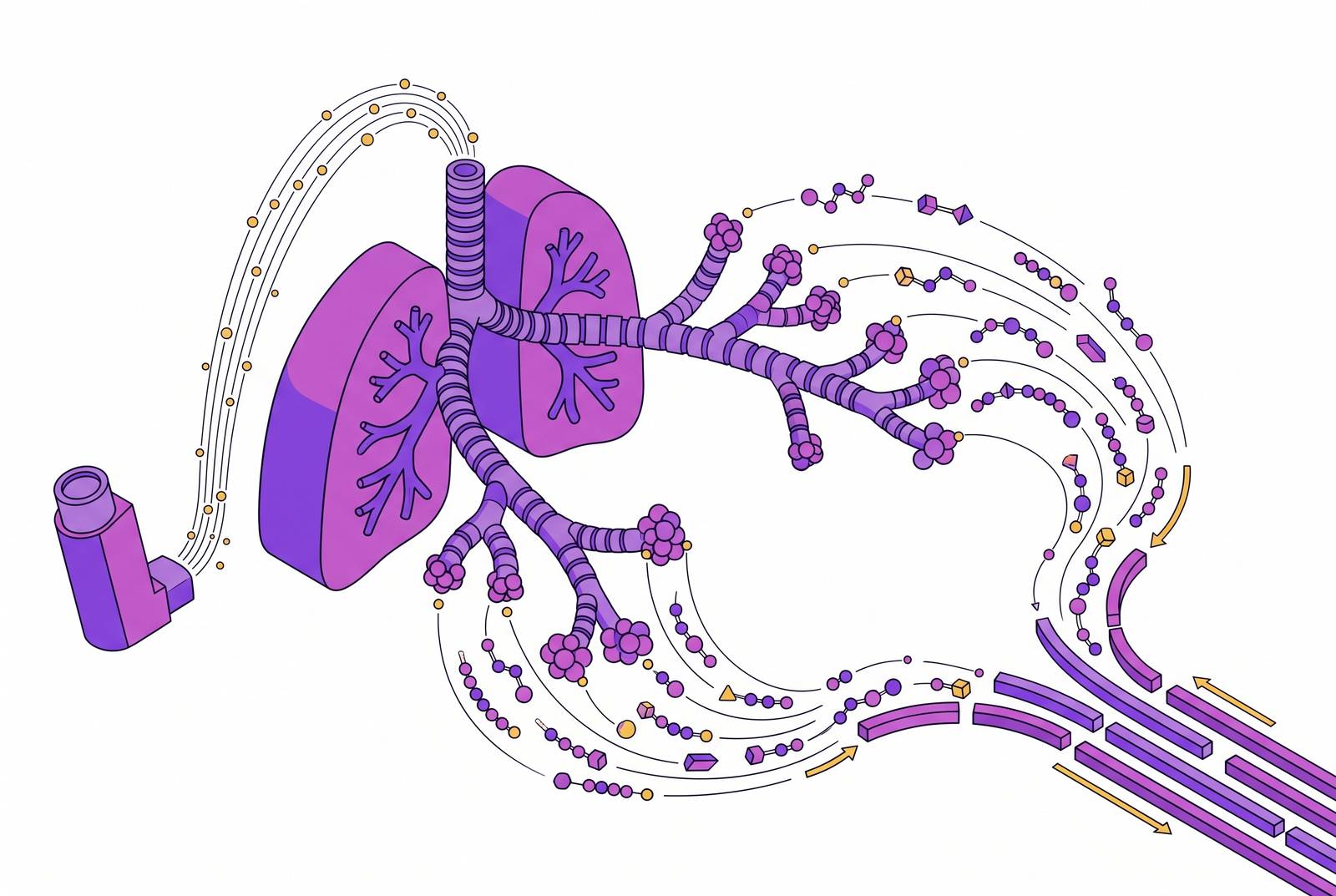
Pulmonary inhalation offers a non-injectable route for systemic peptide delivery, but its promise depends on protecting the peptide and controlling absorption. For needle-averse patients seeking non-injection GLP-1 weight loss treatment, pulmonary and intranasal platforms remain development approaches rather than established substitutes for injectable therapy. The lung provides rapid access to the circulation, but that advantage does not by itself establish reliable dosing, sustained action, or access to neurological targets.
Why the lung is pharmacokinetically attractive for systemic peptide delivery
The alveolar epithelium combines a large surface area, good vascularization, immense capacity for solute exchange, and ultra-thinness. The surface has room for absorption, and the thin epithelial barrier puts inhaled material close to the blood supply. For a peptide that survives deposition and crosses that barrier, the lung therefore offers a short path into systemic circulation. This is the anatomical basis for treating the lung as an entry point.
The circulation strengthens that logic. Blood leaving the alveolar capillaries flows directly to the heart via the pulmonary vein, allowing an absorbed peptide to bypass hepatic first-pass metabolism. Pulmonary administration also avoids gastrointestinal degradation, removing another obstacle faced by peptides delivered through the digestive tract. These properties may help the peptide be absorbed and start to work quickly. Bypassing these routes of degradation does not, however, mean that the peptide escapes metabolism after entering the circulation.
The lung can also be both a delivery conduit and a pharmacological target. GLP-1 receptors are expressed in the lungs as well as pancreatic islets, nervous systems, cardiovascular tissues, kidneys, and the gastrointestinal tract. Where these receptors are found gives a biological reason to study pulmonary GLP-1 delivery, though receptor expression alone does not show how much of the dose reaches each tissue. U.S. Patent 8,372,804 describes an early pulmonary GLP-1 design using a diketopiperazine dry-powder formulation in a cartridge-and-inhaler system. The patent makes the formulation concept concrete, without establishing that the route can meet the demands of a systemic indication.
The biological barriers that make pulmonary peptide delivery genuinely difficult
The first difficulty is that reaching the lung is not the same as reaching its absorptive surface. Airway anatomy, mucus, mucociliary clearance, and epithelial tight junctions all stand between administration and systemic uptake. Disease can alter these barriers as well as the activity of enzymes and immune cells. A formulation therefore encounters a changing biological environment. Its performance depends on the dosage form and delivery device as much as on the peptide's ability to cross the epithelium.
Within that environment, enzymatic degradation and macrophage clearance create distinct but connected problems. Synthetic peptides are typically unstable in the extracellular lung environment, so encapsulation may be needed to preserve them long enough for absorption. Yet a carrier that protects a peptide from enzymes still faces immune recognition and uptake by alveolar macrophages. Clearance is consequently more than a safety consideration, because it determines how long a formulation remains available to deliver its cargo. The peptide must stay protected from deposition through epithelial crossing.
Particle size affects that interval, but making particles smaller does not solve the whole problem. Nanoparticles smaller than 300 nm can evade rapid macrophage uptake and enzymatic degradation while supporting intracellular delivery through endocytosis and, in some cases, passage into systemic circulation. Isolated nanoparticles nevertheless suffer from severe exhaled loss and poor flowability without an aerodynamically effective delivery vehicle. Peptide instability and immune clearance are also relevant across mucosal platforms, including the engineering problems Lionbio's intranasal platform is designed to address, although each anatomical route presents its own conditions.
How nanoparticle engineering is being used to address those barriers
A carrier can protect the cargo, improve solubility, help it penetrate mucus and surfactant, and control its release. Surface chemistry can then alter how that carrier interacts with airway barriers and particular cells. PEG modification can prolong residence in the airways and alveoli, while targeting ligands can enhance uptake by specific cell populations. These design tools help only when longer retention or greater cellular uptake helps the cargo reach where it needs to go.
Liposomal formulations have demonstrated systemic effects for low-molecular-weight heparin, vasoactive intestinal polypeptide, insulin, parathyroid hormone, and calcitonin. Lipid nanoparticles are also advancing for RNA cargo in the lung, but progress with RNA does not establish performance for peptides. Biomimetic carriers offer another approach to mucociliary clearance and alveolar macrophage phagocytosis. The diversity matters because the formulation must match both the cargo and the barrier.
The “nano-in-micro” approach addresses the separate challenge of getting nanoparticles to their intended pulmonary site. It places nanoscale delivery structures within a larger architecture designed to improve deposition. Surface modification can then help with mucus penetration and cellular targeting, while stimuli-responsive designs aim to release cargo where it is needed. The technology underlying intranasal delivery systems illustrates the relevance of foundational work on size optimization, surface chemistry, and carrier design beyond the lung. Shared engineering principles explain why pulmonary and nasal platforms both depend on carrier design as well as peptide chemistry.
LTI-03, an inhaled caveolin-1-derived peptide, is being advanced as a dry-powder formulation for idiopathic pulmonary fibrosis, though its development does not establish whether inhaled peptides can reach distant systemic tissues. Nonclinical and early clinical data support antifibrotic activity and acceptable tolerability when it is delivered directly to the distal lung. That evidence grounds pulmonary peptide development in an actual candidate with a local target. More broadly, clinical translation remains constrained, with more promising candidates than approved products.
Where pulmonary delivery can and cannot succeed for systemic peptide indications
Route suitability begins with the exposure an indication requires. A peptide that benefits from rapid onset may align well with alveolar absorption, especially when avoiding first-pass metabolism is valuable. That alignment is stronger if its therapeutic window can tolerate some variability in deposition. Even with rapid entry, exposure must be precise and reproducible when the treatment requires it.
Investigations of insulin, calcitonin, parathyroid hormone, and growth hormone show the breadth of interest in systemic delivery through the lung. Cardiovascular biologics have a reason to use this route because the lung-to-heart circuit offers a direct pharmacokinetic path, and there is proof-of-concept evidence in heart failure. Neither breadth nor anatomical proximity establishes general clinical readiness. For locally acting peptides, pulmonary deposition can put the drug in the organ that needs treatment without the need for systemic distribution afterward. LTI-03 illustrates why the case for inhalation can be strongest when the destination and the entry point coincide.
The case becomes harder when a peptide is large, structurally complex, or especially vulnerable to enzymes. Additional encapsulation layers may protect it, but each layer introduces delivery inefficiency and regulatory complexity. Breath depth, inhalation technique, and disease-altered airway anatomy can also introduce clinically meaningful uncertainty in the absorbed dose. IPF, COPD, and severe asthma change clearance, aerosol deposition, and macrophage activity, so performance in healthy lungs cannot simply be assumed in the target population.
GLP-1 exposes the distinction between plausible access and suitable exposure particularly clearly. Where its receptors are found and what the patent record shows give reasons to study pulmonary administration, but for it to work as a treatment, receptor engagement must be sustained and controlled across several tissues at the same time. A short path into blood does not by itself satisfy that demand. Pulmonary delivery has not yet demonstrated that it can meet this pharmacokinetic requirement reliably for the indication.
The patient burden that makes non-injectable delivery innovation urgent
The importance of these engineering problems becomes clearer when treatment persistence enters the picture. The JAMA Network Open cohort study of GLP-1 RA initiators found that the majority of patients without type 2 diabetes discontinued within one year. Across all patients, after accounting for censoring, nearly three-quarters had stopped treatment by two years. These findings make sustained treatment a central concern. They do not, however, establish that injections caused the observed discontinuation.
IQVIA found that a substantial share of approved GLP-1 prescriptions were abandoned at the pharmacy counter before a single fill, with a further large share discontinued immediately after the first fill. Prime Therapeutics, 2025, found that only a small fraction of patients from a 2021 cohort remained persistent at three years. Gasoyan et al., 2025, found that cost and insurance coverage were the biggest reasons for discontinuation, with side effects and drug shortages also playing a part. A change in delivery route cannot be assumed to remove those structural barriers.
For patients who fear needles, though, avoiding injection removes that burden. Pulmonary inhalation offers that possibility together with rapid onset and a short path into systemic circulation, but formulation reliability remains a condition of its usefulness. Oral delivery, pulmonary delivery, and intranasal delivery cannot be ranked simply by the absence of a needle. The choice also depends on reproducible exposure, duration of action, tolerability, and which tissue needs treatment. The evidence described here does not establish a best non-injection weight loss medication or a clinically interchangeable pulmonary option.
Lionbio is developing intranasal nanoparticle-based GLP-1 delivery to leverage nose-to-brain absorption while avoiding injection. It aims to match injectable efficacy and reduce the needle burden and GI side effects, though the evidence here has yet to show that it meets those goals. This work represents a parallel non-invasive mucosal approach. Easing the burden of treatment and reaching neurological targets are linked, but each has its own goal.
What GLP-1's neurological indications reveal about the limits of systemic delivery routes
GLP-1 receptors are expressed on neuronal populations in the brain, and GLP-1 receptor agonists are being investigated across neurological conditions. In preclinical models, these agents reduce amyloid-beta and tau pathology, inhibit neuroinflammation, and enhance synaptic plasticity and cerebral glucose metabolism. Those mechanisms give a reason for further study, though they do not prove clinical efficacy. Reaching systemic circulation is only one step toward testing that rationale in the brain.
Cheng et al., 2025, found GLP-1 RA use associated with reduced dementia incidence relative to non-use in a large longitudinal cohort of individuals with type 2 diabetes. UCSF researchers are also studying whether GLP-1s can lower the risk of dementia and protect against neurological diseases including Parkinson's and substance use disorder. Randomized evidence has not matched the epidemiological promise. Two Phase 3 trials of semaglutide in early Alzheimer's disease missed their primary endpoints in late 2025. Those results raise questions about sufficient brain exposure, but they do not by themselves establish that inadequate delivery caused the misses.
The blood-brain barrier remains a separate constraint for a peptide entering circulation through oral, pulmonary, or injectable administration. Systemic bioavailability is therefore not sufficient to establish neurological efficacy. Nose-to-brain delivery addresses that access problem through the olfactory and trigeminal pathways, bypassing the blood-brain barrier. For Lionbio's nanoparticle platform, that anatomical logic is the basis of the neurological delivery approach. Intranasal delivery is thus more than another way to avoid a needle when the intended target is the brain.
The boundary of pulmonary delivery is consequently defined by the indication as much as by the lung. The field is learning to match routes to indications rather than treating any single non-injectable route as a universal solution.
Sources
- Delivery of active agents
- U.S. Department of Health & Human Services - The lung as a route for systemic delivery of therapeutic proteins and peptides
- Advancements in Inhalation Technologies for Pulmonary Delivery of Protein Therapeutics - PubMed
- Cardiovascular inhalation for targeted drug delivery in cardiac disease
- Inhalation-Based Nanoparticle Drug Delivery Targeting the Diseased Lower Airways in Idiopathic Pulmonary Fibrosis
- Therapeutic Potential of Glucagon-like Peptide-1 Receptor Agonists in Respiratory Disorders