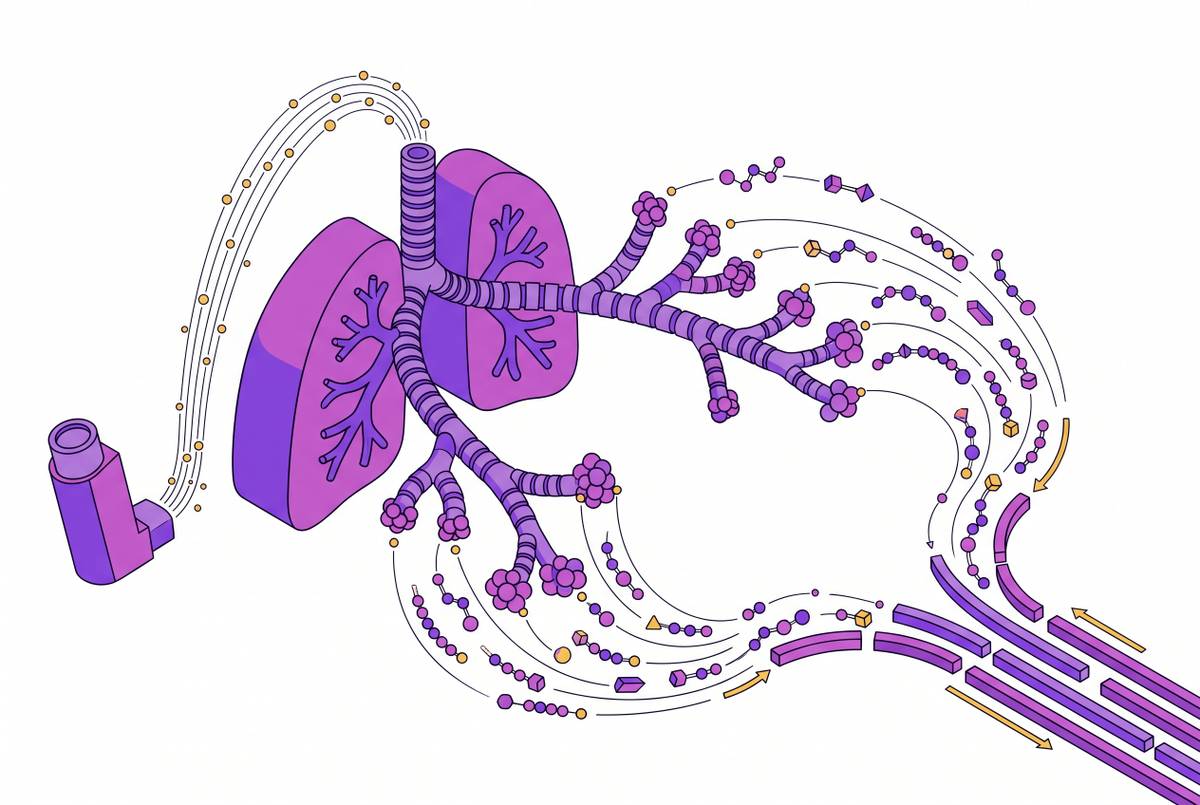
Peptide Absorption Enhancers in Non-Injectable Formulations
Three strategies overcome the gut barriers that keep peptide drugs injectable.
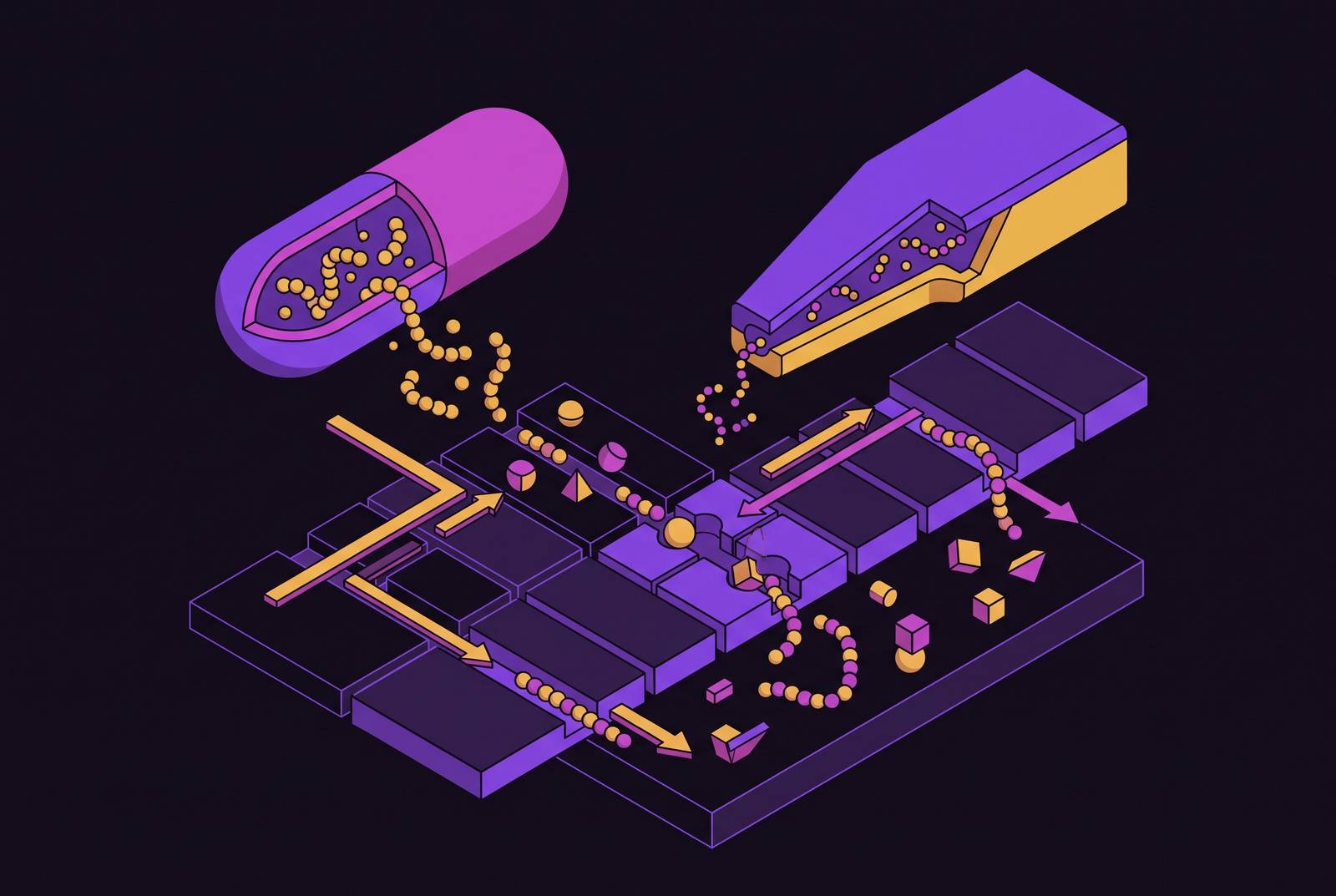
For needle-averse patients, oral semaglutide is an approved non-injectable peptide option, while oral small-molecule GLP-1 agonists offer a different pharmacological approach. Intranasal GLP-1 nanoparticle formulations remain investigational. Peptide absorption enhancers can enable a non-injectable formulation to deliver clinically meaningful exposure, but their success depends on matching the enhancer, the molecule and the delivery route.
Why peptide drugs have remained injectable for so long
Injection gets past the series of barriers that make peptide absorption difficult. In the gut, acidic pH and proteolytic enzymes can degrade peptides before they reach the absorptive surface. Mucus then slows access to the epithelium, where peptides are generally too large and hydrophilic to cross by passive diffusion. Carrier-mediated transport is limited to specific structural classes. Even after absorption, rapid systemic clearance can prevent useful exposure from lasting.
These barriers compound. Absolute oral peptide bioavailability sits in the low single digits at best, multiplying the manufacturing burden per effective dose. Low absorption combined with short half-life can make adequate exposure infeasible, while excessive variability can defeat regulatory requirements even when average exposure looks promising. Raising the dose may instead produce gastrointestinal toxicity before efficacy is reached. These failure modes define the requirements for an absorption enhancer, which must address the limiting barrier without creating an unacceptable safety, consistency or dose burden.
What absorption enhancers actually do, and the three main classes
The three principal classes tackle different parts of this problem. Chemical permeation enhancers act on epithelial membranes or their junctions to widen the absorption pathway. Paracellular enhancers open spaces between cells by targeting junction proteins, while transcellular enhancers transiently alter the lipid bilayer to permit passage through cells.
Enzymatic absorption promoters use catalytic activity to alter the barrier environment. Mucinases break down the gel-forming mucin network, increasing diffusion toward the epithelial surface. Phospholipases act on the membrane itself, so this class is not exclusively extracellular. Neither mechanism requires chemical modification of the peptide.
Nanoparticle and lipid-based carriers instead package the peptide, protecting it from degradation and presenting it at the absorptive surface. They can combine protection and transport in one construct, but particle characterization, batch consistency and stability add complexity. A separate category, peptide hydrophobization, uses non-covalent association with a carrier molecule to improve transcellular permeability. These distinctions provide a map rather than a ranking, because the right mechanism depends heavily on the route.
Chemical permeation enhancers in oral delivery, and why the oral route is the hardest test case
Oral delivery puts chemical permeation enhancers under the greatest combined pressure from degradation, mucus and epithelial impermeability. Sodium caprylate (C8), sodium caprate (C10) and salcaprozate sodium (SNAC) are clinical-stage anchors in a much broader field of tested compounds. They matter because their formulations have been used in humans, though this experience falls short of proving that they work for every peptide. A successful enhancer still needs a compatible peptide.
Oral semaglutide illustrates that compatibility. Its tablet formulation uses SNAC to buffer local pH around the dissolution zone, protect against pepsin-mediated degradation and enhance transcellular transport. Semaglutide also has an exceptionally long half-life, high potency, a wide therapeutic window and time-integrated pharmacodynamics. Those properties let it work despite low and variable absorption, but this boundary case gives no proof that most peptides can become tablets.
Oral octreotide provides another specific success. Its delayed-release capsules contain an oily suspension with C8 and other TPE® excipients, and are approved for long-term maintenance in patients who responded to and tolerated injectable octreotide or lanreotide. Yet oral success remains difficult to translate across molecules and species. Enhancers that open junctions or disrupt membranes also raise the possibility of bystander absorption of luminal antigens and pathogens. Promising preclinical permeability therefore does not settle human efficacy or safety, which helps explain the search for different engineering approaches.
Enzymatic absorption promoters as a mechanistically distinct alternative
Enzymatic promoters shift part of the engineering effort from forcing epithelial passage to clearing the path toward it. Bohley Steiger et al. (2025) demonstrated this approach by co-loading mucinase, phospholipase and desmopressin into enteric capsules. In a canine model, the dual-enzyme formulation achieved relative bioavailability of 155% compared to desmopressin alone. Mucinase and phospholipase address sequential barriers, namely diffusion through mucus and passage across the membrane.
Bohley Steiger et al. also studied a buccal patch containing phospholipase and semaglutide. It had multi-fold higher bioavailability and a much lower coefficient of variation than the commercial oral tablet. The consistency finding matters because high variability can disqualify a formulation regardless of its mean exposure. However, the promoters are themselves proteins, with degradation, temperature sensitivity and immunogenicity concerns. Enteric co-encapsulation protects the enzyme payload from gastric degradation, but it does not remove the broader stability and regulatory demands of a biologic excipient.
Nanoparticle carriers as a multi-function platform for peptide absorption
Polymeric nanoparticles, lipid nanoparticles and self-microemulsifying drug delivery systems can shield peptides from enzymes and present them at the epithelial surface for uptake. Changing the surface can add mucus penetration or membrane transport. This integration comes with demanding requirements for particle size distribution, batch consistency and long-term stability.
The nasal route changes which functions matter most. Avoiding the gut removes much of the gastrointestinal degradation burden, a principle that also underpins Lionbio's nose-to-brain nanoparticle approach. The remaining challenges include mucus penetration, nasal residence and transport through olfactory and trigeminal pathways. Cell-penetrating peptides such as L-penetratin can enhance membrane permeation, while attachment to nanocarrier surfaces brings carrier and permeation strategies together.
Conejos-Sánchez et al. (2026) demonstrated this convergence in a polypeptide-based hybrid nasal platform. Ex vivo diffusion studies and a nasal-mucosa-on-chip model showed permeation, while a hyaluronic acid–poly-L-glutamate crosspolymer extended residence to approximately four hours and increased total brain accumulation. In vivo imaging showed brain distribution and uptake in neurons and microglia, which shows where the drug goes but leaves clinical efficacy unproven. Lionbio's platform draws on more than 30 years of patented IP from Columbia University to develop intranasal GLP-1 delivery. It is an IP-grounded entrant into this field, but no nose-to-brain peptide formulation has received FDA approval.
How delivery route shapes which enhancer strategy is viable
For oral delivery, protection and permeation must work together to get past the most barriers. The first decision is whether the molecule can tolerate low and variable absorption at all. Short half-life, a narrow therapeutic window or high sensitivity to variability can make oral delivery unsuitable before enhancer optimization begins. For suitable peptides, established chemical enhancers remain the clinical benchmark, with enzymatic and nanoparticle approaches offering different ways to address unresolved barriers.
Buccal delivery reduces the enzymatic burden but trades intestinal surface area for a smaller absorptive area and limited residence time. The phospholipase–semaglutide patch results show why this trade can be worthwhile when consistency is a central problem. Here, local contact and membrane access become more important than surviving gastric conditions. Route and enhancer are therefore parts of the same formulation decision.
Nasal delivery shifts that decision toward residence, mucus penetration and, for CNS targets, neural transport. It avoids first-pass hepatic metabolism and offers a direct pathway that bypasses the blood-brain barrier, but macromolecular peptides do not use it efficiently without enhancement. Nanocarrier surface engineering and cell-penetrating peptides address transport, while residence-extending materials preserve contact time. Oral small-molecule GLP-1 agonists such as orforglipron can avoid peptide absorption problems, but they represent different receptor pharmacology.
Why the adherence gap makes non-injectable peptide delivery a clinical imperative, not just a convenience
Oral GLP-1 receptor agonists show substantially higher reported adherence and persistence than injectable formulations, making delivery relevant over the long treatment horizons of metabolic disease. The ATTAIN-1 Phase 3 trial showed that oral orforglipron led to meaningful weight loss. The OASIS-4 trial likewise showed that oral semaglutide led to meaningful weight loss.
Needle fear, however, does not explain every discontinuation. Cost and insurance barriers account for the largest documented share, with side effects and supply shortages also contributing. Bypassing the gut may reduce some nausea, but a change in the administration route alone gives no proof of better tolerability. With its intranasal approach, Lionbio aims to reduce nausea and the burden of injections while keeping efficacy, though clinical studies have yet to show that it can meet these goals.
GLP-1's neurological indications and why route of delivery determines whether they are reachable
For neurological targets, sustained treatment is only part of the problem. The peptide must also reach the brain, where the blood-brain barrier limits exposure after systemic administration. GLP-1 research in dementia, addiction and neuroprotection therefore raises a different delivery question from metabolic treatment. A formulation that produces useful systemic exposure may still fail to expose the relevant brain tissue.
Animal models show reductions in neuroinflammation, oxidative stress, neuronal apoptosis and pathological protein aggregation with GLP-1 receptor agonists. Cheng et al. (2025) found that adults with type 2 diabetes who used GLP-1 receptor agonists had a lower dementia incidence. That epidemiological signal does not establish causation or identify the exposure needed for benefit. Randomized trial evidence has not demonstrated improved memory and cognition in Alzheimer's disease compared with placebo, and the evidence is low certainty.
These negative clinical findings leave a delivery hypothesis to test. Nose-to-brain delivery offers a documented non-injectable pathway to brain parenchyma for macromolecular peptides through the olfactory and trigeminal nerves. Among the routes considered here, it is the direct option for testing whether brain-penetrant GLP-1 formulations can address inadequate CNS exposure. That rationale supports research with earlier intervention, biomarker-guided patient selection and formulations designed for brain access. It does not support neurological use outside clinical trials or establish that any intranasal platform will succeed.
What a principled enhancer selection framework looks like in practice
A principled framework begins with molecular pharmacology and the target tissue. Peptides with short half-lives, narrow therapeutic windows or high variability sensitivity should be screened out of unsuitable oral programs early. Pulmonary, nasal, buccal or long-acting injectable routes can then be considered instead of asking formulation work to overcome a fundamental exposure mismatch.
Membrane impermeability points toward clinically established chemical enhancers such as C8, C10 or SNAC for compatible molecules. Mucus obstruction combined with membrane impermeability points toward the sequential logic of mucinase and phospholipase, with variability assessed separately from average bioavailability. A macromolecular CNS target points toward nasal nanoparticle delivery with permeation enhancement. Nausea and injection-related dropout also justify investigating gut-bypassing routes, although better persistence must be demonstrated.
Manufacturability belongs in this selection process from the start. Enzymatic promoters and nanoparticle products impose greater chemistry, manufacturing and controls complexity than simple permeation-enhancing excipients, affecting development timelines and regulatory demands. Their added functions are worthwhile only when they solve a barrier that matters to exposure at the intended tissue. The governing principle is that delivery does not compensate for pharmacology from outside it. Delivery determines where pharmacology can be expressed, and no amount of oral formulation sophistication substitutes for demonstrated access to a brain target.
Sources
- Enzymatic absorption promoters for non-invasive peptide delivery - PubMed
- Enzymatic absorption promoters for non-invasive peptide delivery - ScienceDirect
- Intestinal Permeation Enhancers for Oral Peptide Delivery
- Frontiers
- A rationally designed polypeptide-based hybrid platform for targeted intranasal brain drug delivery - PubMed