Bioavailability Benchmarks for Intranasal Peptide Formulations
Plasma bioavailability fails to measure what intranasal brain-targeted peptides actually achieve.

Plasma bioavailability measures the fraction of a dose that reaches systemic circulation, and that measurement was built for drugs whose job is to act in the bloodstream or in peripheral tissue like muscle, fat, or the liver. If you apply that same measurement to a peptide designed to reach the brain through the nose, it produces a picture that is backwards. For a peptide traveling the nose-to-brain route, the molecule that bypasses plasma and goes straight into CNS tissue is doing precisely what the formulator built it to do.
A formulation can post low plasma numbers next to a subcutaneous injection and look like the weaker product because of this statistical illusion, yet still achieve a level of brain delivery that no injection, at any dose, can match. That gap means an entire category of CNS-targeted peptide formulations has been evaluated against a ruler that was never built to measure what they do. The rest of this piece works through why that mismatch exists, where the anatomy makes it unavoidable, and what a formulator should measure instead when the destination is the brain and not the blood.
How the nose connects to the brain
The nasal cavity offers two separate, physically direct paths into the central nervous system: the olfactory pathway, running through the cribriform plate, and the trigeminal pathway, running along branches of the trigeminal nerve through the nasal mucosa. Both routes skip the blood-brain barrier entirely, and that barrier is what keeps nearly all large biopharmaceutical molecules out of the brain when they're delivered through the bloodstream. Olfactory nerve axons physically pass through tiny perforations in the cribriform plate on their way into the olfactory bulb, an actual anatomical channel connecting the air inside the nose to brain tissue.
The two pathways don't do the same job. Research on TAT peptide-modified PLGA nanoparticles found that modified particles reached the olfactory bulb at 6.5 times the quantity of unmodified particles, and that pattern points to a division of labor: the trigeminal pathway appears to carry intact nanoparticles, while the olfactory pathway more likely carries material that has already been released from its carrier. The two routes complement each other rather than duplicating the same job. GLP-class peptides, specifically GLP-1 and GLP-2 derivatives carrying functional sequences, have been shown to move rapidly through trigeminal axons after intranasal dosing in mice. That is active transport along a nerve pathway, so it's not simple diffusion across a membrane.
None of this is a workaround for a barrier that normally blocks drugs from the brain. It is a separate delivery route the circulatory system never touches. Because the drug that uses these pathways deposits directly into brain tissue, plasma only ever sees what spills over into systemic circulation afterward. That spillover is a byproduct, not the fraction of the dose doing the therapeutic work, and measuring it as though it were the whole story is why plasma AUC gets the wrong answer for this class of drug.
Molecular weight as the first gate: what the dalton thresholds mean for peptide formulators
Molecular weight decides whether a peptide can cross the nasal mucosa, before any pathway, device, or nanoparticle matters. That single physical property sorts intranasal peptides into three performance tiers, and a benchmark framework that averages across all three into one bioavailability number is hiding more than it reveals.
Peptides under roughly 1,000 daltons generally absorb well through the nasal mucosa with no added absorption enhancers needed. Once a peptide climbs into the thousands of daltons, that ease of absorption falls off, and above the upper threshold, the nasal route delivers only a small fraction of what an injection achieves. That drop is a matter of membrane pore size and molecular packing. Peptides sitting in the middle range, roughly 1,000 to 3,000 daltons, occupy an awkward zone where absorption drops sharply enough that formulation work, not just dosing adjustments, becomes necessary to get meaningful exposure.
GLP-1 analogues sit well above the upper threshold on this scale, so a plain nasal spray with no engineered delivery system cannot get a therapeutic dose into the body through the nose. For molecules in that weight class, an engineered delivery vehicle is the only way the molecule gets through the mucosa.
Weight alone doesn't settle the matter, either. Charge, lipophilicity, and how well a peptide holds its structure in nasal secretions all shape absorption independently of size. A small peptide that gets chewed up by mucosal enzymes on contact performs no better than a large peptide that simply can't fit through the membrane. Semax demonstrates the stability side of this equation clearly: its Pro-Gly-Pro extension resists enzymatic cleavage at the nasal mucosa, and that resistance is a large part of why its intranasal bioavailability runs so much higher than other peptides of similar size that lack that protection. Weight opens or closes the gate. It decides whether the peptide that walks through it survives the trip.
What the established benchmarks show across the molecular-weight tiers
Looking across the three tiers, demonstrated intranasal bioavailability spans a wide range, from figures close to complete absorption down to numbers barely worth reporting, and even inside the best-performing tier, the plasma figure means something different depending on whether the target is a peripheral tissue or the brain.
In the sub-1,000 dalton tier, davunetide, testosterone, and metkephamide all show near-complete intranasal bioavailability, and those figures function as ceiling benchmarks for what an unformulated small peptide can achieve with no enhancement. Semax and Selank, both in a similar weight class, post intranasal bioavailability well above what oral dosing achieves and land only modestly below injection. That gap versus injection can be managed through dose calibration rather than redesigning the delivery vehicle.
Outside the peptide space entirely, the non-peptide drug diazepam, marketed as Valtoco, offers a useful reference point for what formulation engineering can achieve on the high end. Delivered through the Aptar Unit Dose System with dodecyl maltoside as a permeation enhancer and Vitamin E for solubility, it reaches near-complete bioavailability, representing something close to a practical ceiling for what intranasal CNS delivery can do when the formulation is fully optimized. A separate comparison of nasal drops against spray devices for desmopressin found that a spray doubled bioavailability for the identical compound, where drops had not. The device delivering the drug is itself a formulation variable; it is not neutral hardware sitting outside the chemistry.
These figures matter as calibration points for plasma-based measurement, and the field has built a solid base of data on that front. But calibrating plasma AUC more precisely doesn't fix the underlying problem for CNS-targeted peptides. It sharpens the wrong ruler.
Brain-to-plasma ratio as the correct primary endpoint for CNS-targeted peptide formulations
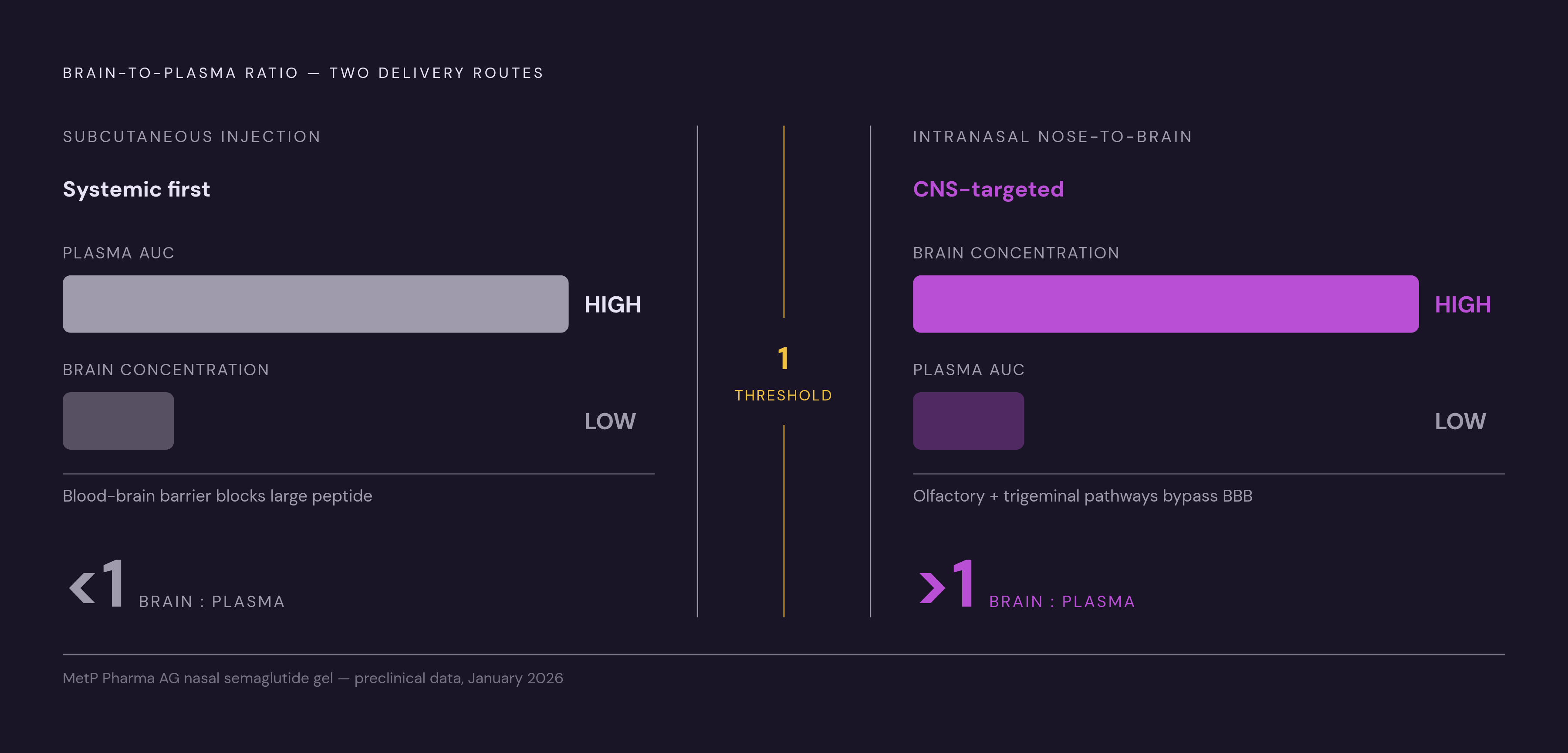
For any peptide whose target is the brain, the number that matters is the brain-to-plasma ratio, not systemic AUC. A ratio above 1 is the one signal that separates a formulation delivering drug preferentially to the brain from one that's simply leaking a therapeutic peptide into general circulation.
Think about what a ratio above 1 actually describes: more drug sitting in brain tissue than in the blood at the same point in time. That is the exact opposite of what a subcutaneous injection produces, where the blood is the first stop and the brain, walled off by the blood-brain barrier, gets whatever small fraction manages to cross. A ratio above 1 is the signature of a nose-to-brain formulation doing its intended job. Plasma bioavailability under 5%, which describes most intranasal peptides, reads as a failing grade next to a subcutaneous comparator posting a substantial share of the dose. But that comparison only matters if the brain is not the target. If brain-compartment concentration from the intranasal dose exceeds what the injection delivers to that same tissue, the low plasma number is beside the point.
The reason plasma AUC undercounts CNS exposure traces straight back to the anatomy covered earlier: drug moving through the olfactory and trigeminal pathways reaches the brain without first equilibrating through the bloodstream, so a measurement tool built to watch the bloodstream misses it structurally, not by a small margin.
MetP Pharma AG, based in Emmetten, Switzerland, published preclinical data in January 2026 showing that its nasal semaglutide gel achieves brain-to-plasma ratios well above 1. That result carries weight because semaglutide sits far above the molecular-weight ceiling where passive nasal absorption works on its own, so the ratio came from deliberate formulation engineering, not from a molecule's natural ability to cross the mucosa. The same result also shows you don't need high systemic exposure or an engineered molecular shuttle riding through the bloodstream to get a peptide preferentially into the brain. The olfactory and trigeminal pathways can be targeted directly, provided the delivery vehicle is built with that target in mind.
One objection deserves a direct answer rather than a dismissal. A real and persistent problem in this research is telling apart drug that traveled directly from nose to brain and drug that was absorbed into general circulation and then crossed the blood-brain barrier by the ordinary systemic route. Many studies report high levels in both plasma and brain tissue at once, and that overlap makes the data hard to interpret. Brain-to-plasma ratio helps here precisely because it's a ratio rather than a raw brain concentration number: a high brain concentration sitting next to an equally high plasma concentration points toward systemic absorption doing the work, while a high brain concentration next to a low plasma concentration points toward the direct nasal pathway. The ratio doesn't resolve every case, but it builds the possibility of systemic spillover directly into the measurement instead of leaving it as a confound outside the data.
Nanoparticle engineering for large peptides that cannot cross the mucosal barrier unaided
For any peptide above the 1,000 dalton line, where passive absorption across the nasal mucosa stops working on its own, an engineered nanocarrier is the only thing that gets the molecule across the barrier. What carrier architecture gets chosen, how its surface gets modified, and what device sprays it into the nose decide whether the brain-to-plasma ratio climbs above 1 or sinks toward zero.
Current work in this space is aimed at three goals at once: getting more of the dose absorbed, keeping the drug in contact with the mucosa longer, and keeping systemic side effects to a minimum. Surface modification is where a lot of that work concentrates, since changing a particle's surface chemistry can make it stick to the mucosa longer and move more effectively along the nose-to-brain pathways. PLGA nanoparticles and solid lipid nanoparticles are the two carrier classes with the deepest research base behind them for CNS delivery. The TAT peptide-modified PLGA nanoparticles mentioned earlier, tested for delivering insulin to the brain, reached far higher drug quantities in the olfactory bulb than unmodified particles carrying the identical drug. That gap came from the surface modification.
Which pathway a nanoparticle is meant to use changes what "good design" looks like. The trigeminal pathway appears to carry nanoparticles while largely intact, and the olfactory pathway more likely carries drug already released from its carrier; if a slow-release particle is built for trigeminal transport but the real target is the olfactory route, it underperforms, and the reverse holds just as well. Carrier choice has to match pathway, not just molecular weight.
Formulation details that sit outside the nanoparticle itself carry just as much weight as the carrier does. Nasal mucosa tolerates a pH range of roughly 4.5 to 6.5 and a tonicity around 285 to 310 mOsm/kg, and getting either of those wrong, along with preservative load or droplet size, changes how long the formulation sits in contact with the mucosa and how well it absorbs, independent of whatever the nanoparticle is doing. Overlooking these variables has undercut otherwise well-designed preclinical studies before. Device architecture belongs on that same list: the two-fold bioavailability gap between nasal drops and spray devices for one identical compound shows that the spray mechanism is part of the therapeutic design, not neutral hardware sitting outside it.
Put together, these variables explain why the nanoparticle platforms capable of producing a brain-to-plasma ratio above 1 tend to rest on real intellectual property: validated surface chemistries, controlled-release behavior tuned to a specific pathway, and targeting built for olfactory or trigeminal transport specifically. A formulation that bolts a generic carrier onto a large peptide without solving any of these problems is not the same category of product as one engineered to solve them.
The limits of systemic GLP-1 delivery to the brain revealed by the Phase 3 failures in Alzheimer's and Parkinson's
Late in 2025, Phase 3 trials of GLP-1 receptor agonists in Alzheimer's disease failed, despite preclinical evidence that had looked encouraging and biomarker signals that had pointed the right direction going in. One might argue that result settles whether GLP-1 is a viable target for neurodegenerative disease. But look more closely at what systemic delivery actually gets into the brain, and a different explanation holds up better: the drug target was sound, and the dose reaching brain tissue under ordinary systemic delivery simply wasn't high enough to produce the effect the preclinical work had predicted.
That explanation lines up with everything the earlier sections lay out. A drug delivered by injection travels through the bloodstream first, and the blood-brain barrier then excludes nearly all of a large peptide like a GLP-1 analogue before it ever reaches brain tissue. Plasma AUC can look strong in that scenario, since the whole dose is sitting in systemic circulation where the measurement tool can see it. Brain-compartment concentration, the number that actually predicts whether the drug can do anything for a neurodegenerative disease, can be low at the very same time. A trial measuring the wrong compartment has no way to catch that gap before the Phase 3 data come back.
A brain-to-plasma benchmark, applied earlier in development, would have flagged the shortfall before billions of dollars went into a Phase 3 program. That is the practical stake behind an argument that might otherwise sound like a dispute over measurement technicalities. Choosing the wrong endpoint doesn't just produce a less informative chart. An entire clinical program can spend years and its full budget testing a delivery method that was never going to get enough drug to the target tissue, even when the underlying biological target was sound all along.
Sources
- Best Peptides for Nasal Sprays: What Actually Works (2026)
- Nasal Spray Peptides: Bioavailability, Administration, and Semax/Selank Research Applications
- Correction: Shrewsbury, S.B. The Upper Nasal Space: Option for Systemic Drug Delivery, Mucosal Vaccines and “Nose-to-Brain”. Pharmaceutics 2023, 15, 1720
- Sustained release pharmaceutical compounds to prevent abuse of controlled substances
- Advanced intranasal peptide delivery systems for improved management of Alzheimer's disease - ScienceDirect
- Intranasal Peptide Therapeutics: A Promising Avenue for Overcoming the Challenges of Traditional CNS Drug Development
- Nose-to-brain drug delivery: from bench to bedside
- (PDF) Intranasal delivery of glucagon-like peptide-1 to the brain for obesity treatment: opportunities and challenges