Transneuronal and Transcellular Transport Mechanisms That Nanoparticle Formulations Must Exploit for Peptide CNS Delivery via the Nasal Route
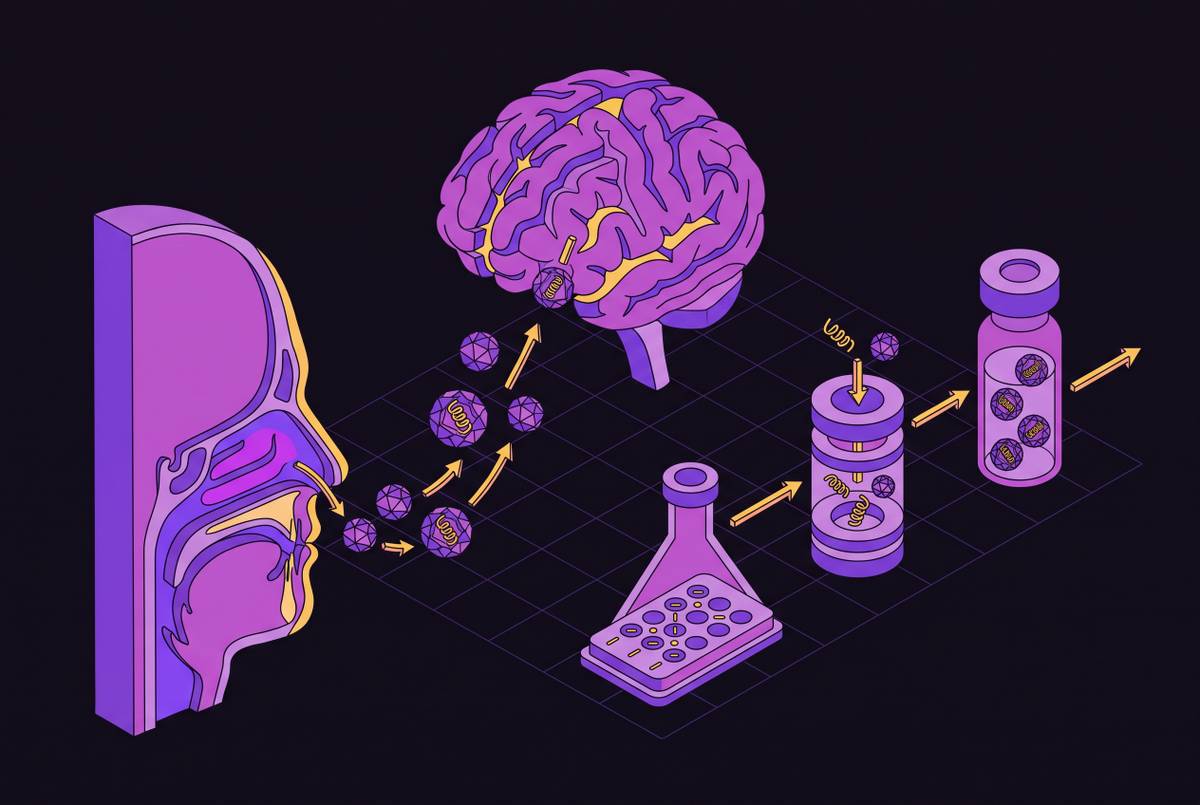
Nanoparticle nose-to-brain delivery for CNS peptide indications depends on coordinated epithelial uptake, neural entry, and intracellular transport. The nasal route can bypass the blood-brain barrier through olfactory and trigeminal corridors. Effective formulations must therefore protect their cargo while engaging the biological machinery that moves it from the nasal lumen toward its CNS target.
Why the nasal route to the brain is not a passive diffusion problem
The blood-brain barrier restricts the entry of most large hydrophilic molecules, including peptides, from systemic circulation into the brain. Nasal delivery offers an alternative because the nasal mucosa has anatomical connections with the CNS. For nanoparticle-mediated transneuronal delivery, cargo must reach the right epithelial compartment and enter living cells before neural transport can help it.
Peptides administered in simple solutions face mucociliary clearance, luminal enzymes, and absorption into systemic capillaries. These processes compete with CNS uptake, so a formulation can disappear from the nasal surface without delivering useful cargo to the brain. Nanoparticle encapsulation can reduce these losses, but the protected cargo still needs a way into the neural compartment.
Can the protected cargo engage the next transport step before clearance or peripheral absorption diverts it? If delivery depends on active, selective transport, the nanoparticle must take part in that transport as well as act as a solubilizer.
The olfactory epithelium as the primary transneuronal gateway
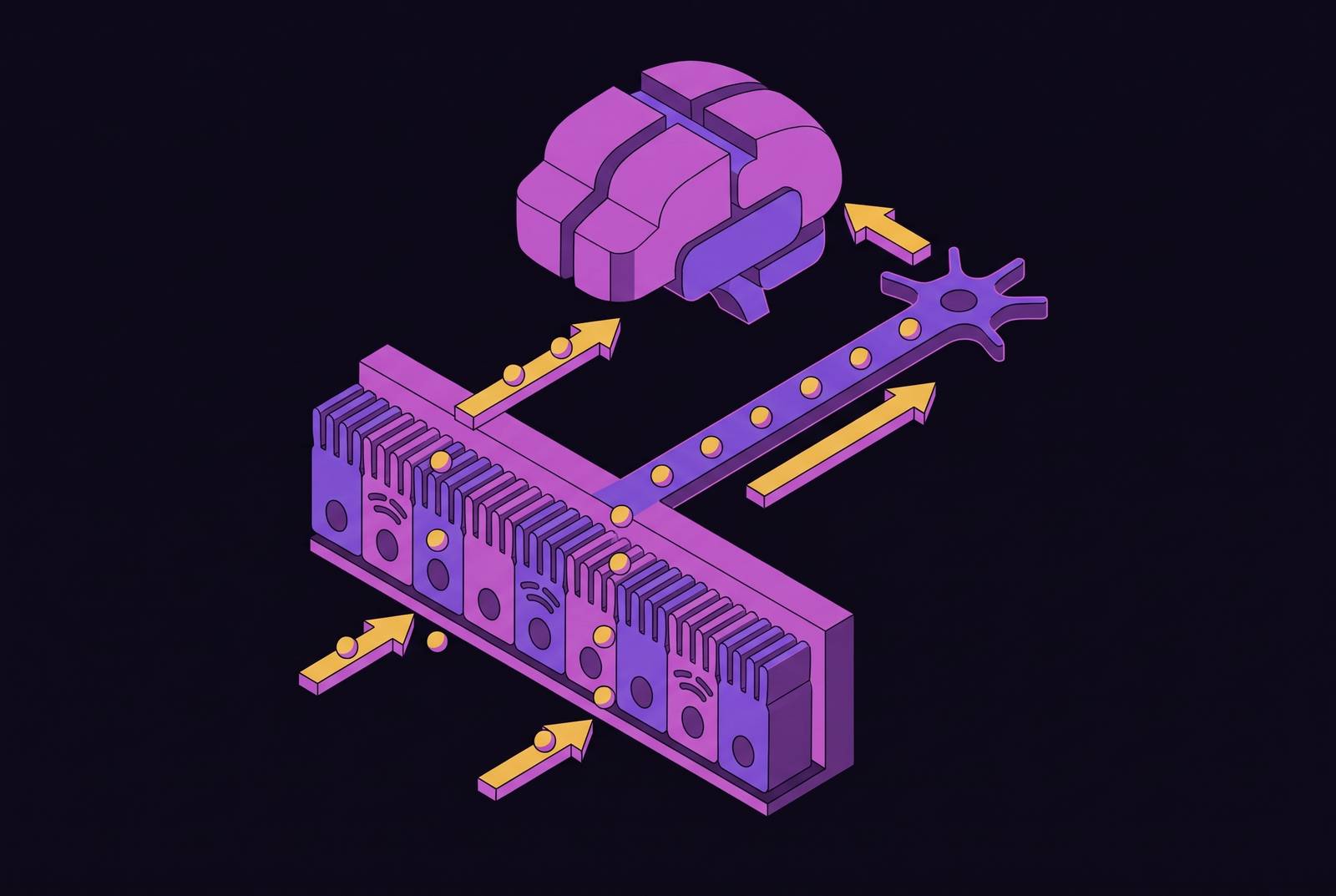
Olfactory sensory neurons, or OSNs, provide the most direct transneuronal corridor from the nasal cavity to the brain. Their dendrites project toward the apical epithelial surface, where sensory cilia contact the nasal lumen. Their unmyelinated axons cross the cribriform plate and terminate in the olfactory bulb. This links an exposed sensory surface to the CNS, so cargo can reach it without passing from blood across the blood-brain barrier.
The olfactory region occupies a relatively small fraction of the nasal mucosa, concentrated in the superior turbinates, upper nasal septum, and nasal roof. Cargo deposited in the olfactory cleft can contact OSN dendrites directly. General nasal deposition, however, does not establish that contact, making the distinction between nasal administration and olfactory access fundamental to this pathway.
Sustentacular cells form tight junctions that restrict passage between cells, so transneuronal delivery relies on cellular uptake. Once internalized by an OSN, cargo can move along its axon toward the olfactory bulb and potentially onward to higher brain structures. That intracellular journey can itself become rate-limiting.
The axon bundles also have a supporting cellular interface. Olfactory ensheathing cells wrap them beneath the epithelium and accompany them through the cribriform foramina. Evidence suggests that these cells may participate in transcellular particle shuttling when cargo does not complete axonal transit. This remains a possible secondary mechanism.
The trigeminal pathway as a parallel and complementary CNS corridor
The trigeminal pathway gives cargo deposited outside the olfactory cleft a second opportunity for neural entry. Trigeminal fibers innervate the respiratory epithelium of the middle and inferior turbinates, with free nerve endings immediately beneath the epithelial layer. Particles must also gain access to the subepithelial space where those terminals reside.
Transport through trigeminal fibers can bring cargo toward the trigeminal ganglion and then the trigeminal nucleus in the brainstem. From this region, distribution can extend to the pons, midbrain, and, through ascending projections, the hypothalamus. That destination is particularly relevant to peptides intended to modulate metabolic and appetite-related circuitry.
The two pathways also differ in their transport kinetics. Trigeminal axons include both myelinated and unmyelinated populations, whereas OSN axons are unmyelinated, and transport rates differ across these neural settings. A formulation that performs well at the olfactory interface may therefore underperform in regions reached primarily through trigeminal projections.
The respiratory epithelium covers most of the nasal mucosa, so total engagement with trigeminal terminals may exceed olfactory engagement even when individual particles have limited access to those terminals. For broad CNS distribution, their value lies in complementarity.
Transcellular endocytosis: how nanoparticles are taken into nasal epithelial cells and transferred toward the neural compartment
For the transcellular routes considered here, uptake into a cell precedes either neuronal trafficking or transfer toward subepithelial nerve terminals. This is distinct from paracellular movement between cells. Tight junctions normally exclude particles above a few nanometers from that alternative route, making endocytosis a critical bottleneck for nanoparticle surface design.
Nasal epithelial cells can internalize particles through clathrin-mediated endocytosis, caveolae-mediated endocytosis, and macropinocytosis. Which pathway dominates depends on particle size, surface charge, and ligand decoration. Clathrin-mediated uptake can internalize particles in the range of roughly 100–200 nm bearing ligands recognized by receptors associated with clathrin-coated pits. Receptor targeting can strongly increase uptake, but greater internalization does not by itself establish intact delivery.
Clathrin-mediated uptake can route cargo toward lysosomal degradation, creating a hazard for acid-labile and protease-sensitive peptides. Caveolae-mediated uptake offers a route that can avoid lysosomal processing and support transfer to the basolateral surface. For intact peptide delivery, this makes caveolae-associated transcytosis a preferred design objective.
Macropinocytosis presents a different balance between entry and preservation. It is less selective and accommodates larger particles and fluid-phase cargo, but its endosomes frequently merge with lysosomes. Endosomal escape can therefore become necessary to preserve peptides entering through this route. Transiently loosening epithelial tight junctions seeks to increase passage between cells and introduces safety tradeoffs, while intracellular routing remains unresolved.
What, then, distinguishes productive uptake from a cellular trap? Transcytosis combines apical endocytosis with basolateral exocytosis while avoiding destructive lysosomal routing. That sequence can move intact peptide-loaded nanoparticles toward the neural compartment, so the formulation must favor entry and sorting that help them get there. Once neuronal uptake occurs, however, axonal transport imposes another set of requirements.
Axonal trafficking inside neurons: anterograde transport as the final intracellular leg
Inside an OSN, movement toward the olfactory bulb depends on transport machinery that a nanoparticle cannot directly program. Anterograde transport moves cargo from the cell body toward the axon terminal using kinesin motors on microtubule tracks. The particle needs compatible intracellular packaging. Vesicles or organelles must connect it to the motor machinery, while particles that cannot enter suitable transport compartments may stall in the perikaryon.
Fast transport, involving kinesin-1 and kinesin-2 family members, moves membranous vesicles and is relevant to nanoparticle-loaded endosomes. Slow transport moves cytoskeletal and soluble proteins, but it is of little practical use for carrying particles. Vesicular compatibility and particle dimensions therefore constrain delivery even after epithelial uptake has succeeded.
Protection must persist throughout this intracellular journey. If a particle-containing endosome fuses with a lysosome during transit, peptide degradation can precede arrival at the olfactory bulb. Surface chemistry that stabilizes the early endosome, or chemistry that permits escape before lysosomal fusion, is consequently relevant beyond the epithelial surface. After escape, it is still unclear whether the released cargo can use the transport needed for the next step.
The trigeminal route complicates a purely anterograde account. Uptake at peripheral axon terminals can lead to dynein-mediated retrograde movement toward the neuronal cell body in the ganglion. For this pathway, retrograde transport can be useful movement toward the CNS rather than movement away from the delivery objective. The longer trigeminal journey also means that cargo needs intracellular stability for longer, so the direction of transport and the protection needed depend on neuronal anatomy.
How nanoparticle physicochemical properties must map onto these transport steps
Particle properties must be optimized together to match the transport sequence. Size affects both passage through the mucus mesh and the uptake pathway available at the epithelial surface. The approximate size associations in the design framework place particles below roughly 200 nm toward clathrin-mediated uptake and particles in the ~200–500 nm range toward caveolae-mediated uptake. These are not universal routing rules, because charge and ligand decoration also influence entry.
Surface charge creates a particularly clear tradeoff. Cationic particles bind mucin fibers electrostatically, which can slow diffusion, while their attraction to negatively charged epithelial surfaces can enhance cellular interaction and uptake. PEGylation or zwitterionic coatings can reduce mucus binding and improve diffusion. Yet a surface that reaches the cell efficiently must still interact sufficiently with it to trigger endocytosis.
Residence time introduces a related design tension. Mucoadhesive polymers, including chitosan, hyaluronic acid, and thiolated polymers, can extend contact time in the olfactory cleft. Excessive adhesion, however, can immobilize particles before they reach the epithelial surface.
Intracellular protection requires a separate but connected design decision. Options include pH-responsive polymers that swell or disrupt membranes, fusogenic lipids, and proton-sponge polymer matrices. Polyethylenimine provides a proton-sponge example, while poly(propylacrylic acid) provides a pH-dependent membrane-disrupting example. Such chemistries can release cargo before lysosomal fusion, but their role must fit the intended route, since intact transcytosis and vesicular axonal transport also depend on appropriate intracellular packaging.
The consequences become concrete when the steps are connected. A particle engineered for mucus penetration but not productive caveolae-associated uptake can fail at the epithelial interface. A particle that enters efficiently but lacks endosomal stability can lose its peptide during neural transit. Conversely, strong cellular binding offers little benefit if mucus immobilization prevents epithelial contact, making the weakest transport step the limit on the formulation’s overall performance.
Why understanding these mechanisms as a connected system, not isolated steps, changes how nose-to-brain platforms are built
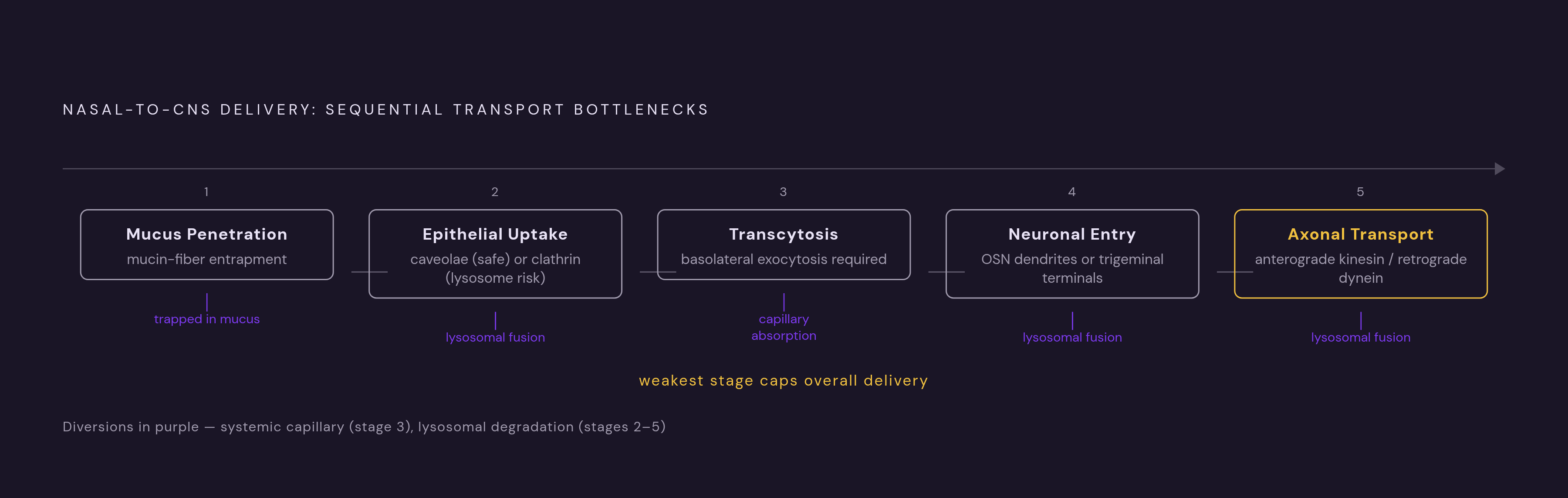
A connected transport model makes formulation failure diagnosable. Mucociliary clearance before epithelial contact is a different problem from tight-junction exclusion, lysosomal degradation, or vesicular incompatibility in the neuronal cell body. Systemic absorption from submucosal capillaries represents another diversion before neural uptake. These outcomes cannot all be corrected by increasing encapsulation or measuring more particle association with nasal tissue.
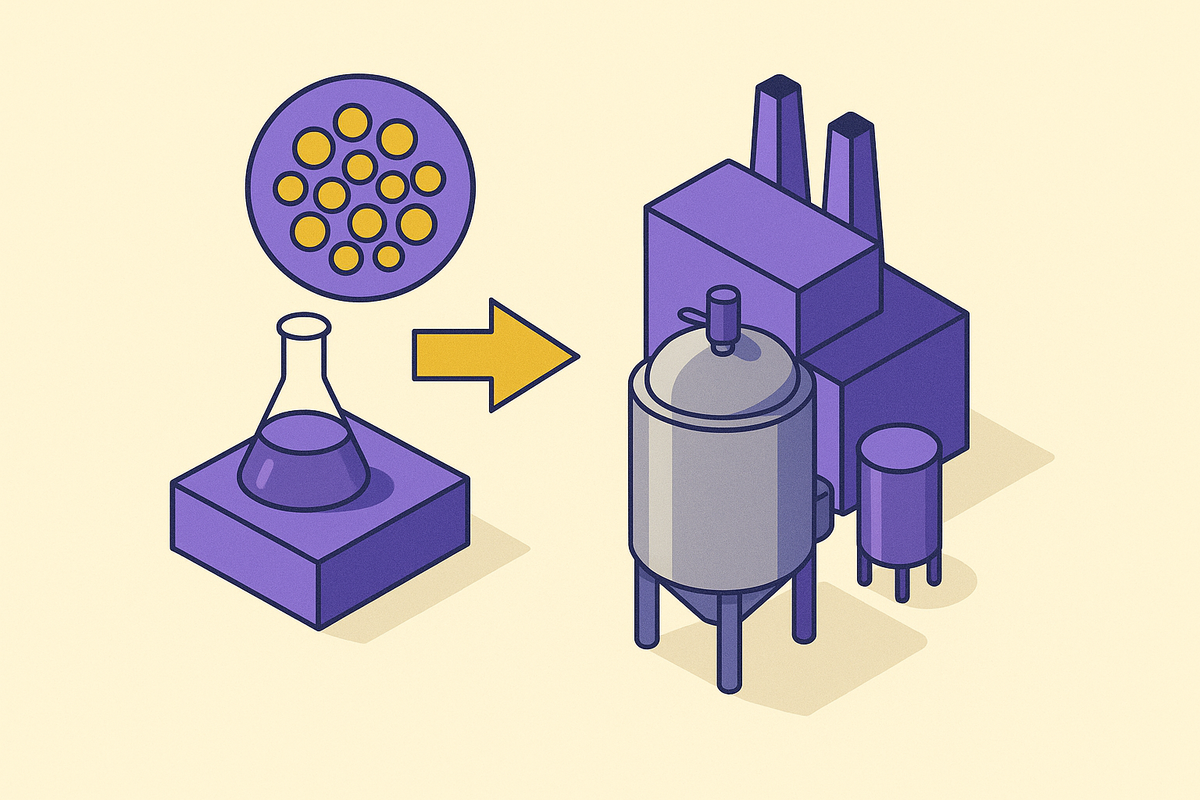
For platform development, the lesson is to identify the rate-limiting step for the specific peptide without weakening the steps that already work. This is a different design logic from treating cellular uptake as the final endpoint. Particle geometry, surface chemistry, and endosomal escape chemistry become interdependent parts of a reproducible formulation. Foundational nanoparticle intellectual property is useful insofar as it translates those relationships into repeatable, scalable performance.
GLP-1 peptides, neuropeptides relevant to addiction circuitry, and peptides relevant to neurodegeneration encounter the same broad transport architecture, although receptor targeting remains cargo-specific. The potential neurological reach includes the hypothalamus, limbic system, brainstem, and prefrontal cortex through olfactory bulb projections. Those destinations connect delivering peptides to appetite regulation, reward, and neurodegeneration rather than to an undifferentiated goal of “brain uptake.
The therapeutic promise is selective access. Direct CNS delivery could support central peptide exposure without the peripheral burden that constrains systemic dosing, including nausea associated with injectable GLP-1 therapy. To fulfill that promise, a formulation must carry cargo to the circuit it needs to reach. How much peptide survives the full journey beyond the nasal epithelium matters more than how much reaches it.