Payload Bioavailability Windows Inside Olfactory Neuroepithelium and What They Demand From Lipid Nanoparticle Design
Three olfactory delivery windows demand jointly optimized lipid nanoparticle architecture.
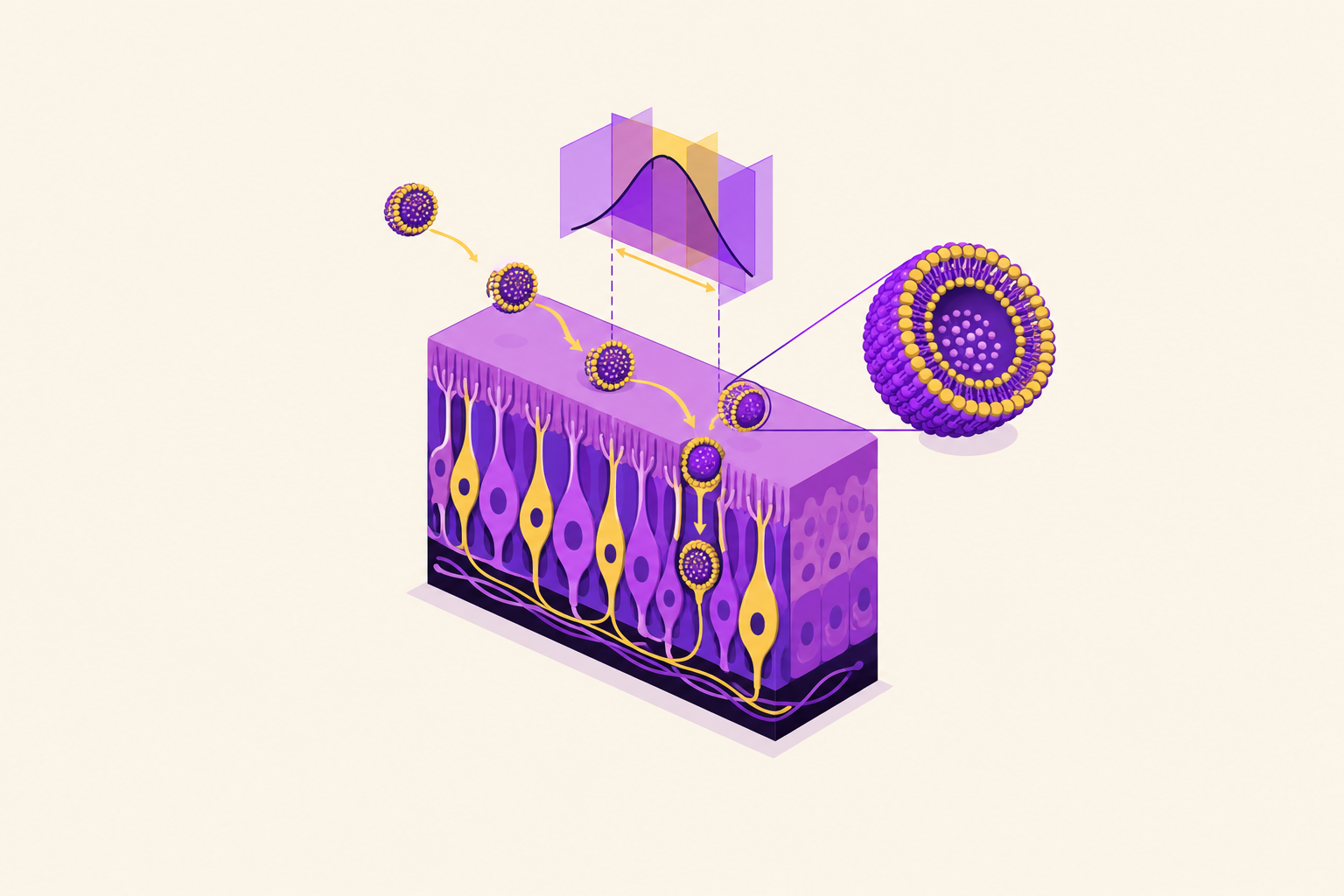
Nanoparticle nose-to-brain delivery for neurological indications depends on preserving intact payload through three overlapping windows in the olfactory neuroepithelium, governed by clearance, epithelial permeability, and enzyme activity. Lipid nanoparticles must gain time at the surface, enter accessible transport routes, and protect their contents until release. These requirements demand a jointly optimized architecture.
Why the olfactory neuroepithelium is a different delivery environment from the rest of the nasal cavity
The olfactory neuroepithelium (OE) is a neural interface. Olfactory sensory neurons (OSNs) extend dendrites toward the epithelial surface and axons through the cribriform plate into the olfactory bulb. This arrangement connects a surface exposed to the nasal environment with the central nervous system. The anatomical connection is unusually direct. A blood-brain barrier is not interposed along this neuronal route, but epithelial access and intracellular transport still impose their own restrictions.
A particle that reaches the olfactory surface still has to enter a neuron, cross the epithelium, or gain access to the bulb. Tight junctions between sustentacular cells restrict passage between cells, while neuronal entry requires interaction with the OSN plasma membrane.
Respiratory mucosa presents a different set of priorities because its clearance machinery moves material away, whereas the OE is organized for chemosensory transduction. These functions coexist within the same nasal cavity without creating interchangeable delivery environments. Survival on respiratory mucosa does not establish access to olfactory neurons. Location alone is not a sufficient criterion. Understanding the OE therefore requires separating deposition, surface residence, membrane crossing, and onward transport rather than treating nasal retention as evidence of neural availability.
The mucociliary clearance window — the first and fastest constraint on contact time
Motile cilia on the adjacent respiratory epithelium move the overlying mucus toward the nasopharynx, taking particles that do not interact with the mucus matrix or epithelial surface with them. The OE itself lacks motile cilia and mucociliary clearance. Its exposure to clearance arises from neighboring mucus transport.
The OE’s posterosuperior position reduces direct ciliary flow compared with the inferior turbinates, giving particles a marginally longer contact window than on respiratory epithelium. That advantage does not provide prolonged residence. The available interval remains short relative to conventional lipid nanoparticle (LNP) design assumptions, making mucoadhesion a first requirement. Yet adhesion must permit progress toward the surface. The lower-viscosity inner, periciliary sol layer is the relevant target for particles that need to pass through the outer mucus gel to reach OSN dendrites.
Mucoadhesive ligands, including chitosan coatings, hyaluronic acid, and thiolated polymers, can provide anchoring long enough for diffusion toward the periciliary layer. Excessive entrapment defeats that purpose. Moderate anionic or near-neutral zeta potential is therefore part of the proposed design envelope, balancing interaction with glycoprotein chains against aggregation in the gel. PEG presents a related tension because its ability to reduce aggregation and extend systemic circulation can come at the expense of mucoadhesion, favoring low-density or cleavable PEG, or mucus-penetrating alternatives.
Could a larger delivered volume simply keep the region wet for longer? Higher volumes instead encourage posterior drainage and deposition on respiratory mucosa, potentially shortening effective OE contact. The design must keep the formulation where it can enter, even if that means keeping less of it in the nose overall.
The epithelial permeability window — size, charge, and lipid composition as gatekeepers of transcellular entry
At the OSN plasma membrane, size, charge, and lipid composition govern whether an LNP can undergo endocytosis. Conventional systemic particle dimensions can fall outside this accessible design range, forcing a downward redesign of core diameter. Smaller cores introduce their own formulation constraint. Payload encapsulation efficiency must remain high even as the volume available to hold that payload decreases.
Internalization also opens a further, intracellular window. After endocytosis, the payload must avoid lysosomal degradation and recycling to the surface while gaining access to onward transport. Endosomal escape is one step toward onward transport. Lipid composition must support fusogenic behavior at endosomal pH, with an ionizable lipid whose pKa suits the relevant environment. For the neuronal route, commitment to axonal transit must occur while uptake remains possible, because anterograde transport toward the bulb is slow relative to surface-clearance timescales.
Could passage between cells avoid these membrane requirements? Tight junctions normally restrict the paracellular route to very small molecules, making intact LNPs generally too large. Some lipid and polymeric formulations can transiently modulate those junctions through mechanisms including calcium chelation or certain fatty acids. That option introduces repeated-dose safety questions. The perineural space offers a different route, acting as a fluid conduit along olfactory nerve fascicles from the nasal submucosa toward the subarachnoid space without requiring neuronal entry, although larger conventional particles still face size restrictions.
Targeting ligands do not remove this architectural constraint. Receptor-mediated uptake can improve the internalization rate, but receptor binding does not change the physical gate imposed by the endocytic vesicle. An oversized bound particle can still enter inefficiently. Targeting also adds manufacturing and regulatory complexity, so it cannot substitute for a core diameter and lipid architecture compatible with the chosen route.
The metabolic enzyme window — how olfactory xenobiotic metabolism degrades payloads before they reach the bulb
The OE metabolizes odorants and has no biological reason to spare a drug. Enzymes can attack payload while it is still at the surface, before it makes any headway toward the bulb. Protection must begin before uptake has occurred.
Peptidases and proteases in mucus and on epithelial surfaces cleave peptide bonds. GLP-1-class peptides, for example, are vulnerable to N-terminal degradation, primarily by DPP-IV. Glutathione S-transferases and other phase II enzymes can conjugate metabolites, further reducing the bioavailability of degraded fragments. Release therefore starts a local degradation race. As an LNP exposes its peptide contents, the enzyme concentration helps determine how much intact payload survives long enough to encounter an accessible entry route.
Where release takes place therefore matters as much as how long it lasts. Controlled, sustained release within mucus or the periciliary layer is intended to avoid a rapid burst at the exposed surface, with lipid composition and PEG density tuned to transit through the enzymatic zone. Prolonged release alone is not sufficient protection. Peptide PEGylation, cyclization, or protease-resistant analogs may also be compatible with encapsulation, but each changes how the particle must be formulated and must be planned as part of its initial design.
Intracellular release offers another way to limit extracellular exposure. If an LNP protects intact peptide through endocytosis and releases it after endosomal acidification, it can bypass much of the extracellular enzymatic window, giving ionizable lipid design both an entry-related and a protective role. The clocks nevertheless remain coupled. Clearance removes material and limits its exposure to enzymes, while mucoadhesion gives enzymes more time to act as it gives the payload more time for uptake.
How do lipid nanoparticles get from the nose to the brain, and why do conventional architectures fall short?
An olfactory route requires particles or protected payloads to reach accessible neuronal or perineuronal pathways before clearance and degradation remove the opportunity. Conventional systemic or pulmonary formulations are built on different assumptions about where particles land, which cells they meet, and how long they need to stay stable. Those assumptions shape the entire architecture. A diameter suited to vascular extravasation or alveolar deposition is not necessarily compatible with the smaller endocytic and perineuronal gates relevant to the OE.
Changing the surface to address that mismatch also affects the other windows. Cationic charge used to promote cellular uptake can encourage adhesion and entrapment in the outer mucus gel, reducing penetration toward the periciliary layer. Greater adhesion is not always greater access. Conversely, high-density PEGylation intended to prolong plasma circulation can impair the mucoadhesion needed to resist nasal clearance.
The same mismatch extends into release behavior. Lipid blends optimized for endosomal escape in hepatocytes or lung epithelium are not necessarily tuned to the pH profile and lipid environment of OSN endosomes. Extracellular release adds another source of loss. A burst-release profile intended to achieve rapid systemic Cmax instead exposes peptide to the OE’s enzyme-rich environment when released payload is most available.
Stronger retention can deepen gel entrapment or enzyme exposure, while faster release can make an otherwise accessible payload vulnerable before uptake. Shrinking the particle, meanwhile, increases the challenge of maintaining encapsulation. The critique concerns the design envelope rather than the LNP concept, because the needed properties must be rebuilt around the OE instead of transferred from a different tissue and patched one at a time.
The engineering brief the three windows write together — what an OE-optimized LNP must accomplish
Core diameter must support endocytic and perineuronal access while preserving encapsulation efficiency at reduced volume. Smallness alone is not a complete specification. The particle must also stay stable as it moves through mucus and protect its payload until release can serve its purpose, so changes to core size must go hand in hand with changes to lipid composition or payload chemistry.
Surface behavior must likewise change with position. The formulation needs to penetrate mucus before establishing useful adhesion near the periciliary layer, rather than maximize both properties at the outer gel surface. Sequence is the key design distinction here. Near-neutral to mildly anionic charge avoids the aggregation and toxicity risks associated with strong cationic charge at a neural surface. Low-density, cleavable, or absent PEG, with mucus-penetrating alternatives where needed, must support that transit without sacrificing the contact time required for uptake.
Within the particle, the ionizable lipid’s pKa must suit OSN endosomal conditions, while helper lipids support fusion without sacrificing stability in mucus. Intracellular timing links access directly to payload protection. The release profile must delay extracellular peptide exposure until penetration toward the periciliary layer, limiting time spent unprotected in the enzyme-rich outer mucus. Where the payload includes protease-resistant modifications, encapsulation chemistry must accommodate those features without compromising them during formulation or storage.
This narrow design space helps explain why success in other LNP applications is not enough on its own to solve OE-to-brain delivery. It also gives accumulated formulation knowledge a specific role, because experience encoded in platform intellectual property can help navigate interactions among size, surface behavior, lipid composition, and release. The advantage rests in solving coupled constraints. Precision is therefore an engineering asset because a defined set of biological demands offers a firmer basis for design than the vague ambition to make a nanoparticle reach the brain.