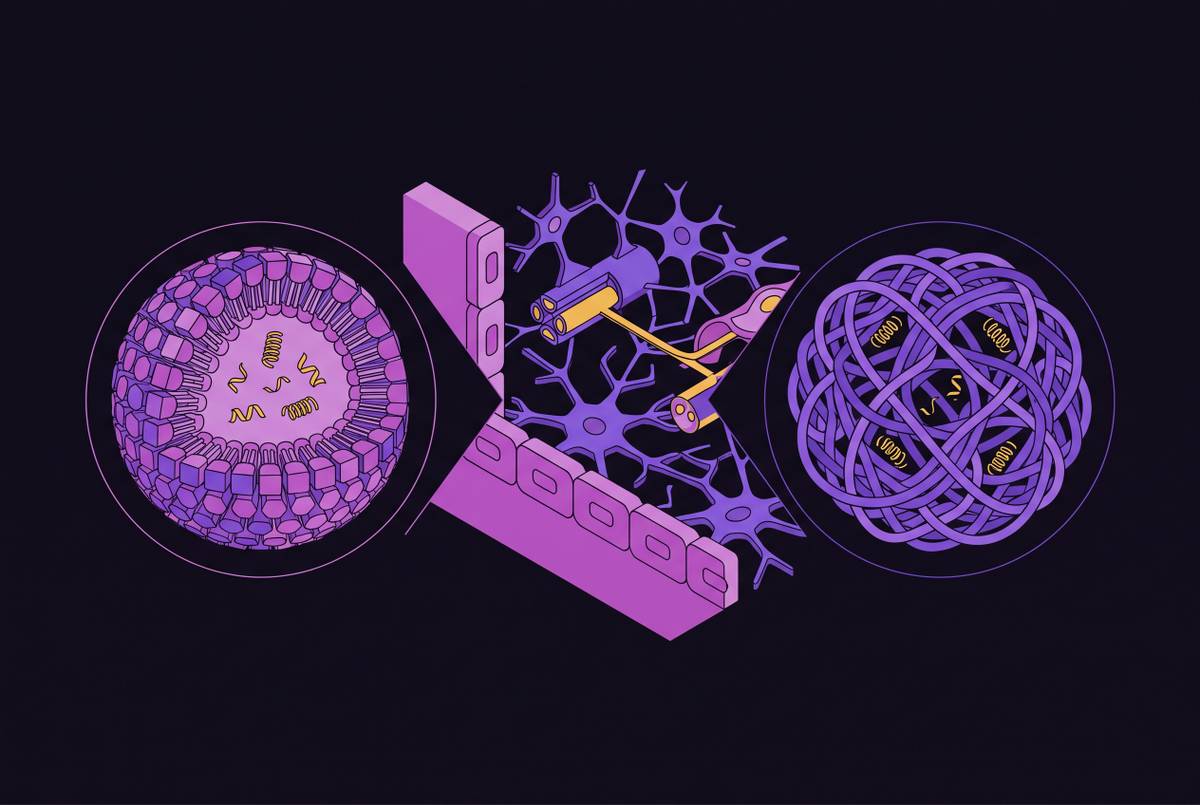
Platform Selection Criteria for Olfactory BBB Bypass Across Dementia and Reward Circuit Indications

Nanoparticle nose-to-brain delivery for neurological indications requires four linked design choices, which are particle architecture, mucociliary retention, regional deposition, and cargo protection. Dementia calls for CNS exposure that lasts and spreads across the brain, while reward-circuit indications favor delivery that is faster and more focused. Platform selection therefore determines which indications a program can credibly pursue.
Why the blood-brain barrier makes peptide delivery structurally different from small-molecule delivery
Large, hydrophilic, proteolytically labile peptides face a structural obstacle at the blood-brain barrier. Their delivery problem is not simply a harder version of small-molecule delivery. Systemic injection requires a peptide to survive circulation and then attempt transcytosis before reaching CNS receptors. These are two separate hurdles. For a therapy intended to act in the brain, systemic exposure is therefore not evidence that the intended organ receives enough drug.
GLP-1 receptor agonists make this mismatch especially consequential because their cognitive and reward effects involve central receptor populations. GLP-1 receptors are expressed throughout the brain, and their activation engages cAMP/PKA and PI3K/Akt pathways that overlap with insulin receptor signaling. That overlap provides a rationale for addressing insulin-resistant neurodegeneration. But biological plausibility does not solve delivery. Engineering must establish whether a route can expose the relevant brain receptors without first making peripheral exposure the dominant feature of treatment.
How peripheral GLP-1 exposure drives the adherence failure that makes delivery redesign urgent
Peripheral plasma exposure activates GLP-1 receptors in the gut and brainstem, which can contribute to nausea. Injectable delivery can therefore cause side effects that make people stop treatment. A Danish population study of first-time semaglutide users found that a majority discontinued within one year. Both cost and side effects played a part, but high out-of-pocket expense was the main reason overall. The study places delivery-related intolerance within a substantial adherence problem.
Changing exposure could address one part of that problem. A route that concentrates drug in the brain while limiting peripheral plasma levels could reduce peripheral receptor activation, although it would not resolve the cost barrier identified in the study. MetP Pharma’s 2026 statement articulates this design logic as shifting GLP-1 exposure toward the brain and away from the periphery. Dementia sharpens the urgency because disease-modifying treatments remain limited and GI intolerance adds a burden to an already vulnerable population. Can an anatomical route separate central delivery from peripheral exposure more effectively?
What the olfactory and trigeminal pathways actually provide as an anatomical escape route
The olfactory and trigeminal nerve pathways provide direct anatomical continuity between the nasal epithelium and the CNS. Therapeutic agents can use these pathways to bypass the BBB and avoid hepatic first-pass metabolism. Whether intranasal administration lowers exposure elsewhere depends on where the dose lands and what happens after it reaches the nasal surface.
Winterdahl et al.’s 2025 first-in-human PET study using ¹³N-labeled oxytocin found detectable but low and variable tracer distribution to brain regions within tens of minutes. That finding supports access without establishing reliable delivery for intranasal peptides. Eliasson et al.’s January 2026 NosaPlugs study demonstrated pharmacologically relevant memantine brain levels in mice after a 30-minute acute exposure. Separately, an anatomically realistic nasal cast model showed cumulative release for up to eight hours in vitro, illustrating how device architecture can shape release. Anatomy is necessary, but it is not sufficient.
Why the nasal epithelium creates a formulation challenge that anatomy cannot solve on its own
Choosing the intranasal route exchanges the BBB obstacle for a different set of constraints. Rapid mucociliary clearance can remove unprotected drug before transit, while the olfactory region occupies only a small fraction of the nasal surface. Peptides also face enzymatic degradation in the mucosa. A formulation can get into the nose yet fail to stay there, penetrate, or keep its cargo intact long enough for CNS delivery.
A 2026 study of intranasal semaglutide in a thermoresponsive PNPHO nanocarrier system illustrates that distinction. Despite a plausible formulation rationale, it found no detectable brain fluorescence in vivo. That result defeats the assumption that a nanoparticle label predicts brain access. The relevant comparison is consequently not nanoparticles versus free drug alone, but which architecture overcomes which nasal barriers.
The four platform-selection criteria that distinguish nose-to-brain delivery engineering from general nanoparticle design
Particle architecture must have the right mix of size, surface chemistry, and targeting ligand presentation to help particles cross the olfactory epithelium. Nanoscale lipid carriers offer drug loading, solubility, and bioavailability advantages, but those properties do not establish regional brain delivery. Synthetic nanoparticles with modular surfaces, extracellular vesicles with parent-cell-derived tropism, and living therapeutics responsive to host environments represent different approaches to the problem.
Mucociliary retention must give the dose time for transit before clearance removes it. Mucoadhesive coatings, including chitosan and poloxamers, and in situ gels can extend residence, while inserts address residence through physical dwell and controlled release. Sprays favor onset, whereas inserts favor sustained exposure. The eight-hour in vitro release finding from NosaPlugs supports the latter design principle, but it is not evidence of eight-hour brain exposure.
Regional deposition must direct the dose toward the olfactory cleft rather than predominantly toward the respiratory epithelium. Otherwise, vascular absorption can reintroduce the peripheral exposure that motivated the route change. Device choice is inseparable from formulation choice here. Bidirectional nasal sprays and precision olfactory delivery technology address deposition, while Aptar Pharma’s May 2026 announcement of patent applications and preclinical work on intranasal and pulmonary GLP-1 delivery identifies device–biologic compatibility as an assessed variable. Nasal deposition is the entry condition for delivery to a downstream brain circuit.
Cargo protection must shield labile peptides from enzymatic degradation during that journey. Encapsulation or conjugation can improve stability and alter retention, biodistribution, and bioavailability relative to free peptides. Without protection, the intended receptor-active cargo may not survive. The four criteria form a chain of delivery steps, and success at one step cannot make up for failure at another.
How dementia indications impose specific pharmacokinetic and pharmacodynamic demands that shape platform choice
Dementia requires sustained exposure across distributed cortical and hippocampal circuits. Treating amyloid and tau pathology and insulin-resistant signaling requires more than getting drug into the brain. The pharmacokinetic requirement is persistent regional exposure. Pharmacodynamic assessment must establish whether that exposure engages the receptor populations needed to affect disease-relevant signaling. GLP-1R activation of PI3K/Akt provides a mechanistic rationale, but only if drug reaches those populations at sufficient concentrations.
The clinical evidence does not yet close that chain. Pooled observational analyses of adults with type 2 diabetes associate GLP-1 receptor agonist use with reduced dementia incidence. In contrast, the 2025 Alzheimer’s disease trial synthesis described in the brief found no improvement in memory and cognition versus placebo, with low-certainty evidence. Association and treatment efficacy are different claims. Insufficient CNS receptor engagement from systemic delivery remains a plausible, unproven explanation for the discrepancy, with the null result still standing.
For platform selection, the implication is a preference for slow-release inserts or depot nanoparticle formulations, strong mucoadhesion, and surface ligands intended to support cortical and hippocampal distribution. These design requirements need testing for their potential to support disease modification. Intranasal experience also counsels restraint. Clinical studies of rivastigmine and insulin give some grounds for hope, but key intranasal insulin randomized trials found no significant improvement in primary outcomes. Specialized devices and nanoformulations must therefore show that changing the administration route improves delivery enough to engage receptors and produce clinical effects.
How reward-circuit indications impose a different set of demands that favor a distinct platform configuration
For reward-circuit indications, the design must help drug engage deep subcortical structures faster. Targets include the VTA, nucleus accumbens, lateral septum, and central amygdala. GLP-1 receptors in the VTA, nucleus accumbens, and lateral septum provide the receptor-level rationale, while an inhibitory GLP-1 circuit in the lateral septum modulates reward processing. Timing now becomes a different design constraint. Compared with dementia’s sustained, distributed cortical coverage, acute reward modulation favors faster onset and a higher initial CNS exposure at the relevant targets.
The Hendershot trial in JAMA Psychiatry in 2025 provides a clinical signal, though not proof of nose-to-brain delivery. Adults with alcohol use disorder who received low-dose semaglutide for nine weeks reported significantly lower alcohol cravings and fewer drinks per drinking day than those who received placebo. The groups did not differ significantly in their average drinks per calendar day or their number of drinking days. Those distinctions limit the efficacy claim. They also leave open whether a different exposure profile could change the pattern of response.
For this indication, the proposed configuration favors a spray over an insert, olfactory-cleft deposition, and surface chemistry designed for trigeminal pathway transit toward subcortical targets. Each element requires regional delivery evidence. A fast nasal dose is not automatically a fast dose at the VTA or central amygdala. If GLP-1 modulates a dopamine reward circuit upstream of substance-specific pathways, one architecture could potentially extend across alcohol, nicotine, and opioid use disorders. That breadth remains a platform hypothesis awaiting demonstration of cross-addiction efficacy.
Where preclinical proof-of-concept stands and what the key unresolved translational gaps are
MetP Pharma’s rat study achieved brain-to-plasma ratios consistently greater than 1 for intranasal semaglutide, supporting CNS enrichment. It does not establish human GLP-1 delivery. The oxytocin PET study provides a separate human signal within 25–45 minutes, but its low and variable distribution cannot stand in for pharmacokinetics specific to the target peptide. These findings address different parts of the translational chain. Neither establishes that a chosen architecture delivers enough active peptide to the intended human circuit.
Landmark Medicines announced in September 2026 that it planned to move its nasal delivery platform toward a human volunteer study, starting with GLP-1 receptor agonists and evaluating candidates including semaglutide. An announced study is not a pharmacokinetic result. Robust clinical trials, standardized regulatory frameworks, and long-term safety evidence remain necessary. Beyond those requirements lies a mechanistic uncertainty about how much behavioral and cognitive benefit mediated by these receptor agonists arises centrally versus through peripheral vagal afferents. Once that balance is measured in humans, can selective CNS delivery offer enough of a benefit to justify a redesign?
How platform architecture choices today determine which indications a nose-to-brain program can credibly pursue
A slow-release mucoadhesive insert aimed at cortical distribution and a fast-onset spray aimed at subcortical reward circuits are not interchangeable configurations. Selecting either as a fixed product narrows the development options available later. Modularity changes that strategic constraint. A nanoparticle architecture with tunable surface chemistry and adjustable release kinetics can potentially support both configurations through changes to ligands and formulation parameters within the existing particle design. Efficacy claims require separate evidence for each indication.
The distinction between a delivery product and a delivery platform therefore rests on demonstrated reconfigurability. Foundational nanoparticle design and the intellectual property supporting it can enable changes in anatomical target, cargo, and release profile that a single-purpose reformulation cannot readily accommodate. Breadth still has to be earned experimentally. Compliance and side effects will shape the clinical and commercial value of GLP-1 therapies as well as efficacy, making exposure control a strategic design objective.
Sources
- First In Vivo Demonstration of Nose-to-Brain Drug Delivery ...
- Intranasal delivery bypasses the blood-brain barrier to target therapeutic agents to the central nervous system and treat neurodegenerative disease
- Intranasal drug delivery: Unlocking the nose-to-brain route for central nervous system therapies - ScienceDirect
- Current Clinical Evidence on Nose-to-Brain Drug Delivery - ScienceDirect
- The Nasal–Brain Drug Delivery Route: Mechanisms and Applications to Central Nervous System Diseases - Qiu - 2025 - MedComm - Wiley Online Library
- Intranasal delivery of glucagon-like peptide-1 to the brain for obesity treatment: opportunities and challenges: Expert Opinion on Drug Delivery: Vol 21 , No 7 - Get Access
- Full article: Differential targeting of olfactory epithelium and respiratory epithelium in nose-to-brain drug delivery
- Navigating the Nose-to-Brain Route: A Systematic Review on Lipid-Based Nanocarriers for Central Nervous System Disorders